


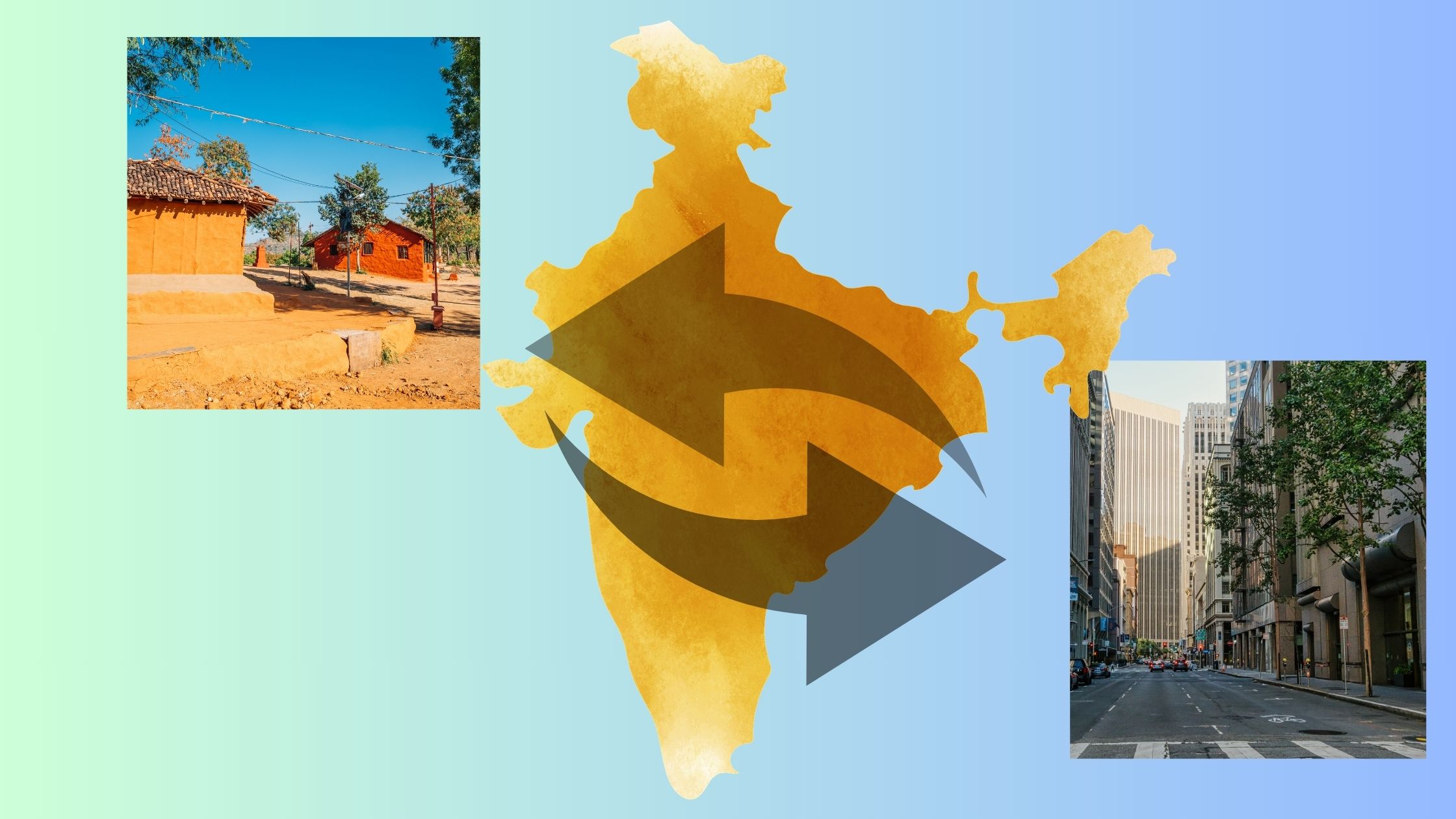
India is experiencing a major socio-economic and political transformation that is affecting hundreds of millions of people in their daily lives and livelihoods. Agriculture still employs, by far, the largest share of the workforce (43.96%, 2021) but it has been declining rapidly in recent years, both in relative and absolute terms. In general, the employment shifts out of agriculture are fairly well documented in the Indian Census and other national surveys. But it is not at all clear where these former agricultural workers and their families go, what new livelihoods they seek out, and how their well-being is affected. This transition away from agrarian livelihoods is accompanied by urban growth in heretofore rural regions, yet very little is known about their linkages.
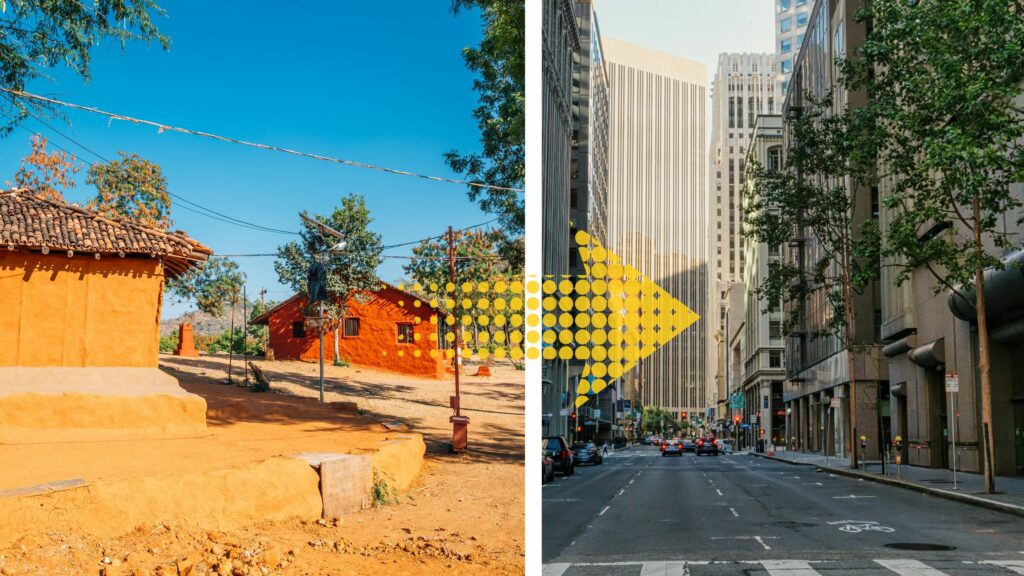
We use the notion of the rural–urban transition in this paper to place the occupational shift out of agriculture in a wider socio-economic and geographical context. The structural change in employment is integral to a social transformation that affects local economies, livelihoods, migration, well-being, and social organization. It is a complex social transformation with multiple dimensions. The occupational shifts, livelihoods, and migration is part of a more comprehensive understanding of India’s rural–urban transition.
The speed and magnitude of change, we think, far exceeds existing views in academia and policy making circles. Empirically, existing data is scarce and often dated, and primary data collection is difficult. The latter is due to the geographically dispersed nature of these employment shifts and of India’s rural–urban transition in general.
Building on the sustainable livelihoods approach, we address four interrelated questions. First, what is the extent of occupational shifts out of agriculture? Second, what new kinds of livelihoods are being forged? Third, what is the role of migration in present-day livelihood strategies of households? Fourth, what are the ramifications for the well-being of the involved populations?
The economic transformation over the past couple of decades is momentous. In theoretical terms, akin to the sustainable livelihood approach, the external conditions of formerly rural livelihoods have undergone fundamental change and household strategies have had to adapt. Stereotypical views of India’s majority population relying on agricultural livelihoods, without change, one generation to the next, are rapidly disappearing in the rear-view mirror. Similar trends are witnessed in tens of thousands of villages and new Census Towns across the country, affecting hundreds of millions of people, presently and in the foreseeable future.

The employment shift out of agriculture is without doubt, but households also face major challenges in forging alternative livelihoods. The local economy in these heretofore agricultural regions offers scant opportunities and shows no signs of strongly developing secondary and tertiary sectors. It is clear that labor migration offers a way out for many households. Migration has a long history in India but today it seems more important than ever and its nature has structurally changed: the notion of the optimizing peasant migrant belongs to the past and seasonal migration (following the agricultural cycle) is firmly replaced by more permanent forms of circular labor migration that provide the mainstay of income for many households.
At the same time, our comparative analysis indicates that India’s rural–urban transition is not happening everywhere synchronously and in the same manner. The shift out of agriculture has a longer history in some places than others and migration patterns, too, can be embedded in historical – geographical context.
Policies should not constrain but instead facilitate labor migration. This issue seems to have become much more acute in recent years because it is critical to the livelihoods of rapidly growing numbers of people. Evidence from many areas of the global South shows that while migration experience and outcomes are not the same for all individuals and households, mobility plays a growing role in livelihood strategies.
Labor migration can be facilitated through legislation on workers’ rights, households’ bargaining position dealing with migratory networks and middle men, easing transportation and money transfers, and improving labor conditions including health care provision. This is particularly relevant in regards to domestic labor migration because it falls entirely under Government’s responsibility and because it involves the poorest households.
A strong pro-active policy stance is needed to simultaneously stimulate local economic restructuring and livelihood opportunities and, as long as these local economies are insufficiently developed, to facilitate and improve the conditions for domestic labor migration.
Contextualizing India’s rural–urban transition
India has witnessed three major escalating trends in the last couple of decades that, together, sketch the contours of the country’s wide ranging rural–urban transition and the ways in which this transition conditions changing livelihoods. The first refers to the substantial and ongoing shift of employment out of the agricultural sector; the second pertains to rapid urban growth at the bottom of the urban system, with rural villages turning into urban-classified settlements at unprecedented rates; and the third relates to significant increases in labor migration.
First, over the past two decades India has experienced a major employment shift out of agriculture. According to data from the International Labor Organization, agricultural sector employment dropped from 250 million jobs in 2004 to 215 million jobs in 2016. The number of jobs lost in agriculture over the same period even higher, at around 40 million. Over a longer period, from 1991 to 2019, employment in agriculture as a percentage of total employed dropped from 63 percent to 43 percent.
The emergence of ‘non-farm villages’ is especially prevalent across the Indo-Gangetic Plain in states that were hitherto considered to be predominantly rural. For example, Uttar Pradesh witnessed an increase of almost 500; in Bihar, the number jumped by 350; and Jharkhand and Odisha showed increases of 500 and 450.
It is well-known that historically circular labor migration has played a major role in the livelihoods of many rural households. Especially in the poorer northern and northeastern states, seasonal migration has long been a source of income for rural households unable to support themselves through agriculture.
It is important to note that seasonal and circular migration streams often overlap, and the distinction between the two is not always clear. Both migration forms involve temporary (and often repetitive) moves, and lack of permanent change in residence. Circular migration is broadly defined as “a temporary move from, followed by return to, the normal place of residence”. This definition implies that all seasonal migration can be categorized as circular. Not surprisingly, the two forms often used interchangeably in the literature. However, there is an important difference. Seasonal labor migration has traditionally been tied to the rhythms of the agriculture cycle at origin whereby rural households engage in migration in lean seasons when there is no farm work locally. It is often supplemental to agriculture-based incomes.
In some instances, seasonal migration is also related to the nature of industry at the destination. This includes, for example, labor migration in the brick kiln industry where workers migrate after winter crop harvest and return before the monsoon (November–May). On the other hand, the timing and duration of circular migration does not necessarily depend on farm seasons, and it can occur independent of them. With labor migration increasingly detached from farming, as our analysis will show, the distinction between seasonal and circular migration is important for understanding livelihood change at India’s rural–urban transition.
Internal (domestic) migration has accelerated to unprecedented levels in the last couple of decades. This is especially true for non-permanent, circular labor migration. Much of this migration goes unrecorded in the Indian Census and other data sets, such as the National Sample Survey, though even these sources suggest a significant increase. Between 1971 and 1991, internal migration in India actually declined but the trend reversed during the 1990s and then gathered momentum since the turn of the century.
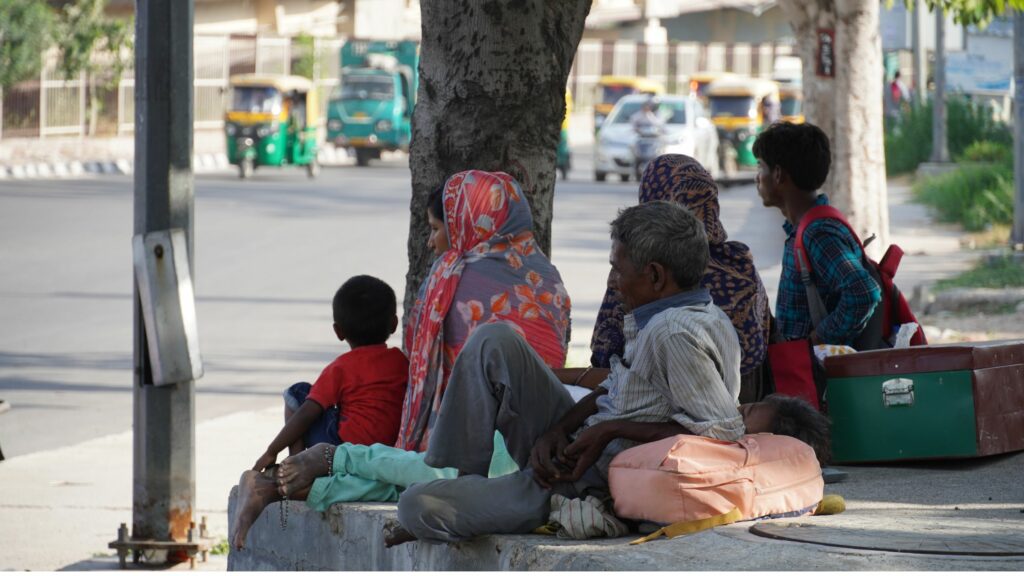
Some estimate that internal labor migration in India increased nearly four-fold between 2004–05 and 2011–12, from 16 million to 60 million; others put the number for 2011 even higher, at 80 million. The highest estimate currently available is based on combined numbers from the National Sample Survey and the India Human Development Survey: between 2007 and 2012, the number of labor migrants is said to have exploded from 15 million to 200 million. This seems a very high estimate, indeed, and it should be noted that migration data is notoriously difficult to calculate and interpret. But there can be no doubt that recent years have seen a very rapid increase in internal labor migration rates.
Theorizing livelihoods at the rural–urban transition
A focus on livelihoods at the rural–urban transition is accompanied with notable conceptual challenges. It involves a huge literature that is fragmented across different fields including development studies, migration studies, urban studies, geography, economics, and sociology. Moreover, a good deal of established theory in these disciplines is not necessarily pertinent to research on India or other parts of the global South, and/or relevant to recent and present-day developments. Even if the disciplines mentioned above do not provide a ready-made conceptual framework to guide our research, they intersect in several ways that are relevant to our study.
First, there is a well-known interdisciplinary body of literature on the relationship between urbanization and economic development. At the macro level, this literature postulates that urbanization is positively associated with development in terms of economic growth and well-being. It is the movement of labor from lower-productivity, agrarian-based activity to higher-productivity, urban-based work in secondary and tertiary sectors, which drives this growth. These sectors benefit from, and generally require, agglomeration dynamics and economies of scale. Accordingly, employment shifts out of agriculture and into secondary or tertiary sectors tend to coincide with urban growth and migration to cities.

Also read: Attacks On The Backbone Of The Economy
Such theorizing is very much based in the historical experience of the west, when both urbanization and industrialization rapidly increased in the latter part of the 19th century and first half of the 20th century. In East Asia, a similar experience has been observed, particularly in Japan after World War II and more recently in China. It may not apply in large parts of the global South. In regard to recent trends in Africa, it has been argued that accelerated urbanization has occurred in the absence of significant industrialization or other urban-based economic growth.
Interestingly, in India, the reverse has been observed: there, in the past couple of decades, urban growth has been exceptionally slow despite rapid economic expansion. The latter implies that Indian economic growth has, to a considerable extent, been jobless, i.e., it has happened in the absence of substantial urban-based job creation . Premature deindustrialization, which appears to have affected a range of countries in the global South. India’s much heralded (post-industrial) IT sector has contributed strongly to the country’s economic growth and it is by and large based in cities, but it is not sufficiently labor-intensive to drive urban population growth. This also explains why much of India’s limited formal urban employment growth has been the reserve of the highly educated.
All of this adds urgency to questions about new kinds of livelihoods, and whereabouts, of large numbers of former agricultural workers. If many former agricultural workers and their families are not likely to be pulled to employment opportunities in the cities, there are two sets of alternatives.
First, given the reported rapid urban growth in heretofore rural areas, they may find non-agricultural jobs locally or nearby. Second, they may choose (or feel forced) to go the route of male circular labor migration, with the rest of the household staying put. The second body of literature sits at the intersection of migration and development studies, both of which represent large and sprawling traditions of scholarship in their own right.
In established (western) urbanization theory, it is one-way rural–urban migration that is viewed as a key driver of urban growth. As suggested above, this does not appear to apply (as much) to India in recent decades. In addition, the neo-classical economics literature is focused more narrowly on the balance between migration flows and urban (un)employment rates and, as such, is more interested in urban labor markets at the receiving end of migration and less so in the rural economy.
An alternative approach was provided by the so called ‘new labor migration economics’ that emerged in the 1980s, shifting the research focus in part to the impact of migration on rural areas, mainly through remittances. It also redirected attention from the individual to the family or household and proposed to view migration as family strategy. Because of this, the prevalence of circular labor migration came more clearly into view.
The main push for a conceptual framework that concentrates on development and circular labor migration from rural environs in the global South came from the field of development studies in the 1990s. This new strain of literature offered a broader and more nuanced perspective in which migration became integral to a primary focus on livelihoods where migration is considered one of various household strategies. The notion of sustainable rural livelihoods was introduced to underscore the importance of different household strategies to stabilize or improve their livelihoods based on shifting external conditions.
In the sustainable livelihood framework, household strategies are viewed as a response to such external conditions (e.g., employment opportunities, changing wage structures); reflecting the resources at the disposal of the household (e.g., land, financial capital, social networks, education); and as a determinant of well-being. This approach distinguishes, broadly, three types of rural livelihood strategies: farming, livelihood diversification including rural non-farm activities, and migration. This framework places livelihoods at the center of inquiry and it offers an even-handed approach of agency and structure in the explanation of livelihood changes.
In other words, it avoids the excessive voluntarism that underlies rational choice approaches and the deterministic tendencies of structuralist approaches. In its attention to variable livelihoods strategies, it also avoids the reductionist emphasis on formal employment that characterizes much economics research. Last but not least, this framework addresses questions of the drivers and impacts of migration (or of the absence of migration). Under the rubric of household resources, the attention to institutional factors and social networks in relation to migration is of special interest. Migration networks can be defined as “sets of interpersonal relations that link migrants or returned migrants with relatives, friends or fellow countrymen at home”.
Such networks are in some ways situated as a medium between agency and structure: they can be cultivated and fostered but at any point in time they constitute a relatively fixed asset. In the words, “migration options are not, as hypothesized by individualistic theories, open to all.” Debates about ‘who migrates’, whether they are especially the poor who are left with no other choice or the more advantaged who are able to seize certain opportunities, have never been resolved with a single answer in part because there are just too many variations of migration, in different contexts, and with different participants. But in almost all instances, migration patterns rest in part on evolving institutional and social networks, and these networks are often more important than work-related aspects and other kinds of household resources.
In regard to the Indian case, it is important to note that circular (male) labor migration seems to have always overshadowed one-way migration from rural parts to urban centers. This pattern of [circular] migration has existed for over 100 years, and it has existed in circumstances where work offered was relatively permanent. This goes some way to explaining the country’s overall slow urban growth rates. It also underscores why so much early theorizing on rural–urban migration (especially in economics) has had limited relevance to the Indian experience or to the global South.
Circular migration patterns in India persisted even if the work offered was permanent, is important because it points to the very significant ties of the labor migrant to the family and community at home. The household stays put in the village where it has strong kinship and community relations, for example through (future) marriage arrangements and shared resources. This again highlights the need for a focus on the household rather than the individual. Family strategies can involve “investing in a potentially remitting child” and sending young male adults to the city. Ultimately, it appears, individual male labor migration serves the needs of the household, and the household is vested in the community.
Research on the impact of circular labor migration and remittances on rural households has been relatively scarce, in part because of the very substantial geographical and historical variability, and it is far from conclusive. However, one tentative finding is of particular interest to our study: some of the earlier research indicates that remittances were used mainly to increase the household’s agricultural productivity. In other words, at least until around the turn of the century, it appears that households with remittances continued to rely heavily on agricultural work as part of their overall livelihood strategy. As we shall see, our findings indicate that, for many households across
India’s rural–urban transition, this no longer holds at the present time. Moreover, with the structural shift of employment out of agriculture, we expect that seasonal labor migration has diminished in importance while that of more permanent circular labor migration has increased. Today, we expect most circular labor migrants to work entirely outside the agricultural sector.
In India the external conditions have shifted dramatically in the past couple of decades in terms of the push out of agriculture and incipient urban growth in heretofore rural areas. The questions are how these changing conditions at India’s rural–urban transition have affected local livelihood strategies (including the practice of migration) and what the ramifications are for the well-being of these households.
Changing livelihoods
Occupational shift out of agriculture
Notwithstanding the substantial occupational shifts away from the primary sector, we also observe continued engagement with certain elements of agrarian livelihoods and lifestyles. Land often functions as an important part of households’ dynamic livelihood strategies: sometimes it is leased out; sometimes it is cultivated for the household’s own food needs; sometimes it is kept as an insurance for possible future needs; and often it serves as a symbol of status.
Livelihoods beyond agriculture
These businesses were typically in retail (e.g., grocery stores, roadside dhabas, puffed rice selling, kiosks, jewelry stores, restaurants, electronics stores, etc.); small-scale in nature; and employing family labor. These numbers on self-employment at the two sites are not different from national level statistics on rural non-farm or urban workforce structure where self-employed constitute about 40 percent of total workers, and where the lack of availability of jobs in the formal sector is considered widespread. The construction sector also provides some of the (more occasional) employment of other manual workers.
The role of migration
Let us now turn to the role of migration. About one-third of all households reported their main breadwinner is a migrant. This still does not fully capture the importance of migration: some households had a migrant worker who is not the main breadwinner and some households had multiple migrant workers. Almost all of the labor migration, long term or short term, and almost all involved male migrants.
Livelihoods and well-being
How do shifting livelihoods affect the standard of living or well-being? With nearly half of all household depending at least in part on labor migrant remittances, it should be evident that the local options for better livelihoods are limited.
The occupational shifts out of agriculture, alternative livelihoods in the local economy, the role of migration in livelihood strategies, and the ramifications of evolving household strategies for well-being.
The following are some of the emerging trends:
- The shift out of agriculture is highly significant, with less than 9 percent of main breadwinners still working in farming. The much smaller share of households that (still) owns agricultural land and a smaller share that holds livestock.
- The options for new livelihoods in the local economy are limited at both sites. Some find employment in construction or other manual labor jobs and more than a third had started small businesses, usually in retail. Employment opportunities shifts out of agriculture does not translate in more developed secondary or tertiary employment sectors.
- Circular labor migration patterns concern almost exclusively domestic migration with Kolkata, Hyderabad, Surat, Mumbai, Delhi, Punjab, Haryana, Kerala and Chennai as primary destinations.
- Households with international migrants are among those with the highest incomes while those with domestic migrants tend to have the lowest incomes, with non-migrant households in-between. It appears that domestic labor migration is a last-resort strategy for the poorest households, while international labor migration is considered an opportunity for advancement.
- The strongest predictors of household well-being are employment of the main breadwinner in agriculture (negative) and landownership (positive). Doing farm work rarely implies ownership of the land, while landownership is a broad indicator of household assets and does not mean the main breadwinner actually works the land. This suggests a strong legacy of agrarian class relations and little signs of developing secondary and tertiary sectors.

