



For decades, IQ was treated as the ultimate measure of a person’s potential. Good grades, sharp logic, and quick problem-solving were seen as the clearest path to success. Parents pushed children toward academic excellence, employers hired based on test scores and degrees, and intelligence was reduced to a single number.
But the real world rarely works that way. Careers are built on relationships, not just results. Marriages survive on communication, not correctness. Leadership depends on trust, not textbook knowledge. This is where the shift matters.
Emotional intelligence, often abbreviated as EQ, has quietly become one of the strongest predictors of long-term success, stronger in many cases than raw cognitive ability. It shapes how people handle pressure, build relationships, lead teams, and recover from setbacks. In this blog, you will learn what emotional intelligence actually means, how it compares to IQ, its five core components, why it matters across every part of life, and practical ways to strengthen it starting today.
Table of Contents

What Is Emotional Intelligence
The ability to recognize, understand, and manage your own emotions while also recognizing and influencing the emotions of people around you. It is not about suppressing feelings or appearing calm on the surface. It is about responding to situations with awareness instead of reacting on impulse.
IQ measures how well a person can think, analyze, and solve problems. EQ measures how well a person can feel, connect and adapt. Both matter, but they operate in different areas of life.
Here is a simple way to understand the difference:
| IQ | EQ |
| Logical reasoning | Emotional awareness |
| Academic learning | Relationship building |
| Problem solving | Conflict resolution |
| Fixed after a certain age | improves throughout life |
This has gained importance in recent decades because the modern world runs on collaboration. Remote teams, diverse workplaces and fast paced industries all demand people who can manage themselves and work well with others, not just people who can solve equations quickly.

The Five Core Components of Emotional Intelligence
Psychologist Daniel Goleman broke this concept down into five measurable parts. Understanding each one makes it easier to identify where you are strong and where you have room to grow.
1. Self Awareness
Self awareness is the foundation everything else is built on. It means understanding your own emotions as they happen, not after the fact. People with strong self awareness can name what they feel, recognize their strengths and weaknesses honestly and identify the specific triggers that set off strong reactions.
2. Self Regulation
Self regulation is what separates a reaction from a response. It is the ability to manage emotions instead of being controlled by them. This shows up as staying calm under pressure, pausing before speaking in a heated moment and choosing a thoughtful response over an impulsive outburst.
3. Motivation
Emotionally intelligent people are driven by internal goals, not just external rewards. This component covers setting meaningful goals, staying committed when progress is slow and bouncing back after failure instead of giving up.
4. Empathy
Empathy is the ability to understand what someone else is feeling, even when they have not said it directly. It involves genuinely listening, picking up on unspoken emotions and using that understanding to build trust rather than judgment.
5. Social Skills
The final component ties everything together. Strong social skills include clear communication, effective teamwork, natural leadership and the ability to manage conflict without damaging relationships.
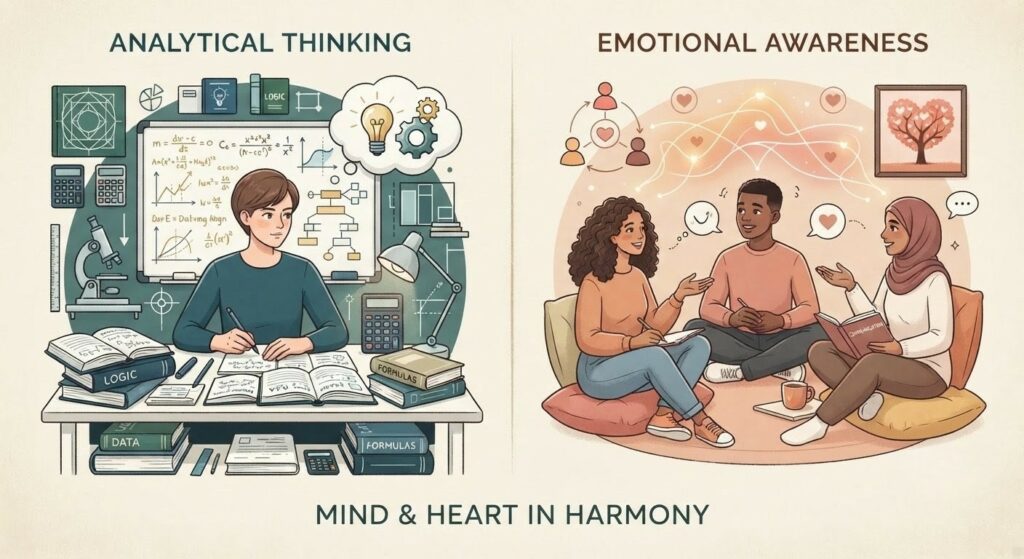
EQ vs IQ Which Matters More
This is one of the most debated questions in psychology and workplace research, and the honest answer is that both matter, just in different ways.
IQ often determines who gets the opportunity. It helps students get into competitive programs, helps candidates pass technical interviews and helps professionals grasp complex information quickly. But on its own, it rarely determines who keeps and grows that opportunity.
EQ determines who sustains success over time. It shapes how people handle criticism, resolve disagreements, and build long-term trust with others. Consider how much this skill influences everyday life.
In careers, EQ affects how well someone collaborates and leads.In friendships, it shapes how conflicts are resolved without damaging the bond.In marriage, it determines how couples communicate during disagreements.
In parenting, it influences how children learn to manage their own emotions. In business, it affects negotiation, client relationships and team culture.
In leadership, it decides whether people are inspired to follow or told to comply.
Today’s employers are noticing this shift. Alongside technical expertise, companies are actively seeking communication skills, collaboration, adaptability, and emotional resilience when hiring and promoting talent.

Why Emotional Intelligence Matters in Today’s World
In the Workplace
Teams with high EQ collaborate more smoothly and resolve friction faster. Leaders with this strength build trust instead of fear, employees report higher satisfaction, and customer relationships improve because communication feels genuine instead of scripted.
In Relationships
Emotional intelligence in the workplace gets most of the attention, but its impact on personal relationships runs just as deep. Couples and friends who build this skill communicate more openly, misunderstand each other less often, offer stronger emotional support and build trust that holds up under pressure.
In Mental Health
People with developed trait tend to manage stress more effectively. They recognize early signs of anxiety, regulate their reactions before emotions spiral and recover their confidence faster after a setback.
In Education
Students with strong EQ participate more actively in class, form healthier friendships, regulate frustration during difficult assignments and contribute to a classroom culture with less bullying.
In Leadership
Leadership skills built on this trait look different from leadership built on authority alone. Leaders with high EQ inspire their teams rather than pressure them, make decisions with a clearer head, manage conflict without escalating it and shape a workplace culture people actually want to be part of.

Signs of High Emotional Intelligence
Some patterns tend to show up consistently in people with strong EQ.
- You stay calm during disagreements instead of escalating them.
- You accept constructive criticism without becoming defensive.
- You recognize your emotional triggers before they take over.
- You communicate respectfully, even when frustrated.
- You listen more than you speak.
- You adapt easily when plans change unexpectedly.
- You apologize sincerely instead of making excuses.
- You show empathy toward people going through a hard time.
- You resolve conflicts peacefully rather than avoiding or escalating them.
- You stay open to learning, even when it means admitting you were wrong.
Common Signs of Low Emotional Intelligence
On the other end, certain patterns often point to underdeveloped EQ.
- Frequent emotional outbursts over small issues.
- Difficulty accepting feedback without taking it personally.
- Poor listening habits during conversations.
- A tendency to blame others instead of reflecting.
- Lack of empathy toward other people’s struggles.
- Constant defensiveness when questioned.
- Trouble maintaining long term relationships.
Recognizing these patterns in yourself is not a failure. It is simply the first step toward growth.
Also Read: Why Making Friends as an Adult Feels So Hard (And How to Fix It)

Can Emotional Intelligence Be Improved
Unlike IQ, which tends to stabilize by early adulthood, emotional intelligence is not fixed. It can be strengthened at any age through intentional practice, honest self reflection and real world experience. This is one of the most encouraging facts about it. Nobody is permanently stuck with poor emotional skills.
Practical Ways to Improve Emotional Intelligence
1. Practice Self Reflection
Keep a journal and write down moments when you felt strong emotions. Reviewing these patterns over time makes triggers easier to spot before they cause a reaction.
2. Pause Before Reacting
Take a few deep breaths before responding in a tense moment. That short pause creates space between the emotion and the reaction.
3. Improve Active Listening
Focus on listening to understand the other person, not just waiting for your turn to reply.
4. Ask for Feedback
Ask people you trust how your communication comes across. Their perspective often reveals blind spots you cannot see on your own.
5. Build Empathy
Make a habit of trying to see situations from someone else’s point of view before forming a judgment.
6. Develop Stress Management Techniques
Meditation, regular exercise, mindfulness and consistent sleep all support better emotional regulation over time.
7. Strengthen Communication Skills
Use clear language, express emotions respectfully and practice assertiveness instead of passive or aggressive communication.

Real Life Examples of Emotional Intelligence
A manager notices tension between two team members and instead of assigning blame, calmly facilitates a conversation until both sides feel heard.
A parent validates a child’s frustration first, saying something like “I understand why that upset you” before offering any advice or correction.
A student receives a disappointing exam result, feels the disappointment fully, then creates a realistic study plan instead of giving up entirely.
None of these examples involve suppressing emotion. They involve managing it well.
Common Myths About Emotional Intelligence
| Myth | Reality |
| EQ means being emotional. | It means managing emotions effectively, not expressing every feeling openly. |
| IQ guarantees success. | Success depends on a combination of skills, and EQ plays a major role alongside IQ. |
| EQ cannot be learned. | It improves steadily with consistent practice. |
| Empathy is a weakness. | Empathy strengthens relationships and is one of the defining traits of effective leaders. |

Why Employers Value Emotional Intelligence More Than Ever
The shift toward hybrid work environments has made emotional intelligence in the workplace a genuine hiring priority rather than a nice to have trait. Customer focused industries need employees who can read frustration and respond with patience. Team collaboration across departments requires people who communicate clearly and manage disagreements maturely. Diversity and inclusion efforts depend on empathy and open mindedness. Leadership development programs increasingly focus on emotional skills rather than technical ones alone, and adaptability during constant change has become a baseline expectation rather than a bonus quality.
Companies have learned that technical skills can be trained relatively quickly, but emotional maturity takes real effort to build. That is exactly why leadership skills rooted in EQ are becoming a defining factor in who gets promoted and who gets left behind.

Intelligence alone is no longer enough to guarantee a fulfilling or successful life. This shapes how people communicate, lead, solve problems, and build relationships that actually last. IQ might open the door to an opportunity, but EQ often determines how far someone goes once they are inside.
The good news is that emotional intelligence is not something you either have or don’t have. It is a skill, and like any skill, it grows with practice. Start with one area today, whether that is pausing before reacting or listening a little more carefully, and let that small change build momentum over time.
Frequently Asked Questions
What is emotional intelligence?
Emotional intelligence is the ability to recognize, understand and manage your own emotions while also understanding and responding to the emotions of others.
Why is emotional intelligence more important than IQ?
IQ often helps people access opportunities, but EQ determines how well they sustain relationships, handle pressure and grow within those opportunities over time.
Can emotional intelligence be learned?
Yes. Unlike IQ, which tends to stabilize early in life, it can be developed at any age through self-reflection and consistent practice.
What are the five components of emotional intelligence?
The five components are self awareness, self regulation, motivation, empathy and social skills.
How does emotional intelligence help in the workplace?
It improves teamwork, strengthens leadership, increases employee satisfaction and leads to better relationships with customers and colleagues.
Is emotional intelligence important for leadership?
Yes. Leaders with this trait build trust, communicate more effectively and manage conflict in ways that strengthen rather than damage their teams.
How can I improve my emotional intelligence every day?
Small daily habits such as pausing before reacting, practicing active listening and asking for honest feedback can steadily build this skill.
What is the difference between EQ and IQ?
IQ measures logical reasoning and problem solving ability, while EQ measures the ability to understand and manage emotions in yourself and others.
Also Read: The Hidden Signs of High-Functioning Anxiety Most People Ignore

