


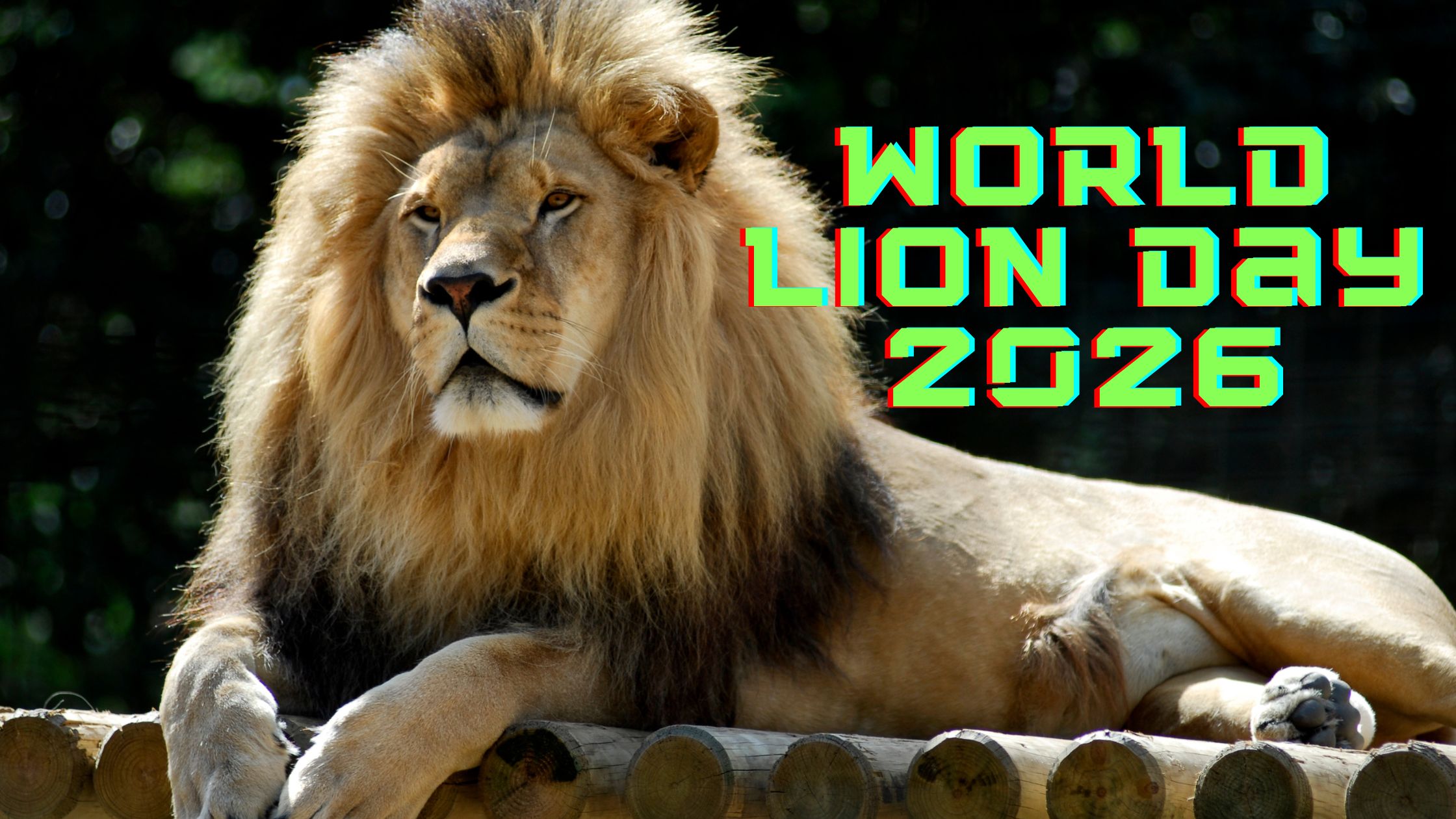
World Lion Day 2026 falls on August 10, 2026, bringing attention once again to one of the world’s most recognisable wild animals.
The lion has always carried a certain mystique. We call it the king of the jungle, use its image to represent courage and strength, and feature it everywhere from ancient stories to modern logos. But behind that powerful image is a species whose survival depends on something much more fragile: healthy habitats, sufficient prey, connected landscapes, and peaceful coexistence with humans.
So, what is World Lion Day really about? More than celebrating a magnificent animal, it is about understanding the challenges lions face and recognising why protecting them matters.
When Is World Lion Day 2026?
World Lion Day 2026 will be observed on Monday, August 10, 2026.
World Lion Day is observed every year on August 10 to raise awareness about lions, their habitats, conservation challenges, and the need to protect wild populations.
For wildlife enthusiasts, conservation organisations, schools, environmental groups, and content creators, the day offers an opportunity to start conversations about lions that go beyond photographs and documentaries.
After all, admiring a lion is easy. Understanding what it takes to keep lions living in the wild is where the real conversation begins.
What Is World Lion Day?
World Lion Day is an annual awareness day dedicated to lions and their conservation.
The day encourages people to learn about where lions live, the threats they face, the importance of their ecosystems, and the conservation efforts being undertaken to protect them.
The lion has an enormous cultural presence around the world. It appears in mythology, literature, national symbols, sports teams, films, advertisements, and traditional art.
But there is an interesting contradiction here.
We have made the lion a symbol of power, yet the future of wild lions depends heavily on human decisions.
World Lion Day attempts to bridge that gap by turning fascination into awareness—and awareness into action.
How Did World Lion Day Start?
World Lion Day is closely associated with Big Cat Rescue, which helped establish the annual observance to raise awareness about lions and the threats faced by big cats.
The initiative became an opportunity to bring global attention to lion conservation and encourage people to understand the difference between appreciating wildlife and actively protecting it.
The larger message remains relevant today: if we want future generations to see lions in the wild, conservation has to be more than a slogan.
Why Is World Lion Day Celebrated on August 10?
August 10 became associated with World Lion Day through the efforts of Big Cat Rescue to create a dedicated annual awareness day for lions.
The date now provides a regular opportunity for conservationists, educators, wildlife enthusiasts, and organisations to discuss lion populations and the pressures affecting them.
One day cannot solve a conservation crisis. But one day can start a conversation.
And sometimes, that conversation is where change begins.
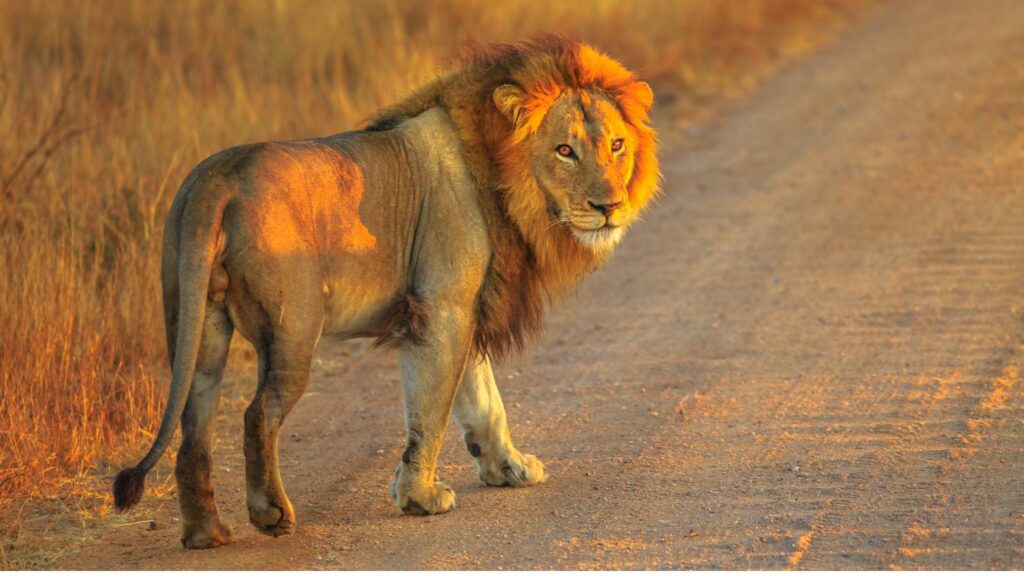
Why Are Lions Important to the Ecosystem?
Lions are much more than impressive predators.
As apex predators, they occupy an important position near the top of the food chain. Their presence can influence prey populations, animal behaviour, and the broader balance of an ecosystem.
Think of an ecosystem as a giant web rather than a collection of separate animals.
Pull on one strand, and the others can move too.
When large predators disappear from an ecosystem, the effects can extend beyond that one species. Changes in predator numbers can influence prey behaviour, population dynamics, vegetation, and other ecological relationships.
Protecting lions, therefore, is also about protecting the ecosystems in which they live.
Lions as Apex Predators
Lions don’t need to hunt every animal in their territory to influence an ecosystem.
Their presence alone can affect how prey animals move through a landscape and where they choose to feed or rest.
This is why lion conservation cannot be reduced to simply counting lions.
A healthy lion population needs a healthy ecosystem around it—including adequate prey, water, vegetation, breeding areas, and space to move.
Why Lion Conservation Benefits More Than Lions
There is another side to lion conservation that often gets overlooked: people.
Wildlife tourism in parts of Africa and India can contribute to local economies and create employment opportunities.
When managed responsibly, wildlife tourism can make living landscapes economically valuable while encouraging people to protect the animals within them.
But responsible tourism matters.
A lion should not have to become a photo prop for people to value it.
The best wildlife experiences allow animals to behave naturally while giving people the opportunity to appreciate them from a respectful distance.
What Is the Conservation Status of Lions?
The conservation story of lions is complicated.
Lions still exist in the wild, and some populations have shown encouraging signs of recovery. At the same time, they have disappeared from large parts of their historical range.
Habitat loss, human-wildlife conflict, declining prey populations, disease, and other pressures continue to affect wild lions.
This means there is no single global story about lions.
Some populations are recovering. Others remain under serious pressure.
The real challenge is ensuring that short-term population increases become long-term conservation success.
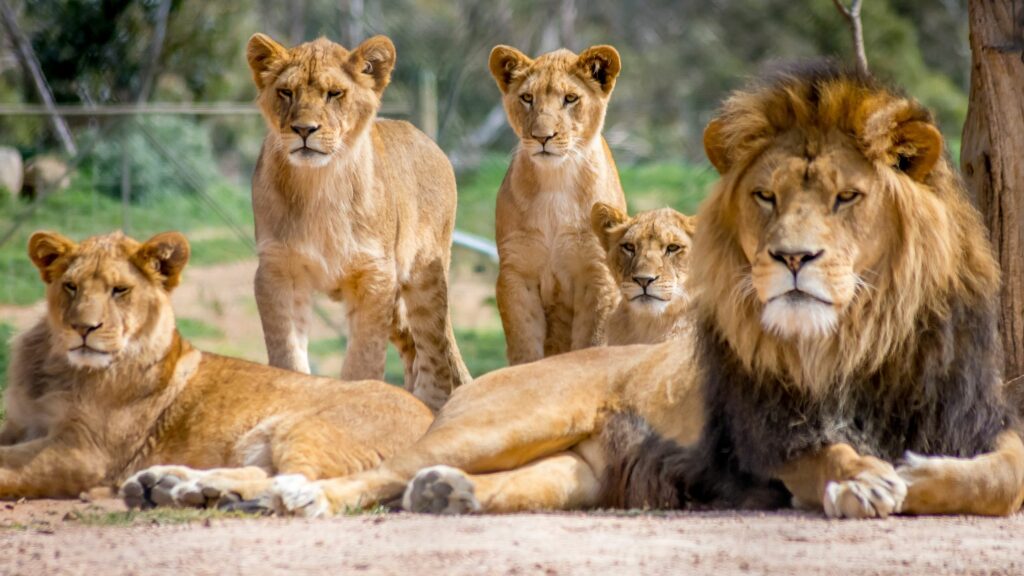
Where Do Wild Lions Live Today?
Today, wild lions are primarily found across parts of sub-Saharan Africa, along with the world’s only remaining wild population of Asiatic lions in India.
Historically, lions occupied a much larger range, extending across parts of Africa, Europe, the Middle East, and Asia.
Their current distribution is therefore only a fraction of their historical range.
African Lions
Most wild lions live in Africa, particularly in national parks, wildlife reserves, conservation areas, and surrounding landscapes.
However, a protected area does not exist in isolation.
Many wildlife habitats are surrounded by farms, villages, roads, livestock-grazing areas, and other human activity.
A lion does not recognise a boundary drawn on a map.
If prey becomes scarce or a lion’s territory changes, it may move into human-dominated areas. That is when the possibility of human-wildlife conflict increases.
Asiatic Lions in India
India is home to the world’s only remaining wild population of Asiatic lions.
These lions are primarily found in Gujarat, with the Gir landscape playing a central role in their conservation.
The Asiatic lion is not simply an African lion living in a different country. It is a distinct population with its own evolutionary history and characteristics.
Protecting it means protecting an important part of India’s natural heritage.
India’s Asiatic Lions: A Remarkable Conservation Story
The story of the Asiatic lion is one of the most encouraging examples of wildlife recovery in India.
The population was once pushed dangerously close to extinction. Conservation efforts in and around the Gir landscape helped the population recover significantly.
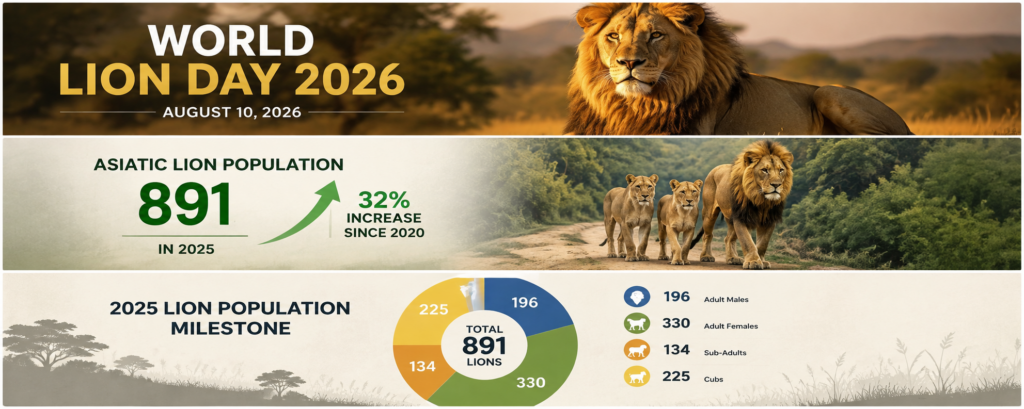
According to Gujarat’s 2025 Lion Population Estimation, the Asiatic lion population reached 891, compared with 674 in 2020. That represents a 32% increase over five years.
That is a remarkable achievement.
But there is an important point to remember: population growth is not the finish line.
A growing lion population still needs enough habitat, prey, safe movement corridors, genetic diversity, and protection from disease and human-wildlife conflict.
The Importance of Gir
Gir National Park and the surrounding Gir landscape in Gujarat have played a central role in saving the Asiatic lion.
The Gujarat Forest Department describes the Gir ecosystem as home to the only surviving population of Asiatic lions and credits sustained management efforts and local community support with helping the species recover from the brink of extinction.
But lions are no longer restricted to one small pocket.
The 2025 population estimation recorded lions across several satellite populations and corridor areas beyond the core Gir landscape.
That expansion is significant.
A species is generally more resilient when individuals can move between suitable habitats instead of being concentrated in a single isolated area.
The 2025 Lion Population Milestone
The 2025 estimation recorded:
- 891 total Asiatic lions
- 196 adult males
- 330 adult females
- 134 sub-adults
- 225 cubs
- Lions recorded across core, satellite, and corridor populations
The number of adult females is particularly important because breeding females are central to the continued growth of a population.
The increase demonstrates what sustained conservation management can achieve.
But it also creates a new responsibility: making sure the expanding population has enough connected habitat to survive in the long term.
What Threatens Lions Today?
There isn’t one single threat facing lions.
Instead, several pressures overlap, and their effects can vary from one region to another.
Understanding those threats is essential if World Lion Day is going to be more than a celebration.
Habitat Loss and Fragmentation
As human settlements, agriculture, infrastructure, and other development expand, natural habitats can become smaller and increasingly fragmented.
A forest or grassland might still exist on a map, but if it has been divided into isolated pieces, wildlife may struggle to move between them.
For lions, movement matters.
They need space to hunt, establish territories, find mates, and raise cubs.
This is why wildlife corridors are becoming increasingly important in modern conservation.
Human-Wildlife Conflict
This is perhaps one of the most complicated challenges in lion conservation.
Imagine a farmer or livestock owner living near a wildlife habitat.
A lion kills livestock.
For a conservationist, the lion is a protected wild animal.
For the livestock owner, the loss can mean a serious financial setback.
Both realities can exist at the same time.
That is why effective conservation cannot simply ask communities to tolerate wildlife without addressing the costs they may face.
Compensation systems, community involvement, better livestock protection, education, and conflict-prevention measures can all play an important role.
Declining Prey Populations
Lions need prey.
It sounds obvious, but it is one of the most important pieces of the conservation puzzle.
When wild prey populations decline because of habitat degradation, overhunting, competition with livestock, or other factors, lions may have fewer natural food sources available.
That can increase pressure on lion populations and potentially push them closer to human settlements.
Protecting lions therefore also means protecting the animals they depend on.
Illegal Wildlife Trade
Illegal wildlife trade is another threat affecting big cats around the world.
Lions can be targeted directly, while their body parts may enter illegal markets.
The problem also extends to the wider exploitation of big cats in captivity and tourism.
Wildlife conservation therefore requires not only habitat protection but also strong laws, enforcement, monitoring, and public awareness.
Climate Change and Disease
Climate change can influence wildlife in ways that are sometimes difficult to see immediately.
Changes in rainfall, water availability, vegetation, prey distribution, and extreme weather can alter the landscapes lions depend on.
Disease is another concern.
When an animal population is geographically concentrated, a serious disease outbreak can have significant consequences.
This makes population diversification and strong wildlife health monitoring important parts of long-term conservation.
How Is Lion Conservation Changing?
Modern conservation is no longer simply about creating protected areas and keeping people away from wildlife.
The approach is becoming much broader.
Conservation now involves habitat management, community participation, wildlife corridors, veterinary science, technology, policy, tourism, education, and local livelihoods.
Protecting Wildlife Corridors
A wildlife corridor allows animals to move between otherwise separated habitats.
For lions, this can mean access to new territories, prey, and potential mates.
It can also help reduce the risks associated with having an entire population concentrated in one geographical area.
The 2025 Asiatic lion population estimation recorded animals in corridor areas, highlighting the importance of landscape connectivity as the population expands.
Working With Local Communities
Conservation is much more effective when local communities are treated as partners.
People living near wildlife habitats often have direct knowledge of the landscape and the animals moving through it.
They also experience the consequences of human-wildlife conflict first-hand.
Community participation, compensation programmes, local employment, awareness initiatives, and sustainable livelihoods can help create conditions where protecting wildlife becomes a shared goal.
The future of the lion isn’t decided only inside a national park.
It is also shaped in the villages, farms, schools, forests, and communities surrounding it.
How Can You Celebrate World Lion Day 2026?
You don’t need to visit a wildlife sanctuary to participate in World Lion Day.
Start with something simple: learn more about lions.
Understand the difference between African and Asiatic lions. Read about conservation initiatives. Learn how human-wildlife conflict works.
And when you share information online, check whether the statistic or claim you’re sharing is accurate.
Learn Before You Share
Social media has made wildlife awareness easier than ever.
One photograph can reach thousands of people within hours.
But misinformation can travel just as quickly.
Before sharing a dramatic statistic about lions, check its source and date.
A beautiful photograph may capture attention.
Accurate information can change behaviour.
On World Lion Day, aim for both.
Support Responsible Conservation
If you want to financially support lion conservation, research organisations carefully and look for transparent programmes with clearly defined conservation goals.
You can also support responsible wildlife tourism, habitat restoration, conservation education, and community-based initiatives.
And remember that conservation is rarely glamorous.
Sometimes it looks like a ranger patrol.
Sometimes it is habitat monitoring.
Sometimes it is a community meeting or veterinary intervention.
Sometimes it is simply protecting a corridor from being fragmented.
The quiet work can be just as important as the spectacular moments we see in documentaries.
Avoid Wildlife Exploitation
A photograph of a tourist cuddling a lion cub may look harmless.
But the story behind that photograph may be much more complicated.
Responsible wildlife tourism should prioritise animal welfare and natural behaviour rather than encouraging close-contact experiences that turn wild animals into entertainment.
Supporting genuine conservation means asking where an animal came from, how it is being treated, and whether the activity actually contributes to protecting wildlife.
Why World Lion Day 2026 Matters
The lion is often described as fearless, powerful, and dominant.
Yet its future depends heavily on decisions made by humans.
That contradiction is exactly why World Lion Day matters.
The story of India’s Asiatic lions shows that conservation can work. The population reached 891 in the 2025 estimation, with lions now recorded across the core Gir landscape, satellite populations, and corridor areas.
But success creates a new responsibility.
As populations grow, conservation must grow with them.
More lions mean greater importance for habitat connectivity, disease preparedness, prey availability, conflict management, and community participation.
So World Lion Day 2026 shouldn’t simply be about posting a photograph of a lion with a quote about courage.
It can be about understanding the real animal behind the symbol.
It can be about recognising that wildlife conservation is complicated, local, and often slow.
And most importantly, it can remind us that protecting a species means protecting the ecosystem and people connected to it.
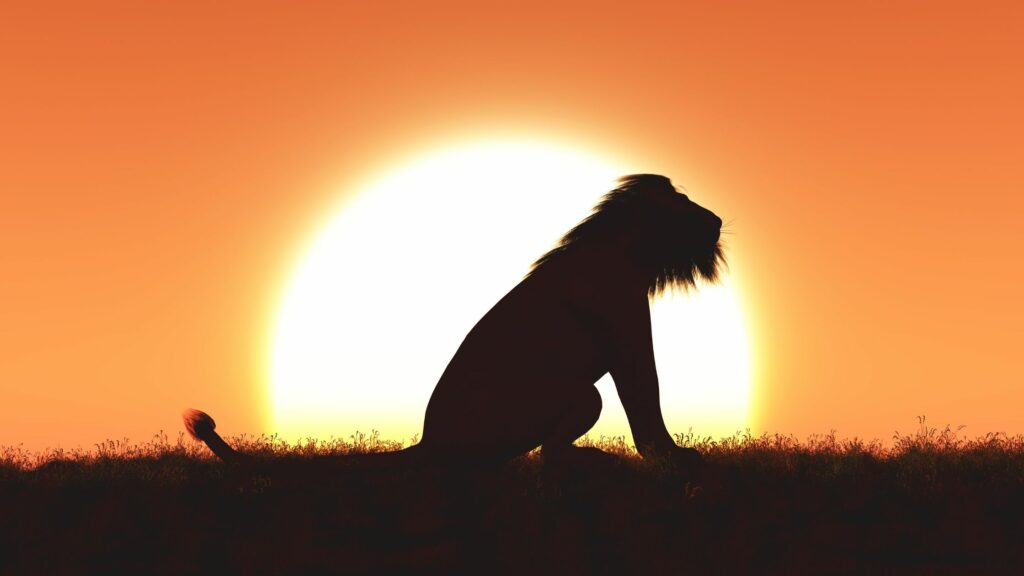
World Lion Day 2026 is more than a date for celebrating one of the world’s most iconic animals. It is a reminder of the responsibility that comes with sharing the planet with wildlife.
Lions may represent strength, but their survival depends on healthy ecosystems, connected habitats, sufficient prey, responsible conservation, and communities that can coexist with wildlife.
India’s Asiatic lions offer an encouraging example of what sustained conservation can achieve. But recovery is not the same as permanent security.
So, this August 10, celebrate the lion—but look beyond the roar.
Learn where lions live. Understand what threatens them. Support responsible conservation. And remember that the strongest way to honour the king of the jungle is to make sure there is still a wild world for it to rule.
Also Read: Small Cats in Odisha: The Hidden Wild Felines of Eastern India

