


In today’s competitive digital landscape, performance marketing has become one of the most effective ways to grow a business while maintaining complete control over advertising costs. Unlike traditional marketing, where businesses invest in campaigns without guaranteed outcomes, performance marketing focuses on measurable actions such as clicks, leads, sales, app installs, and conversions. Every dollar spent is tied to a specific business objective, making it a preferred strategy for startups, small businesses, and global enterprises alike.
Whether we are promoting an eCommerce store, generating qualified leads, increasing app downloads, or boosting brand visibility, understanding the fundamentals of performance marketing is essential for achieving sustainable online growth.
What Is Performance Marketing?
Performance marketing is a digital marketing strategy in which advertisers pay only when a desired action occurs. Instead of paying solely for ad exposure, businesses invest in measurable outcomes such as:
- Website clicks
- Product purchases
- Lead form submissions
- Newsletter sign-ups
- Mobile app installs
- Phone calls
- Video views
- Subscription registrations
This data-driven approach enables marketers to monitor campaign performance in real time, optimize budgets, and maximize return on investment (ROI).
How Performance Marketing Works
Performance marketing follows a structured process that connects businesses with potential customers through digital advertising platforms.
Step 1: Set Campaign Objectives
Every campaign begins with a clear business goal, such as:
- Increasing online sales
- Generating qualified leads
- Growing website traffic
- Promoting a mobile application
- Building email subscribers
Clearly defined objectives determine how campaign success will be measured.
Step 2: Define the Target Audience
Audience targeting plays a crucial role in campaign success. Advertisers can target users based on:
- Age
- Gender
- Location
- Interests
- Occupation
- Income level
- Online behavior
- Purchase history
- Device usage
Advanced audience segmentation ensures advertisements reach users who are most likely to convert.
Step 3: Create High-Converting Advertisements
Successful campaigns rely on compelling creatives that include:
- Attention-grabbing headlines
- High-quality visuals
- Persuasive copy
- Strong value propositions
- Clear calls-to-action (CTAs)
Examples of effective CTAs include:
- Shop Now
- Download Today
- Get Started
- Book a Demo
- Claim Your Offer
Step 4: Launch Campaigns
Ads are published across various performance marketing platforms where they reach targeted audiences through auctions and bidding systems.
Step 5: Measure Results
Campaign performance is continuously monitored using analytics tools that track:
- Impressions
- Clicks
- Cost
- Conversions
- Revenue
- Customer acquisition
Optimization decisions are based entirely on real-time performance data.
Also Read: Digital Marketing in Modern Business
Why Performance Marketing Is Important
Businesses increasingly rely on performance marketing because it provides measurable growth while reducing advertising waste.
Some of its biggest advantages include:
- Complete budget control
- Real-time performance tracking
- Scalable campaigns
- Higher return on investment
- Better audience targeting
- Data-driven decision making
- Transparent reporting
Rather than relying on assumptions, marketers use actual performance metrics to improve every campaign.
Popular Performance Marketing Channels
Google Ads
Google Ads remains one of the most effective performance marketing platforms because it captures users actively searching for products and services.
Campaign formats include:
- Search Ads
- Display Ads
- Shopping Ads
- Performance Max
- YouTube Ads
- Discovery Ads
Businesses typically pay using:
- Cost Per Click (CPC)
- Cost Per Acquisition (CPA)
- Target ROAS
- Maximize Conversions
Meta Ads (Facebook & Instagram)
Meta Ads enable advertisers to target audiences based on demographics, interests, and online behavior.
Popular campaign objectives include:
- Brand awareness
- Website traffic
- Lead generation
- Sales
- Engagement
- App promotion
Meta’s machine learning algorithms continuously optimize delivery for better results.
LinkedIn Ads
LinkedIn is ideal for B2B performance marketing.
Businesses can target professionals using filters such as:
- Job title
- Industry
- Company size
- Skills
- Seniority
- Education
LinkedIn performs particularly well for lead generation and enterprise marketing.
YouTube Advertising
Video advertising has become a major performance marketing channel.
Popular campaign objectives include:
- Video views
- Website visits
- Brand awareness
- Product sales
- App installs
Engaging video creatives often deliver higher engagement rates than static advertisements.
Affiliate Marketing
Affiliate marketing allows publishers to promote products in exchange for commissions generated from successful sales or leads.
This model benefits both advertisers and affiliates by aligning payment directly with measurable performance.
Email Marketing
Although often overlooked, email marketing remains one of the highest ROI digital marketing channels.
Performance metrics include:
- Open Rate
- Click-Through Rate
- Conversion Rate
- Revenue Per Email
- Subscriber Growth
Automated email sequences significantly improve customer retention
Essential Performance Marketing Metrics
Understanding key metrics helps marketers evaluate campaign effectiveness.
CTR (Click-Through Rate)
CTR measures how often users click after viewing an advertisement.
Formula:
CTR = (Clicks ÷ Impressions) × 100
Higher CTR generally indicates more relevant advertisements.
CPC (Cost Per Click)
CPC measures the average amount paid for each click.
Lower CPC often results in more efficient advertising budgets
CPA (Cost Per Acquisition)
CPA calculates the cost required to generate one customer or lead.
Lower CPA indicates better campaign efficiency.
Conversion Rate
Conversion Rate measures the percentage of users completing the desired action.
Formula:
Conversions ÷ Total Visitors × 100
Improving landing pages often increases conversion rates significantly.
ROAS (Return on Ad Spend)
ROAS evaluates advertising profitability.
Formula:
Revenue Generated ÷ Advertising Cost
For example:
- Revenue: $5,000
- Ad Spend: $1,000
ROAS = 5:1
Higher ROAS indicates stronger advertising performance.
Customer Lifetime Value (CLV)
CLV estimates the total revenue generated by a customer throughout their relationship with a business.
Performance marketers often optimize campaigns based on lifetime value rather than immediate purchases.
Performance Marketing Funnel
Successful campaigns guide customers through multiple stages.
Awareness
Introduce products through:
- Display advertising
- Social media
- Video marketing
Interest
Build curiosity using:
- Educational content
- Product demonstrations
- Reviews
- Case studies
Consideration
Encourage comparison through:
- Testimonials
- Free trials
- Pricing pages
- Feature comparisons
Conversion
Drive final purchases using:
- Limited-time offers
- Discounts
- Strong CTAs
- Optimized checkout pages
Retention
Increase customer loyalty with:
- Email automation
- Loyalty programs
- Personalized recommendations
- Remarketing campaigns
Landing Pages: The Foundation of High-Converting Campaigns
Even the best advertisements fail without optimized landing pages.
Effective landing pages include:
- Clear headlines
- Fast loading speed
- Mobile responsiveness
- Trust badges
- Customer reviews
- Strong CTA buttons
- Minimal distractions
- Simple forms
A well-designed landing page can dramatically improve conversion rates while lowering acquisition costs.
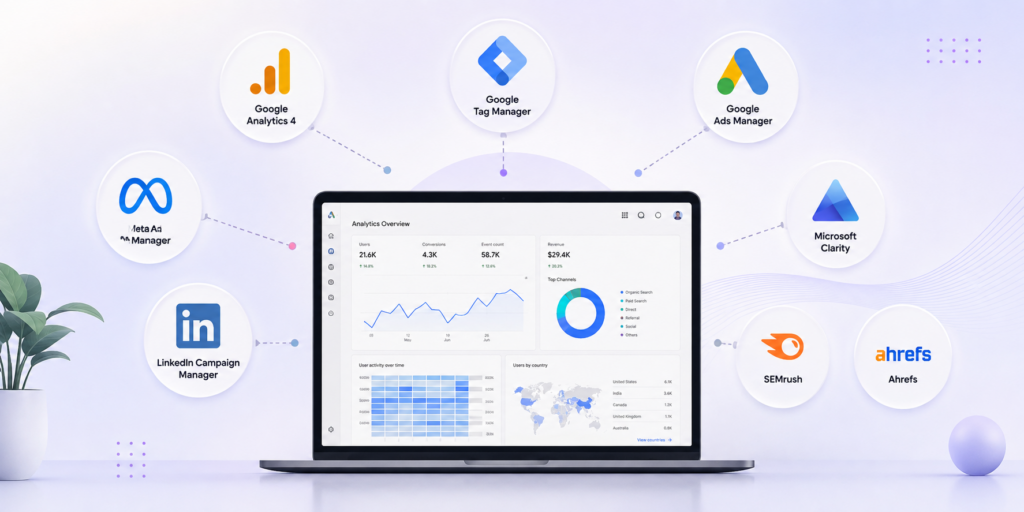
Performance Marketing Tools Beginners Should Learn
Modern marketers rely on specialized tools for campaign management and optimization.
Popular tools include:
- Google Analytics 4
- Google Tag Manager
- Google Ads Manager
- Meta Ads Manager
- LinkedIn Campaign Manager
- Microsoft Clarity
- Hotjar
- Looker Studio
- SEMrush
- Ahrefs
These tools provide valuable insights into user behavior, campaign performance, and optimization opportunities.
Common Performance Marketing Mistakes to Avoid
Many beginners lose advertising budgets due to avoidable mistakes.
Some of the most common include:
- Running campaigns without clear objectives
- Targeting audiences that are too broad
- Ignoring conversion tracking
- Using weak ad creatives
- Sending traffic to poorly designed landing pages
- Not performing A/B testing
- Making optimization decisions too quickly
- Neglecting mobile users
- Overlooking customer lifetime value
- Failing to analyze campaign data regularly
Avoiding these pitfalls helps improve campaign efficiency over time.
Best Practices for Beginners
To build successful performance marketing campaigns, we should focus on proven strategies:
- Define measurable goals before launching campaigns.
- Install accurate conversion tracking.
- Start with small budgets and scale gradually.
- Test multiple creatives and audiences.
- Optimize landing pages continuously.
- Monitor campaign metrics daily.
- Pause underperforming advertisements.
- Reinvest budget into high-performing campaigns.
- Use remarketing to recover lost visitors.
- Analyze customer behavior before making major changes.
Consistent optimization is the key to long-term success.
The Future of Performance Marketing
Performance marketing continues to evolve with advances in automation, artificial intelligence, privacy regulations, and machine learning. Smart bidding strategies, predictive analytics, first-party data, and AI-powered creative optimization are reshaping how advertisers reach and convert customers. Businesses that embrace these innovations while maintaining a strong focus on measurable outcomes will be better positioned to achieve sustainable growth in an increasingly competitive digital environment.
Performance marketing empowers businesses to make every advertising dollar accountable by tying investment directly to measurable outcomes such as clicks, leads, and sales. By mastering audience targeting, selecting the right advertising channels, tracking key performance metrics, and continuously optimizing campaigns, we can build scalable strategies that deliver consistent growth and maximize retu rn on investment. For beginners, the path to success starts with clear objectives, accurate data, ongoing experimentation, and a commitment to improving performance based on real results. As digital advertising continues to evolve, a disciplined performance marketing approach will remain one of the most effective ways to acquire customers, increase revenue, and build a competitive online presence.
Also Read: Digital Branding: The Smart, Human-Centered Approach to Building a Brand People Actually Remember

