


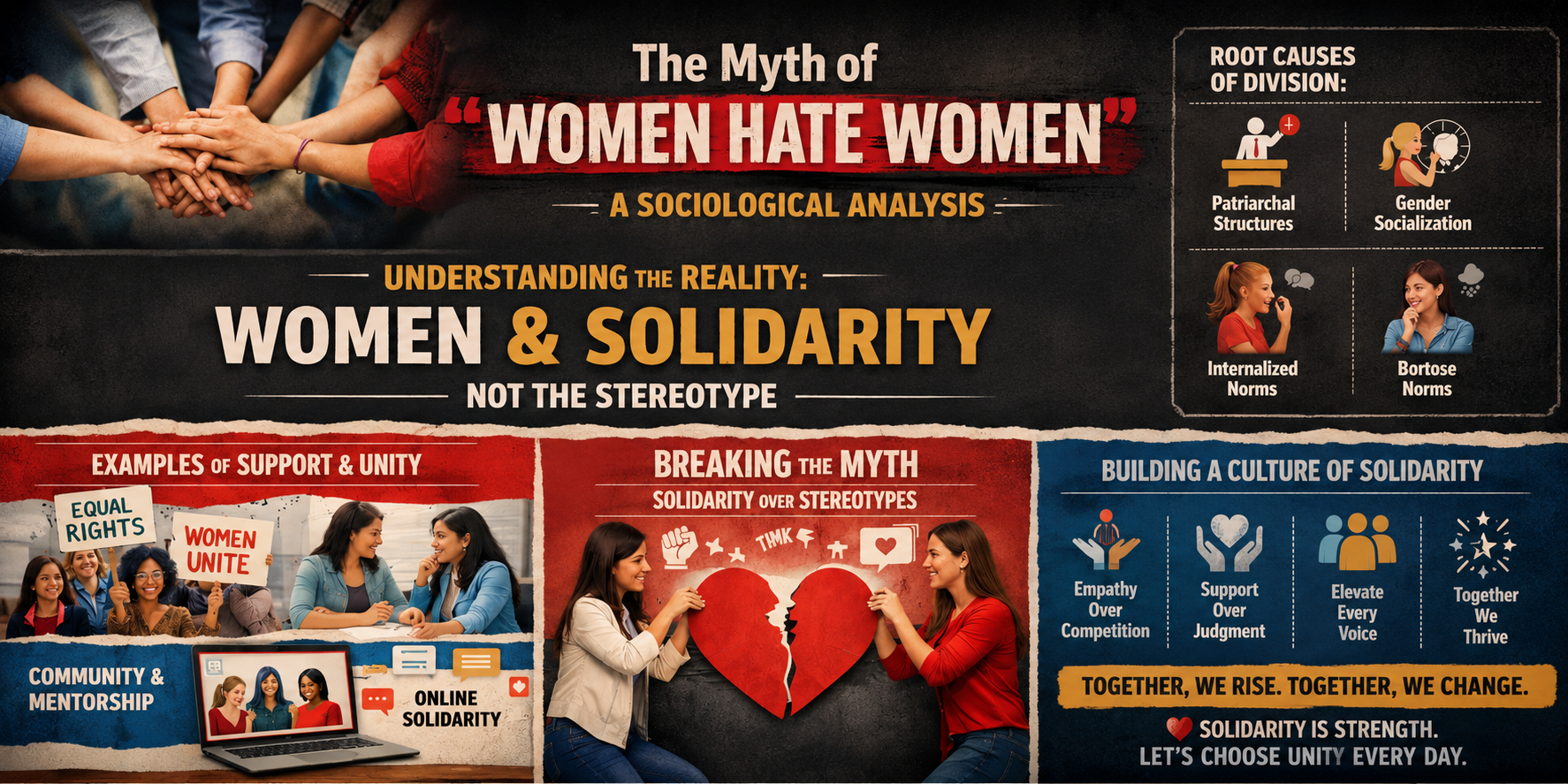
The phrase “women hate women” is commonly used to explain conflicts, competition, jealousy, or criticism among women. Popular culture, social media, and even everyday conversations often reinforce the stereotype that women are naturally unsupportive of one another. However, from a sociological perspective, this assumption oversimplifies complex social relationships and ignores the broader structures that shape women’s interactions.
Rather than being an inherent characteristic of women, instances of rivalry or conflict among women are often products of socialization, gender norms, unequal opportunities, and patriarchal social structures. This article critically examines the myth that women inherently dislike other women and explores how social conditions influence female relationships.
Some reasons why this myth exists include
The belief that women naturally compete with one another has deep historical roots. Traditional patriarchal societies often restricted women’s access to education, employment, property, and public power. When opportunities were scarce, women were frequently placed in competition for social status, economic security, or marriage prospects.
Sociologists argue that such competition was not a result of women’s nature but rather a consequence of structural inequality. When a social system provides limited opportunities to a group, competition becomes more visible and intense. The stereotype persists because conflicts among women are often highlighted and sensationalized, while examples of cooperation and solidarity receive less attention.
1. Patriarchal stereotypes – Feminist sociologists have introduced the concept of internalized patriarchy, where women may unconsciously adopt beliefs and values that reinforce gender inequality. In some cases, women may judge, criticize, or limit other women based on societal expectations regarding femininity, motherhood, career choices, or personal behavior. These actions are often interpreted as evidence that women dislike other women. However, a deeper analysis reveals that these behaviors are manifestations of broader cultural norms rather than expressions of innate hostility. Internalized gender norms can affect both men and women, influencing how they perceive and evaluate others within society
2. Media representation –Media representations often reinforce the stereotype of female rivalry. Television shows, films, and celebrity culture frequently portray women as jealous, competitive, or engaged in personal conflicts. Such portrayals attract attention and entertainment value, but they do not accurately represent the diversity of women’s relationships. Positive examples of collaboration, mentorship, and collective action receive comparatively less coverage. Consequently, audiences may develop distorted perceptions about female relationships.
3. Limited opportunities – In societies or workplaces where few positions are available for women, competition can sometimes create tension. The problem is usually the unequal system, not women themselves.
4.Intersectionality and Women’s Experiences- Women’s experiences are not uniform. Factors such as class, caste, race, ethnicity, religion, age, and education influence how women interact with one another. The concept of intersectionality highlights that women experience social realities differently depending on their social positions. Understanding these differences allows for a more nuanced analysis of cooperation and conflict among women. It shifts attention away from simplistic explanations and toward the structural conditions that shape social relationships.
5. Confirmation bias – People tend to remember instances of conflict more than examples of cooperation, making female rivalry seem more common than it actually is.
In reality, women’s movements throughout history—from the struggle for voting rights to campaigns for education, workplace equality, and protection from violence—have depended on women supporting one another. Examples include organizations such as National Organization for Women and UN Women, which are built on collective action and solidarity.
So, rather than “women hate women,” a more accurate view is that women, like all human beings, can experience both cooperation and conflict. The stereotype exaggerates the conflict and overlooks the much larger reality of mutual support
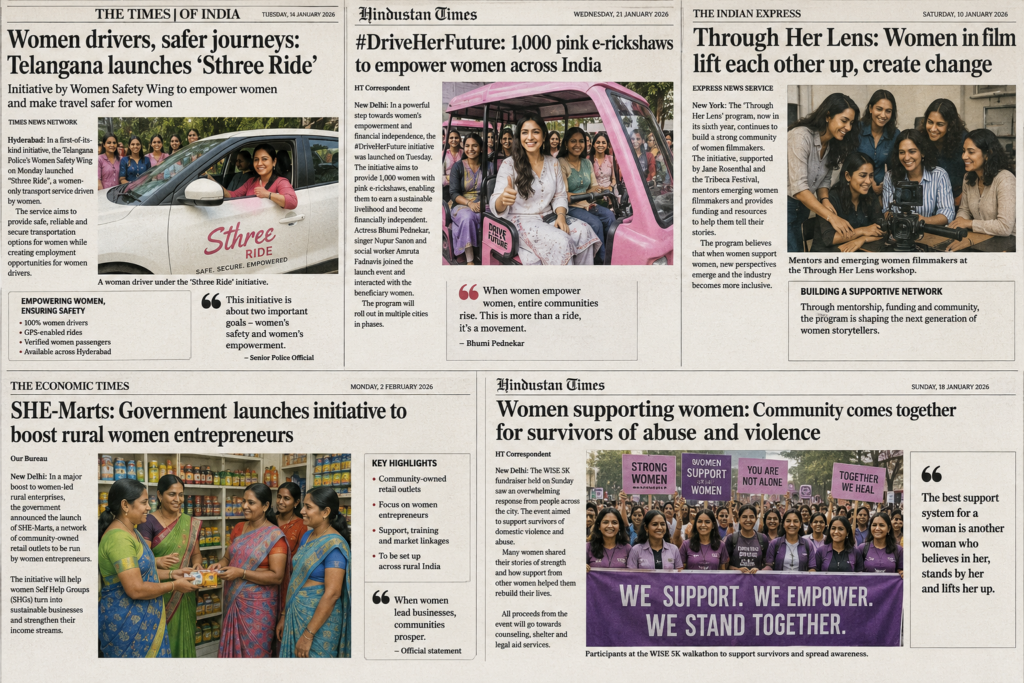

How Women Support Women
1. Emotional Support: Women often provide emotional comfort during difficult times such as family problems, breakups, illness, or career setbacks. Female friendships are frequently built on empathy, listening, and mutual encouragement.
2. Mentorship and Guidance: Senior women in workplaces, academia, and communities often mentor younger women, helping them navigate challenges and build confidence.
3. Advocacy for Women’s Rights: Women have historically united to fight for voting rights, education, equal pay, reproductive rights, and protection against violence.
4. Professional Networking: Women’s groups, professional associations, and online communities help women find jobs, scholarships, business opportunities, and career advice.
5. Community Care: Women often organize self-help groups, neighborhood initiatives, charity drives, and support networks for families, children, and vulnerable populations.
6. Standing Against Gender-Based Violence: Many women support survivors of harassment, domestic violence, and abuse by providing resources, advocacy, and safe spaces.
7. Celebrating Each Other’s Success: Women increasingly use social media and professional platforms to promote female-owned businesses, celebrate achievements, and amplify one another’s voices.
8. Sharing Knowledge and Resources: From educational opportunities to health information and financial advice, women frequently help other women access valuable resources.
9. Building Collective Movements: Major social changes have often been achieved through women working together, demonstrating cooperation rather than rivalry.
10. Everyday Acts of Solidarity: Simple actions such as recommending a friend for a job, helping a new mother, supporting a student, or encouraging a colleague are common examples of women supporting women

Also read: The Plight of Women in the Economy
Theoretical Perspectives on the Myth of “Women Hate Women”
1.Feminist Theory and Simone de Beauvoir : French feminist philosopher and social theorist Simone de Beauvoir argued in her influential work The Second Sex that women are not born with a fixed social identity; rather, they become women through socialization and cultural expectations. Her famous statement, “One is not born, but rather becomes, a woman,” highlights the socially constructed nature of gender.
From Beauvoir’s perspective, competition among women cannot be understood as a natural characteristic. Instead, it emerges from a patriarchal social order that historically positioned women as dependent on male approval and limited their access to power and resources. When society values women primarily for beauty, marriageability, or caregiving roles, women may be encouraged to compete with one another for recognition and status. Therefore, what appears as hostility between women is often a consequence of unequal social structures rather than an inherent tendency among women themselves.

2. Gender Performativity and Judith Butler: Judith Butler’s theory of gender performativity provides another important lens for understanding female relationships. Butler argues that gender is not a biological essence but a social performance continuously produced through repeated actions, behaviors, and cultural expectations. According to Butler, society creates norms regarding what constitutes an “ideal woman.” Women are often expected to conform to specific standards of appearance, behavior, motherhood, and professional success. These expectations can generate pressure to monitor and evaluate both themselves and other women.
When women criticize other women’s choices regarding clothing, careers, family life, or sexuality, they are often reinforcing socially constructed gender norms rather than expressing natural hostility. Butler’s framework demonstrates that such judgments are linked to broader systems of power that regulate gender identities. Thus, the notion that women inherently dislike one another obscures the role of social institutions in shaping behavior and maintaining gender expectations.
3. Intersectionality and Patricia Hill Collins: Patricia Hill Collins expanded feminist sociology by emphasizing the importance of intersectionality. She argued that gender cannot be analyzed separately from other social categories such as race, class, caste, ethnicity, and nationality. Collins’ concept of the “matrix of domination” suggests that women experience oppression differently depending on their social location. Consequently, relationships among women are influenced by multiple forms of inequality rather than gender alone.
Intersectionality also highlights the importance of collective solidarity. Women’s movements become stronger when they recognize diverse experiences and work across social divisions. Collins’ theory challenges simplistic assumptions about female rivalry and encourages a more nuanced understanding of women’s relationships.

Also read: Waves of Feminism – A Topic to Be Talked and Understood About!
4. Symbolic Interactionism and Female Relationships : From the perspective of symbolic interactionism, social reality is created through everyday interactions and shared meanings. Labels such as “jealous,” or “competitive” are social constructions that influence how people interpret women’s behavior. The media often amplifies stories of conflict among women while ignoring examples of cooperation, mentorship, and solidarity. As these representations become normalized, society begins to expect rivalry among women and interprets interactions through that lens. This perspective suggests that the myth persists because it is continuously reproduced through language, media portrayals, and everyday social interactions.

5. Conflict Theory and Structural Competition: Conflict theorists argue that competition emerges when access to resources and opportunities is limited. Historically, women were excluded from many positions of power, education, and economic independence. In such contexts, competition among women was often a rational response to structural constraints. Rather than blaming women for competing, conflict theory directs attention toward social systems that create scarcity and inequality. As opportunities for education, employment, and leadership expand, collaborative relationships among women become increasingly visible.
Conclusion
The claim that “women hate women” is a social myth rather than a sociological reality. While conflicts among women certainly exist, they are neither unique to women nor evidence of an inherent female trait. Such conflicts are often rooted in social structures, gender socialization, limited opportunities, and internalized cultural norms. A sociological perspective reveals that women have historically demonstrated remarkable solidarity, resilience, and collective action in the pursuit of social change. Recognizing and challenging stereotypes about female relationships is essential for promoting gender equality and fostering more inclusive social environments.
Also Read:

