


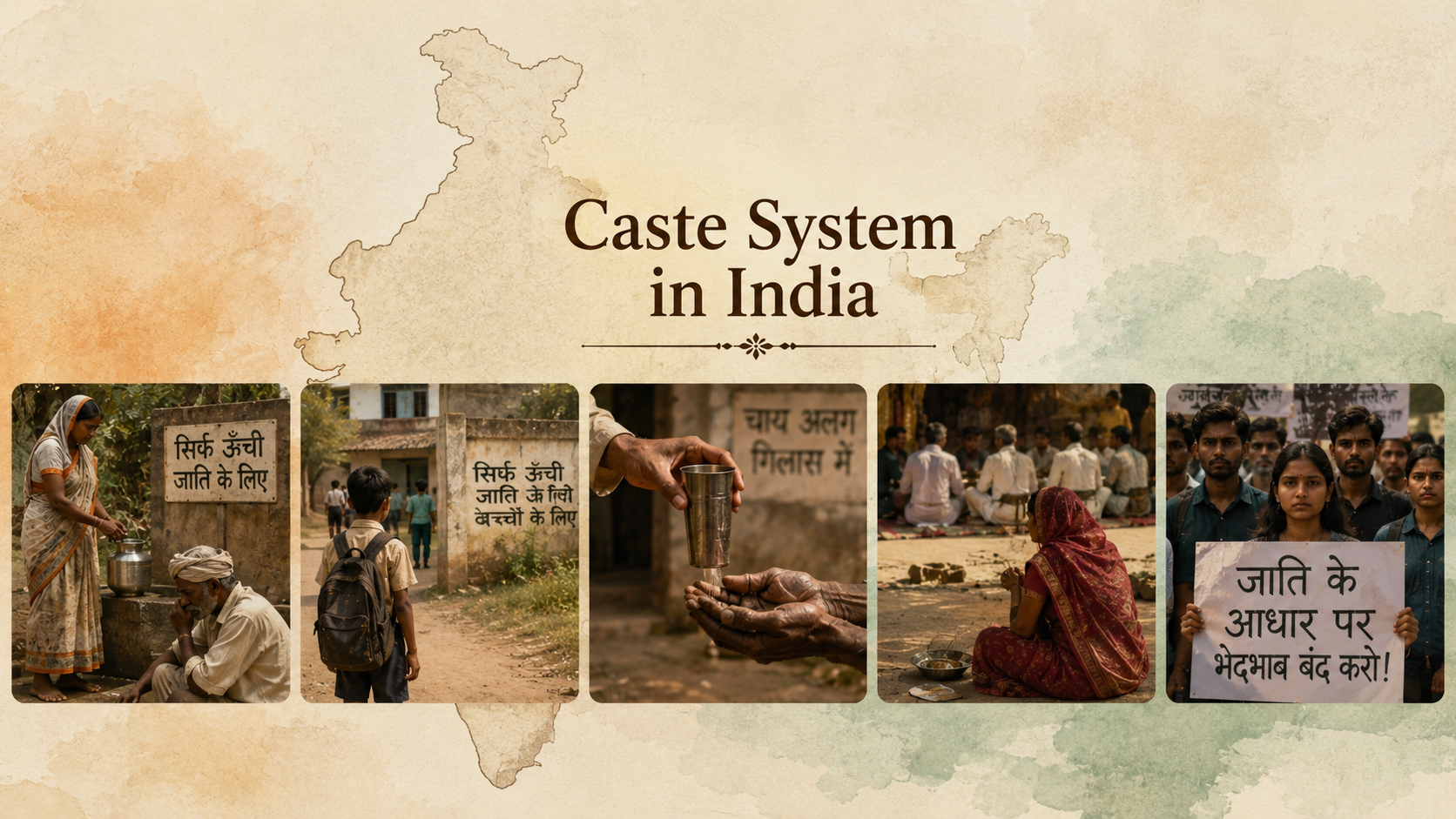
In India, social classification based on caste has its origin in ancient times. It was transformed by various ruling elites in medieval, early-modern, and modern India, especially in the aftermath of the collapse of the Mughal Empire and the establishment of the British Raj. Caste is traditionally associated with Hinduism, but is more pervasive in extent: an estimated 98% of contemporary Indians, including Hindus, Muslims, Christians, Sikhs, Buddhists, and Jains, identify with a caste.
Beginning in ancient India, the caste system was originally centered around varna, with Brahmins (priests) and, to a lesser extent, Kshatriyas (rulers and warriors) serving as the elite classes, followed by Vaishyas (traders and merchants) and finally Shudras (labourers). Outside of this system are the oppressed, marginalised, and persecuted Dalits (also known as “Untouchables”) and Adivasis (tribals).
Over time, the system became increasingly rigid, and the emergence of jati led to further entrenchment, introducing thousands of new castes and sub-castes. With the arrival of Islamic rule, caste-like distinctions were formulated in certain Muslim communities, primarily in North India. The British Raj furthered the system, through census classifications and preferential treatment to Christians and people belonging to certain castes. Social unrest during the 1920s led to a change in this policy towards affirmative action.
Caste-based differences have also been practised in other regions and religions in the Indian subcontinent, like Nepalese Buddhism, Christianity, Islam, Judaism and Sikhism. It has been challenged by many reformist Hindu movements, Buddhism, Sikhism, Christianity, and present-day Neo Buddhism. With Indian influences, the caste system is also practiced in Bali.
After achieving independence in 1947, India banned discrimination on the basis of caste and enacted many affirmative action policies for the upliftment of historically marginalised groups, as enforced through its constitution. However, the system continues to be practiced in India and caste-based discrimination, segregation, violence, and inequality persist.
Definitions and concepts
Varna
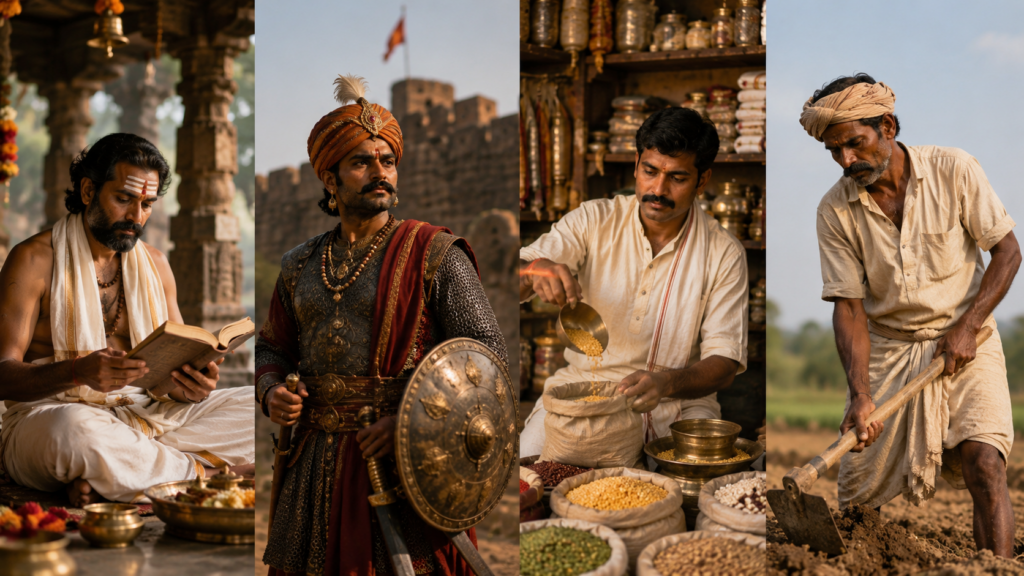
Varna, meaning type, order, colour, or class are a framework for grouping people into classes, first used in Vedic Indian society. It is referred to frequently in the ancient Indian texts. There are four classes: the Brahmins (priestly class), the Kshatriyas (rulers, administrators and warriors; also called Rajanyas), the Vaishyas (artisans, merchants, tradesmen and farmers), and the Shudras (labouring classes). The varna categorisation implicitly includes a fifth element, those deemed to be entirely outside its scope, such as tribal people and the Dalits (also known as “Untouchables”).
Jati
In ancient texts, Jati, meaning birth, is mentioned less often and clearly distinguished from varna. There are four varnas but thousands of jatis. The jatis are complex social groups that lack universally applicable definitions or characteristics and have been more flexible and diverse than was previously often assumed.
Certain scholars of caste have considered jati to have its basis in religion, assuming that the sacred elements of life in India envelop the secular aspects; for example, the anthropologist Louis Dumont described the ritual rankings that exist within the jati system as being based on the concepts of religious purity and pollution. This view has been disputed by other scholars who believe it to be a secular social phenomenon driven by the necessities of economics, politics, and at times geography.
Jatis have existed in India among Hindus, Muslims, Christians, and tribal people, and there is no clear linear order among them.
Also Read: Modernization: A Hegemonic Discourse to Development
Caste
The term caste is derived from the Portuguese and Spanish word casta, meaning “race, lineage, breed” and, originally, “‘pure or unmixed (stock or breed)”. Originally not an Indian word, it is now widely used in English and in Indian languages, closely translated to varna and jati.
Ghurye’s 1932 description
The sociologist G. S. Ghurye wrote in 1932 that, despite much study by many people, we do not possess a real general definition of caste. It appears to me that any attempt at definition is bound to fail because of the complexity of the phenomenon. On the other hand, much literature on the subject is marred by lack of precision about the use of the term.
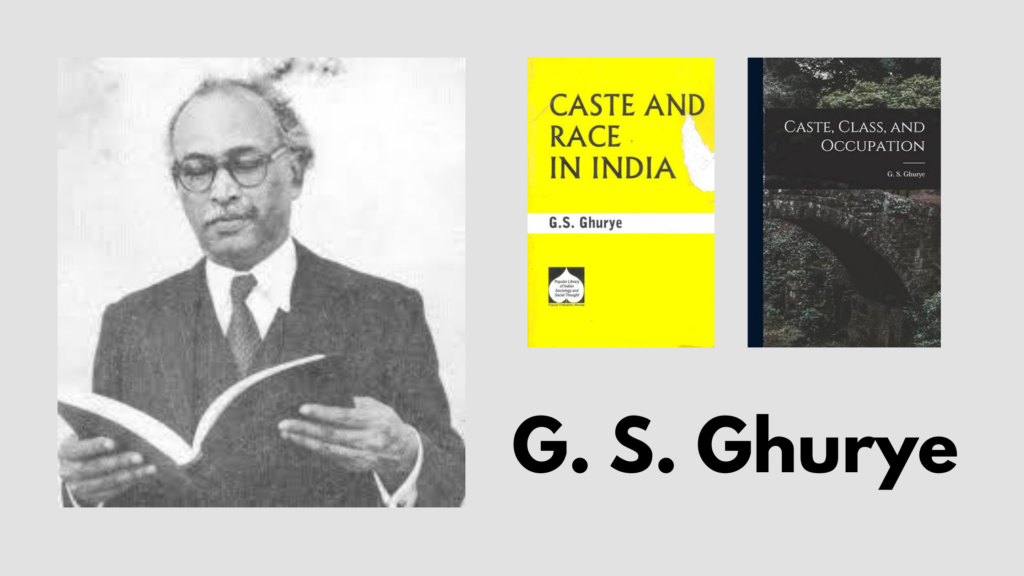
Ghurye offered what he thought was a definition that could be applied across India, although he acknowledged that there were regional variations on the general theme. His model definition for caste included the following six characteristics:
- Segmentation of society into groups whose membership was determined by birth.
- A hierarchical system wherein generally the Brahmins were at the head of the hierarchy, but this hierarchy was disputed in some cases. In various linguistic areas, hundreds of castes had a gradation generally acknowledged by everyone.
- Restrictions on feeding and social intercourse, with minute rules on the kind of food and drink that upper castes could accept from lower castes. There was a great diversity in these rules, and lower castes generally accepted food from upper castes.
- Segregation, where individual castes lived together, the dominant caste living in the center and other castes living on the periphery. There were restrictions on the use of water wells or streets by one caste on another: an upper-caste Brahmin might not be permitted to use the street of a lower-caste group, while a caste considered impure might not be permitted to draw water from a well used by members of other castes.
- Occupation, generally inherited. Lack of unrestricted choice of profession, caste members restricted their own members from taking up certain professions they considered degrading. This characteristic of caste was missing from large parts of India, stated Ghurye, and in these regions all four castes (Brahmins, Kshatriyas, Vaishyas and Shudras) did agriculture labour or became warriors in large numbers.
- Endogamy, restrictions on marrying a person outside caste, but in some situations hypergamy allowed. Far less rigidity on inter-marriage between different sub-castes than between members of different castes in some regions, while in some, endogamy within a sub-caste was the principal feature of caste-society.
Modern perspective on definition
Ronald Inden, the Indologist, agrees that there has been no universally accepted definition of “caste”. For example, for some early European documenters it was thought to correspond with the endogamous varnas referred to in ancient Indian scripts, and its meaning corresponds in the sense of estates. To later Europeans of the Raj era it was endogamous jatis, rather than varnas, that represented caste, such as the 2,378 jatis that colonial administrators classified by occupation in the early 20th century.
Arvind Sharma, a professor of comparative religion, notes that caste has been used synonymously to refer to both varna and jati but that “serious Indologists now observe considerable caution in this respect” because, while related, the concepts are considered to be distinct.
The name stuck and became the usual word for the Hindu social group. In attempting to account for the remarkable proliferation of castes in 18th- and 19th-century India, authorities credulously accepted the traditional view that by a process of intermarriage and subdivision the 3,000 or more castes of modern India had evolved from the four primitive classes, and the term ‘caste’ was applied indiscriminately to both varna or class, and jati or caste proper. This is a false terminology; castes rise and fall in the social scale, and old castes die out and new ones are formed, but the four great classes are stable. There are never more or less than four and for over 2,000 years their order of precedence has not altered.
The sociologist André Beteille notes that, while varna mainly played the role of caste in classical Hindu literature, it is jati that plays that role in present times. Varna represents a closed collection of social orders whereas jati is entirely open-ended, thought of as a “natural kind whose members share a common substance”. Any number of new jatis can be added depending on need, such as tribes, sects, denominations, religious or linguistic minorities and nationalities. Thus, “Caste” is not an accurate representation of jati in English. Better terms would be ethnicity, ethnic identity and ethnic group.
Complexity and flexibility
Research on caste systems across the Indian subcontinent during the latter 1900s revealed that caste was far more complex and dynamic than previously thought. While British colonial authorities had portrayed it as a uniform, rigid system fundamental to Indian society, studies showed that caste’s significance and structure varied considerably between regions.
Rather than being a fixed hierarchy, caste functioned as one of several possible forms of social organization and identity. People could maintain multiple community affiliations, with caste sometimes taking precedence and other times being secondary to different social bonds. This flexibility allowed caste to serve as one way of creating social cohesion while leaving room for other types of community ties to flourish.
Sociologist Anne Waldrop observes that while outsiders view the term caste as a static phenomenon of stereotypical tradition-bound India, empirical facts suggest caste has been a radically changing feature. The term means different things to different Indians. In the context of politically active modern India, where job and school quotas are reserved for affirmative action based on castes, the term has become a sensitive and controversial subject.
Sociologists such as M. N. Srinivas and Damle have debated the question of rigidity in caste and believe that there is considerable flexibility and mobility in the caste hierarchies.
Contemporary extent and enumeration
Between 2019 and 2020, Pew Research interviewed 29,999 Indian adults, finding that 98% of Indians identified as members of a caste when asked.
The question of if and how to enumerate caste is politically fraught in its own right. No census under the Republic of India has enumerated caste, on the premise that doing so would be socially divisive; the last Indian census to do so was in 1931, under British rule. The 15th census in 2011 did not count caste, but an associated Socio Economic and Caste Census was conducted outside the scope of the 1948 Census of India Act. The 16th census, which as of 2026 is scheduled to enumerate population data in 2027, is anticipated to ask each individual to declare a jati.
Origins
Perspectives
There are at least two perspectives for the origins of the caste system in ancient and medieval India, which focus on either ideological factors or on socio-economic factors.
- The first school of thought focuses on ideological factors that are claimed to drive the caste system and hold that caste is rooted in the four varnas. This perspective was particularly common among scholars during the British colonial era and was articulated by Dumont, who concluded that the system was ideologically perfected several thousand years ago and has remained the primary social reality ever since. This school primarily justifies its theory by citing the ancient law book Manusmriti and has been criticized for disregarding economic, political and historical evidence.
- The second school of thought focuses on socioeconomic factors, claiming that those factors drive the caste system. It believes caste to be rooted in the economic, political and material history of India. This school, which is common among scholars of the post-colonial era such as Berreman, Marriott, and Dirks, describes the caste system as an ever-evolving social reality that can only be properly understood by the study of historical evidence of actual practice and the examination of verifiable circumstances in the economic, political and material history of India. This school has focused on the historical evidence from ancient and medieval society in India, during the Muslim rule between the 12th and 18th centuries, and the policies of the British colonial government from the 18th century to the mid-20th century.
The first school has focused on religious anthropology and disregarded other historical evidence as secondary or derivative of this tradition. The second school has focused on sociological evidence and sought to understand the historical circumstances. The latter has criticised the former for its caste origin theory, claiming that it has dehistoricized and decontextualised Indian society.
Untouchable outcastes and the varna system
The Vedic texts neither mention the concept of untouchable people nor any practice of untouchability. The rituals in the Vedas ask the noble or king to eat with the commoner from the same vessel. Later Vedic texts ridicule some professions, but the concept of untouchability is not found in them.
The post-Vedic texts, particularly Manusmriti, mention outcastes and suggest that they be ostracised. Recent scholarship states that the discussion of outcastes in post-Vedic texts is different from the system widely discussed in colonial era Indian literature, and in Dumont’s structural theory on caste system in India. Patrick Olivelle, a professor of Sanskrit and Indian Religions and credited with modern translations of Vedic literature, Dharma-sutras and Dharma-sastras, states that ancient and medieval Indian texts do not support the ritual pollution, purity-impurity premise implicit in the Dumont theory.
Sanskritisation
Sanskritisation is often aimed to claim the Varna status of Brahmin or Kshatriyas, the two prestigious Varna of the Vedic-age Varna system. One of the main examples of that is various non-elite pastoral communities like Ahir, Gopa, Ahar, Goala etc. who adopted the Yadav word as part of a Sanskritisation effort to gain upward mobility in society during the late 19th century to early 20th century.
Race science
Colonial administrator Herbert Hope Risley, an exponent of race science, used the ratio of the width of a nose to its height to divide Indians into Aryan and Dravidian races, as well as seven castes.
Enforcement
From the 1850s, photography was used in Indian subcontinent by the British for anthropological purposes, helping classify the different castes, tribes and native trades. Included in this collection were Hindu, Muslim and Buddhist (Sinhalese) people classified by castes. Above is an 1860s photograph of Rajputs, classified as a high Hindu caste.
Jobs for forward castes
The role of the British Raj on the caste system in India is controversial. The caste system became legally rigid during the Raj, when the British started to enumerate castes during their ten-year census and meticulously codified the system. Between 1860 and 1920, the British incorporated the caste system into their system of governance, granting administrative jobs and senior appointments only to the upper castes.
Social identity
Nicholas Dirks has argued that Indian caste as we know it today is a “modern phenomenon”, caste was “fundamentally transformed by British colonial rule”. According to Dirks, before colonial rule, caste affiliation was quite loose and fluid, but colonial rule enforced caste affiliation rigorously, and constructed a much more strict hierarchy than existed previously, with some castes being criminalised and others being given preferential treatment.
Other theories and observations
Smelser and Lipset propose in their review of Hutton’s study of caste system in colonial India the theory that individual mobility across caste lines may have been minimal in India because it was ritualistic. They state that this may be because the colonial social stratification worked with the pre-existing ritual caste system.
The emergence of a caste system in the modern form, during the early period of British colonial rule in the 18th and 19th centuries, was not uniform in South Asia. Claude Markovits, a French historian of colonial India, writes that Hindu society in north and west India (Sindh), in the late 18th century and much of the 19th century, lacked a proper caste system, their religious identities were fluid (a combination of Saivism, Vaisnavism, Sikhism), and the Brahmins were not the widespread priestly group (but the Bawas were). Markovits writes, “if religion was not a structuring factor, neither was caste” among the Hindu merchants group of northwest India.
Also Read: Changing Livelihoods – India’s Rural-Urban Transition

