



In the debate of motivation vs discipline vs obsession, every productivity guru seems to have a different answer. Some swear that motivation is the spark you need. Others say discipline is the only thing that matters. A growing crowd—particularly in startup culture—celebrates obsession as the secret sauce behind every billion-dollar company. But what does the research actually say? Which of these three forces predicts who gets ahead over the long haul—and which ones quietly lead people off course?
This piece cuts through the clichés. We break down each force using psychology, neuroscience, and behavioral data, then show how the world’s highest performers actually combine all three in a very specific order.
Table of Contents
What Motivation Is and Isn’t
Motivation is the psychological state that initiates goal-directed behavior. It is not a personality trait. It is not something you either have or don’t. Psychologically, it is a fluctuating internal signal influenced by dopamine, perceived reward, and proximity to a goal.
That doesn’t make motivation useless. In fact, it serves an important purpose. Motivation is often what gets us moving in the first place. It helps us identify what we care about and gives us the initial push to begin.
The challenge is the gap between starting and sustaining. Motivation excels at ignition—it gets you to sign up for the gym, start the business plan, or open the blank document. But because it depends on how you feel in any given moment, it is structurally unreliable for long-term output.

The Motivation vs Discipline Trap
A pervasive myth in productivity culture is that high achievers are simply more motivated than everyone else—that they wake up fired up, never doubt themselves, and ride that energy to the top. Neurological data contradicts this entirely. A 2021 study published in Nature Neuroscience found that elite performers in athletic and academic contexts do not report higher baseline motivation than their average peers. What separates them is behavioral consistency in the absence of motivation—which is, by definition, discipline.
This is the core of the motivation vs discipline debate: motivation feels like the engine, but discipline is the chassis the engine sits in. Without structure, motivational energy dissipates. With structure, even low motivation produces results.
“Motivation is a visitor. Discipline is the resident. You build a life with the resident, not the visitor.”
Why Discipline Is the Backbone of Long-Term Success
Discipline is not willpower. That distinction matters, because most people treat them as synonyms — then exhaust their willpower and conclude they have no discipline. Research consistently shows that high-discipline individuals rely less on willpower, not more. They design their environment and routines so that the right action requires minimal mental energy.
Research on habit formation by Phillippa Lally and colleagues at University College London suggests that habits develop through consistent repetition over time rather than through sudden bursts of effort. Their findings also challenged the popular myth that habits form in just 21 days.
In reality, lasting habits often require much longer periods of consistent practice. This matters because long-term success is rarely built on occasional moments of brilliance. It is built on repeated actions performed over months and years. A single productive day rarely changes a life. Hundreds of productive days often do.
What Disciplined People Actually Do Differently
They reduce decision fatigue by building systems. They pre-commit to behaviors before moods shift. They treat their routines as non-negotiable professional obligations, not personal preferences. Crucially, research from the University of Toronto showed that high-discipline individuals do not experience their routines as effortful—they experience them as identity-consistent. “I am someone who works out at 6 a.m.” is structurally different from “I am trying to work out at 6 a.m.”
This is why the motivation vs discipline framing ultimately favors discipline for long-term success. Motivation is a bonus. Discipline is the floor.
“Discipline is not about forcing yourself to do hard things. It is about constructing a life in which the hard thing becomes the default.”
Also Read: Everyday Activities That Can Make Your Brain Smarter

Obsession: The Most Powerful and Most Dangerous Force
Obsession is different in kind from both motivation and discipline. Where motivation is emotional and discipline is behavioral, obsession is identity-level. The obsessed individual does not choose to engage with their work—they cannot not engage with it. Their pursuit is woven into how they understand themselves.
Throughout history, many extraordinary achievements have been associated with people who were intensely focused on a particular mission. Inventors, athletes, researchers, artists, and entrepreneurs often describe periods of their lives when their work consumed much of their attention.
This level of focus can create remarkable results. But it also comes with risks. When obsession becomes unhealthy, it can lead to burnout, strained relationships, poor work-life balance, and difficulty stepping away from the pursuit when necessary.
“Obsession without discipline is a wildfire. It covers ground fast—and burns everything, including the one holding the match.”
When Obsession Becomes a Competitive Superpower
In domains with extreme skill ceilings—elite athletics, frontier science, transformative art, founding-stage startups—obsession provides an edge no amount of routine discipline can replicate. It produces the irrational extra hours, the refusal to accept conventional limits, and the creative leaps that come from living inside a problem rather than working on it. But the research is clear: obsession produces outsized outcomes only when it is routed through disciplined systems. Undirected obsession produces chaos.

So Which One Actually Drives Long-Term Success?
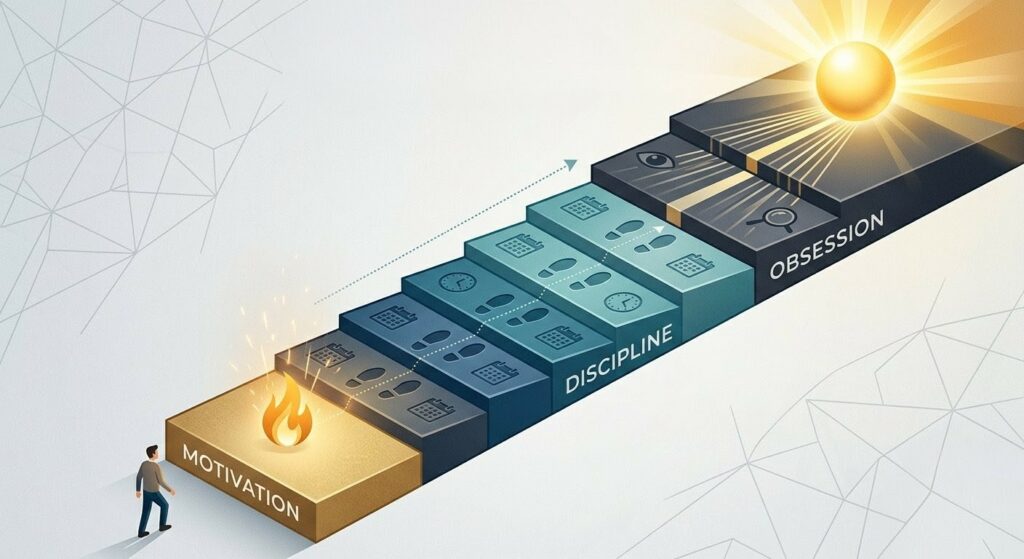
The honest answer is: none of them alone. Each force contributes something valuable. Motivation provides direction. Discipline provides consistency. Obsession provides intensity.
The problem arises when people rely on only one of them. Motivation alone often fades. Discipline alone can become mechanical and uninspiring. Obsession alone can become unhealthy and unsustainable.
The strongest approach combines all three. Motivation helps you identify what matters. Discipline helps you act on it consistently. Obsession, when healthy, helps you push beyond ordinary limits.
Rather than competing with one another, these forces work best as partners.
Why Most People Get This Backward
Most people wait for motivation before building discipline. They delay starting until they “feel ready.” This is backward. Discipline generates momentum, and momentum regenerates motivation—not the other way around. Behavioral research consistently shows that “action precedes motivation” more often than motivation precedes action. Starting a task, even reluctantly, triggers dopamine reward loops that make continuation more likely. Waiting to feel motivated first means waiting indefinitely.
Similarly, chasing obsession before building discipline is like pouring accelerant without a firebreak. The most prolific creators and builders in any field share a common trait: obsessive interest, disciplined execution. The obsession is the fuel; discipline is the container that makes that fuel useful rather than explosive.
How to Actually Build This in Your Own Life
1. Use Motivation to Set Direction, Not Schedule
When motivation appears, use it to clarify your goals and priorities. Decide what matters. Create a plan.Then build systems that continue working after the emotional excitement fades.
2. Build Discipline Through Shrinking, Not Forcing
Focus on showing up regularly rather than performing perfectly. Small actions repeated consistently are usually more effective than occasional bursts of intense effort. The goal is not perfection. The goal is repetition.
3. Let Obsession Evolve Naturally, Don’t Force It
Not every interest needs to become an obsession. Give yourself permission to explore. As your skills grow and your understanding deepens, genuine passion may emerge on its own.
4. Protect Balance
Even meaningful pursuits require rest. Sustainable success depends not only on effort but also on recovery, perspective, and maintaining a healthy relationship with your goals.

In the debate of motivation vs discipline vs obsession, discipline wins for long-term reliability. Motivation wins for getting started. Obsession wins for reaching the outer edge of what is possible in a domain but only when it is structured by disciplined habits and directed by motivational clarity.
The achievers who last are not the most fired-up at the starting line. They are the ones who showed up on Tuesday when no one was watching, when they did not feel like it, when the result was not guaranteed and they did that so many Tuesdays in a row that showing up became cheaper than not showing up. That is discipline. That is the real driver of long-term success.
Motivation gives you permission to start. Discipline gives you the infrastructure to persist. Obsession gives you the horsepower to go further than anyone thought reasonable. The order is not negotiable. The infrastructure has to come before the horsepower—or the whole machine tears itself apart.
Also Read: The Pressure of Monetizing Hobbies: Are We Forgetting How to Enjoy Things?

