


Introduction
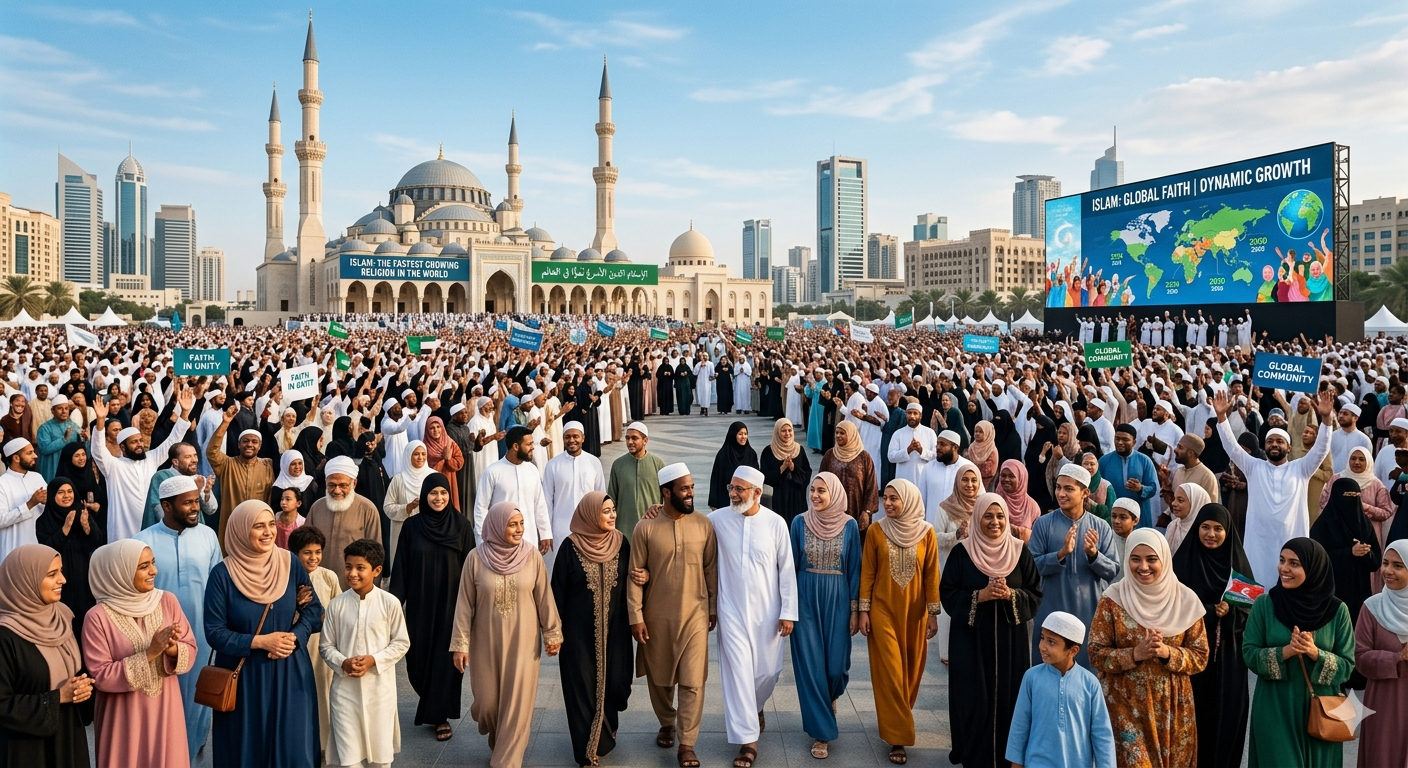
Islam is currently the fastest-growing religion in the world. According to global demographic studies, the Muslim population increased by approximately 347 million people between 2010 and 2020, making it the largest increase among all major religious groups during that period. Hindus remain the fourth-largest religious group globally, accounting for 14.9% of the world’s population.
This growth reflects broader demographic trends, including population growth rates, regional population distribution, migration patterns, and religious affiliation changes across different parts of the world.
Muslim Population Grew Significantly in the Last Decade
The global Muslim population grew by approximately 347 million people between 2010 and 2020, exceeding the combined growth of all other major religious groups during the same period.
A significant factor behind this increase is the relatively higher birth rate among Muslim populations compared to many other religious communities. Studies indicate that only a small portion of the growth can be attributed to religious conversion; most of it results from natural population growth.
Muslim populations are primarily concentrated in regions experiencing rapid demographic expansion, particularly the Middle East and North Africa (MENA) region. Muslims represent approximately 94.2% of the population in this region. Significant growth was also recorded in the Asia-Pacific region, where the Muslim population increased substantially between 2010 and 2020.
also read:Taliban’s War Against Women
Christianity Continues to Grow but Declines in Global Share
Christianity remains the world’s largest religion, with approximately 2.3 billion followers, representing about 29% of the global population. Between 2010 and 2020, the Christian population increased by approximately 122 million people. However, its overall share of the world’s population declined slightly due to faster growth among other religious groups and the religiously unaffiliated population.
The decline was particularly noticeable in Europe, North America, Australia, and New Zealand, where a growing number of people identified as having no religious affiliation. Despite these shifts, Christianity remains the dominant religion in many parts of the world.
Rise of the Religiously Unaffiliated Population
After Islam and Christianity, the third-largest category globally is the religiously unaffiliated population, often referred to as people with no religious affiliation.
This group accounts for approximately 24.2% of the world’s population. The growth of this segment has had a noticeable impact on the proportional representation of several major religions, particularly Christianity.
Many individuals within this category identify as secular, agnostic, atheist, or simply unaffiliated with any organized religion.
Buddhism and Religious Disaffiliation
Buddhism has been significantly affected by the rise in religious disaffiliation, particularly in East Asia. Between 2010 and 2020, more individuals left Buddhist identification than joined it, resulting in a decline of approximately 19 million followers worldwide. Researchers note that many people who continue to practice Buddhist traditions and cultural customs may not formally identify themselves as Buddhists in surveys.
Hindu Population: The Fourth Largest Religious Group
Hindus constitute approximately 14.9% of the global population, making Hinduism the fourth-largest religious group in the world.
The vast majority of Hindus—around 95%—live in India. Between 2010 and 2020, Hindu populations grew in several regions, including the Middle East and North Africa, where migration contributed to a growth rate of approximately 62%. In North America, the Hindu population increased by approximately 55%, largely due to immigration and demographic expansion.
Also read:Child Marriage in India: Impact, Laws, and Hope for Change
Jewish Population Growth and Distribution
The global Jewish population grew by approximately 6% between 2010 and 2020, increasing from around 14 million to 15 million people. Jews account for approximately 0.2% of the world’s population. Nearly 45.9% of the global Jewish population resides in Israel, making it the country with the highest concentration of Jewish residents worldwide.
Conclusion
Global religious demographics continue to evolve as a result of population growth, migration, changing religious identities, and regional demographic trends. Islam experienced the fastest growth between 2010 and 2020, while Christianity remained the world’s largest religion. At the same time, the rise of the religiously unaffiliated population has reshaped the global religious landscape. Understanding these demographic shifts provides valuable insight into how societies, cultures, and belief systems are changing across the world.

