


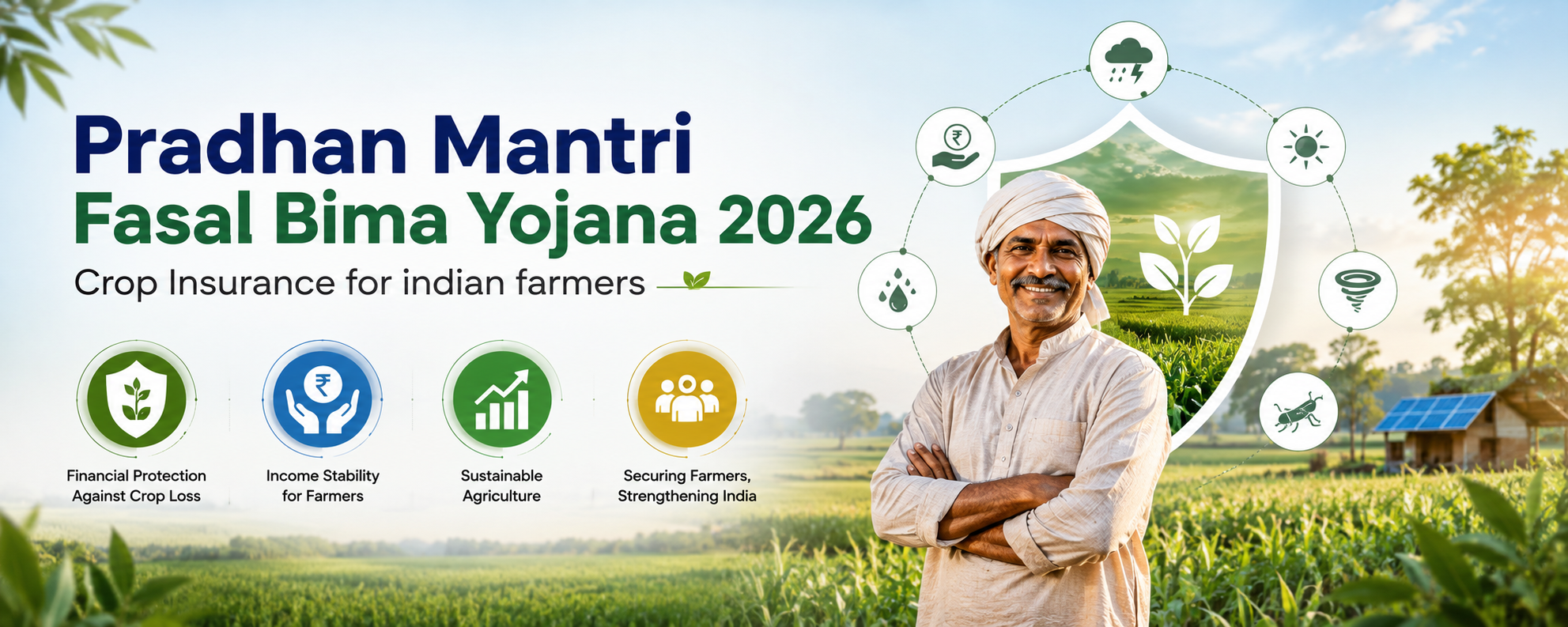
For a farmer, a crop is more than a harvest. It represents months of work, investment in seeds and inputs, repayment obligations and, in many cases, the primary source of household income. A drought, flood, cyclone, pest attack or unseasonal rainfall can therefore create a financial crisis far beyond the immediate loss in the field.
This is where crop insurance becomes important.
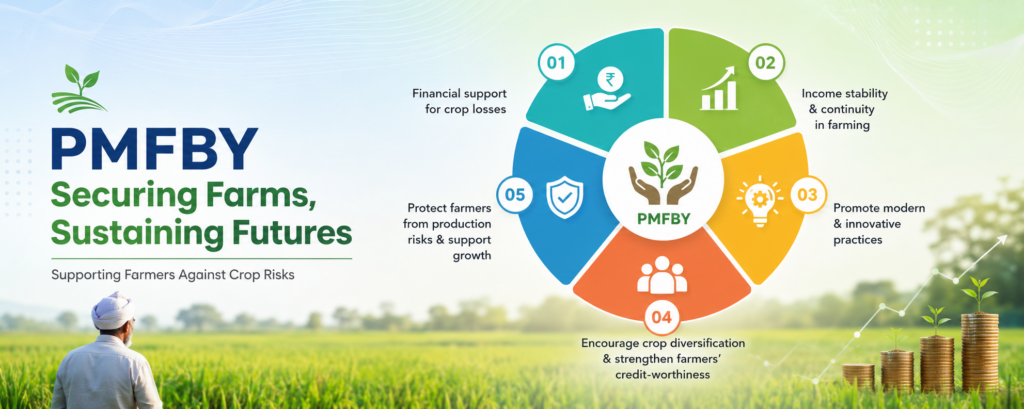
The Pradhan Mantri Fasal Bima Yojana (PMFBY) is one of India’s major crop insurance programmes, designed to provide financial protection to farmers against a range of crop-related risks. Launched in February 2016, the scheme has now completed a decade of implementation and continues to evolve through technology, digital platforms and wider risk coverage.
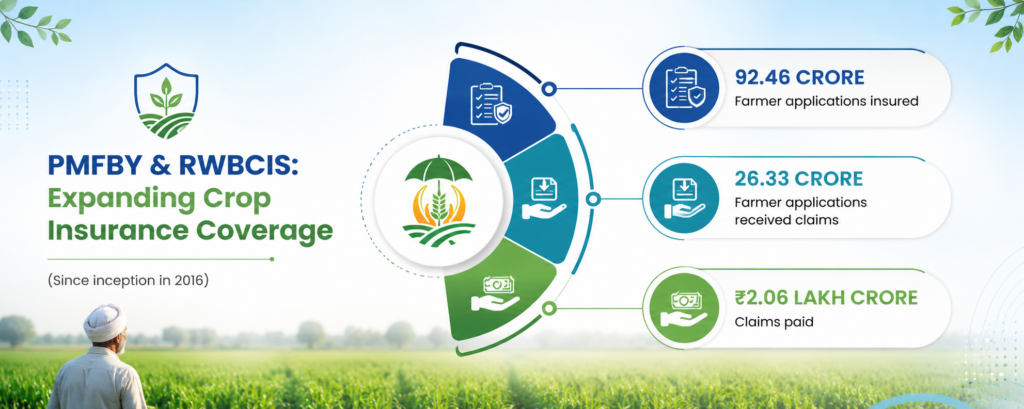
According to the latest information released by the Press Information Bureau on 29 August 2026, more than 92.46 crore farmer applications have been insured under PMFBY since Kharif 2016, while more than 26.33 crore farmer applications have received claims exceeding ₹2.06 lakh crore. For 2026–27, the Union Budget has allocated ₹12,200 crore to the scheme.
But what exactly does PMFBY cover? Who can benefit from it? How much premium does a farmer have to pay? And how are technologies such as YES-TECH and WINDS changing the way crop losses are assessed?
Here is a closer look at the scheme.
What Is Pradhan Mantri Fasal Bima Yojana?
The Pradhan Mantri Fasal Bima Yojana is a government-supported crop insurance scheme that protects farmers against financial losses caused by specified natural and climatic risks.
The scheme was launched on 18 February 2016 with the objective of bringing more farmers under crop insurance coverage and creating a more effective financial safety net for agricultural production.
Agriculture is inherently exposed to risks that farmers cannot always control. Rainfall may fall short of expectations, excessive rainfall can damage standing crops, pests and diseases can reduce yields, while cyclones, hailstorms and floods can destroy crops within hours.
PMFBY addresses these risks through insurance coverage across different stages of the crop cycle. Depending on the notified crop and applicable conditions, protection can extend from prevented sowing to standing crop losses and certain post-harvest losses.
The underlying idea is straightforward: when a farmer pays an affordable premium and suffers a covered crop loss, the insurance mechanism can provide financial compensation, helping the farmer manage the resulting income shock.
Why Is Crop Insurance Important for Farmers?
The importance of crop insurance becomes clearer when agricultural losses are viewed as a chain reaction.
A crop failure can mean lost income. That lost income can affect the farmer’s ability to repay loans, purchase seeds and fertilisers, pay farm labour or finance the next agricultural season.
Timely compensation can therefore serve as a financial bridge between one crop cycle and the next.
The government describes crop insurance as a tool that can help farmers recover from crop losses, manage income shocks and continue investing in agricultural production. It can also support greater resilience as farmers face increasingly uncertain weather and climatic conditions.
For this reason, PMFBY is relevant beyond the question of compensation. It is also part of the larger conversation around climate-resilient agriculture in India.
What Does PMFBY Cover?
One of the important features of PMFBY is that coverage can apply to different types of crop risks.
Yield losses
Standing crops can be insured against a range of non-preventable risks, including drought, dry spells, floods, inundation, cyclones, hailstorms, lightning, pests and diseases, subject to the applicable scheme conditions.
Prevented sowing
Sometimes adverse weather conditions prevent farmers from sowing their crops even after they have incurred expenses.
Under specified conditions, PMFBY provides coverage for prevented sowing. The eligible claim can be up to 25% of the sum insured.
Post-harvest losses
Crop damage does not necessarily stop being a risk once harvesting is complete.
Certain crops kept in a cut-and-spread condition for drying in the field can receive coverage for up to 14 days after harvesting against specified cyclonic and unseasonal rainfall events.
Localised calamities
PMFBY also provides coverage for specified individual farm-level losses resulting from events such as hailstorms, landslides, inundation, cloudbursts and natural fire.
However, farmers should understand that PMFBY does not cover every possible type of agricultural loss. Certain risks, including war, nuclear risks, riots, theft and specified preventable risks, are excluded. Coverage is also subject to notified areas, crops, insurance conditions and applicable timelines.
This makes it important for farmers to understand the specific notification applicable to their crop and area rather than assuming that every crop loss automatically qualifies for compensation.
How Much Premium Do Farmers Pay Under PMFBY?
Affordability is one of the defining features of PMFBY.
Farmers pay a maximum premium of:
- 2% of the sum insured for Kharif foodgrain and oilseed crops
- 1.5% for Rabi foodgrain and oilseed crops
- 5% for commercial and horticultural crops
The remaining eligible premium is subsidised by the Central and State Governments. In most states, the subsidy is shared between the Centre and the State in a 50:50 ratio. For North-Eastern and Himalayan States/UTs, the government contribution follows a 90:10 Centre-State ratio.
The objective is to keep the farmer’s share of the premium manageable while maintaining meaningful insurance protection.
Who Can Enrol Under PMFBY?
PMFBY is designed to cover both loanee and non-loanee farmers, subject to the prescribed eligibility requirements.
Tenant farmers and sharecroppers can also be covered where they meet the applicable conditions and have the required documentation or proof of cultivation.
A farmer generally needs an insurable interest in the crop and must satisfy the applicable requirements relating to land records, tenure documents or sowing certificates, depending on the state and scheme notification. Enrolment must also be completed within the specified timeframe.
Non-loanee farmers can voluntarily enrol for crop insurance. The PIB backgrounder notes that, over the past decade, around half of farmer applications on average have come from voluntary non-loanee enrolment.
This is significant because it shows that crop insurance is increasingly relevant beyond farmers who already have institutional crop loans.
PMFBY in Numbers: What Has Changed Over a Decade?
The scale of PMFBY has expanded considerably since its launch.
From Kharif 2016 through Rabi 2025–26:
- More than 92.46 crore farmer applications have been insured.
- More than 26.33 crore farmer applications have received claims.
- Claims paid have exceeded ₹2.06 lakh crore.
- PMFBY is being implemented across 25 States and Union Territories in Kharif 2026.
The latest Kharif figures also show continued expansion.
In Kharif 2025, crop insurance covered 229.77 lakh farmers across 269.38 lakh hectares.
By 27 August 2026, Kharif 2026 enrolment had reached 241.38 lakh farmers, covering 278.12 lakh hectares. This means both farmer enrolment and insured area had already exceeded the corresponding Kharif 2025 levels.
For Kharif 2025, claims amounting to ₹9,837.61 crore had already been paid to 60.89 lakh eligible farmers.
The scheme also reached an all-time high in national enrolment during 2024–25, with more than 15.23 crore farmer applications, covering more than four crore farmers and over 623 lakh hectares.
Also Read: Effective Strategies for Promoting Sustainable Agriculture
Technology Is Changing How Crop Insurance Works
One of the biggest developments in PMFBY is the increasing use of digital technology.
Traditional crop insurance processes can involve extensive field-level assessment and coordination among farmers, government agencies, financial institutions and insurance companies.
PMFBY is increasingly using digital systems to improve this process.
National Crop Insurance Portal
The National Crop Insurance Portal (NCIP) acts as a central digital platform for several aspects of the scheme.
It supports farmer enrolment, subsidy administration, coordination, dissemination of information, claim calculations and electronic transfer of eligible claims.
The integration of state land records with NCIP is also helping validate insured land parcels and areas.
As of the latest PIB update, around 85% of the insured area in the states where digital land-record integration is being implemented had been validated through integrated land records.
DigiClaim
The DigiClaim module, introduced in Kharif 2022, enables digital calculation and settlement of claims through NCIP.
The system allows claims to be processed digitally and paid through the Public Finance Management System.
According to the government, more than ₹55,000 crore in claims have been calculated and paid through the digital platform since its introduction.
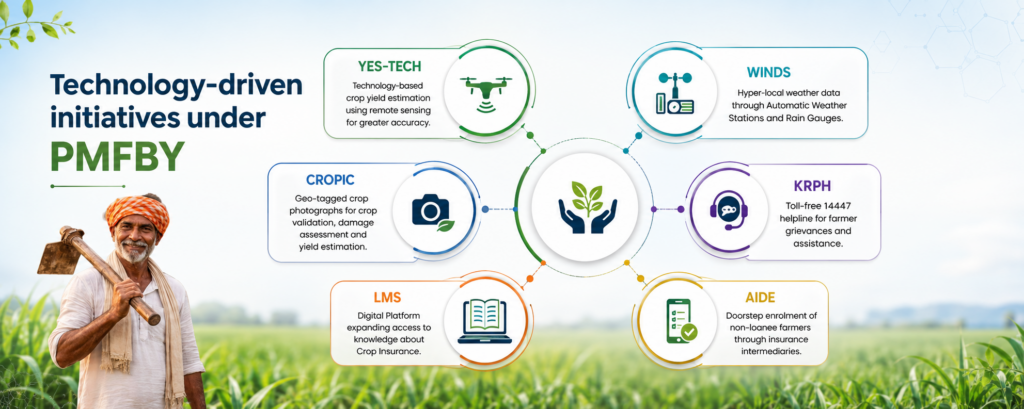
YES-TECH
The Yield Estimation System Based on Technology (YES-TECH) uses technology and remote-sensing-based methods to improve crop-yield estimation.
It was introduced for paddy and wheat in Kharif 2023 and soybean in Kharif 2024. The technology initially carried at least 30% weightage in relevant yield estimation and has now reached up to 50% in certain states.
The broader goal is to make yield estimation more data-driven and improve the accuracy and fairness of claim assessment.
WINDS
The Weather Information Network and Data System (WINDS) focuses on collecting hyperlocal weather information.
Automatic Weather Stations and Automatic Rain Gauges provide weather data at the Block and Gram Panchayat levels.
This information can support crop insurance, disaster management, weather forecasting and weather-based insurance products.
Such systems matter because agricultural risks can vary significantly even between nearby locations. More granular weather data can therefore help create a stronger evidence base for assessing weather-related risks.
What Is CROPIC?
Another technology initiative mentioned in the latest PMFBY update is CROPIC — Collection of Real-time Photos and Observations of Crops.
The system uses geo-tagged photographs to periodically capture information about crop health within an insurance unit.
The technology is also being explored for crop-damage assessment and yield estimation through image-based analytics, with nationwide pilots being initiated.
This reflects a larger shift in agricultural risk management: photographs, location data, weather information and remote sensing are increasingly becoming part of the evidence used to understand crop conditions.
How is PMFBY Handling Farmer Grievances?
Insurance becomes meaningful only when farmers can seek assistance when something goes wrong.
To address this requirement, the Krishi Rakshak Portal & Helpline (KRPH) provides a dedicated toll-free number, 14447, for crop-insurance-related grievances and assistance.
The service was launched nationally in January 2024.
According to the latest PIB data, more than 26.12 lakh grievances from insured farmers had been addressed and resolved, with a reported resolution rate of 99.66%.
Digital grievance systems can be particularly important for farmers who may otherwise struggle to navigate multiple institutions involved in insurance claims.
What Do the Latest State-Level Trends Show?
The national picture becomes more interesting when individual states are examined.
Some major agricultural states have increased their participation in PMFBY in recent years.
Andhra Pradesh rejoined the scheme from Kharif 2022, Jharkhand from Kharif 2024 and West Bengal from Kharif 2026. Bihar has also decided to return to PMFBY from the Rabi 2026–27 season.
At the same time, enrolment patterns in Maharashtra and Andhra Pradesh have been affected by changes in their implementation models.
The PIB notes that both states had previously followed a universalisation approach in which the state government paid the entire premium for farmers. When that 100% premium support was discontinued in 2025, enrolment declined.
However, Andhra Pradesh saw a strong recovery in Kharif 2026, with 16.22 lakh farmers enrolled by 28 August 2026, representing a 108% increase over Kharif 2025.
In Maharashtra, 42.55 lakh farmers had enrolled by the same date, equivalent to 92% of its Kharif 2025 enrolment.
Other major agricultural states recorded strong growth in Kharif 2025. Uttar Pradesh saw a 35% increase in insured farmers, Haryana 20%, Rajasthan 19% and Madhya Pradesh 12%, according to the PIB backgrounder.
These variations show why national enrolment figures should always be read alongside state-level implementation policies.
PMFBY and India’s Climate-Resilient Agriculture
Climate variability has made agricultural risk management increasingly important.
Farmers face multiple uncertainties: changing rainfall patterns, extreme weather events, heat, floods, droughts, pests and diseases.
Crop insurance cannot prevent these events. Its role is different: it can help reduce the financial consequences when a covered event damages the crop.
PMFBY’s evolution towards digital land records, technology-based yield estimation, hyperlocal weather data, geo-tagged crop observations and digital claims processing reflects this changing agricultural environment.
The scheme is therefore becoming part of a broader ecosystem of climate-resilient agriculture, where financial protection works alongside better weather information, improved farming practices, irrigation, technology and access to agricultural services.
PMFBY and the Future of Farmer Risk Protection
A decade after its launch, PMFBY has developed into a large-scale crop insurance framework with millions of farmer applications and substantial claims payouts.
Its next phase will depend on how effectively technology can improve three areas: accurate assessment, timely settlement and easy access for farmers.
The latest developments suggest that digital systems will play an increasingly important role.
YES-TECH can contribute to technology-based yield estimation. WINDS can provide more granular weather information. CROPIC can support crop-health monitoring. NCIP and DigiClaim can strengthen digital administration and claim processing. The KRPH helpline provides an additional channel for farmer grievances.
For farmers, however, the success of crop insurance ultimately comes down to a practical question: does the system provide meaningful financial support when a crop is damaged?
That is why awareness is just as important as enrolment. Farmers need to know which crops and areas are notified, what risks are covered, what documents are required, when premiums need to be paid and how claims and grievances can be raised.
Frequently Asked Questions About PMFBY
What is PMFBY?
PMFBY stands for Pradhan Mantri Fasal Bima Yojana. It is a government-supported crop insurance scheme launched in 2016 to provide financial protection against specified crop losses caused by natural and climatic risks.
How much premium does a farmer pay under PMFBY?
Farmers pay a maximum premium of 2% for Kharif foodgrain and oilseed crops, 1.5% for Rabi foodgrain and oilseed crops, and 5% for commercial and horticultural crops, subject to the applicable scheme provisions.
Does PMFBY cover floods and droughts?
Yes. Specified losses caused by risks such as drought, floods, inundation, cyclones, hailstorms, pests and diseases can be covered, subject to notified crops, areas and scheme conditions.
Are tenant farmers eligible for PMFBY?
Tenant farmers and sharecroppers can be covered under PMFBY where they meet the prescribed eligibility and documentation requirements.
What is YES-TECH?
YES-TECH stands for Yield Estimation System Based on Technology. It uses technology and remote sensing to support crop-yield estimation for crop insurance.
What is the PMFBY helpline number?
The Krishi Rakshak Portal & Helpline provides assistance for crop-insurance-related grievances through the toll-free number 14447.
To conclude, The risks faced by Indian farmers are changing, and crop insurance has to change with them.
The Pradhan Mantri Fasal Bima Yojana has moved beyond a conventional insurance framework by increasingly incorporating digital land records, technology-based yield estimation, weather data, geo-tagged crop observations and digital claim processing.
The latest figures show the scale of this system: more than 92.46 crore farmer applications insured since the scheme began, more than ₹2.06 lakh crore in claims paid and continued expansion of coverage in Kharif 2026.
Yet the real value of PMFBY lies at the farm level. When an unexpected climate event damages a farmer’s crop, timely financial support can help protect income, reduce financial stress and make it possible to prepare for the next season.
As India works towards a more climate-resilient agricultural economy, accessible and responsive crop insurance will remain an important part of that transition.
Also Read: Farmer-to-Farmer Extension System

