



There was a time when making friends felt effortless.
You sat next to someone in class. You shared lunch during recess. You ended up talking after practice. Before you knew it, they were part of your everyday life. Friendship happened almost by accident.
Then adulthood arrived. Somewhere between careers, rent, relationships, and endless to do lists, these bonds stopped forming on their own. They became something we had to build on purpose. Strangely, almost no one taught us how.
If you have ever looked around and wondered why is it so hard to make friends as an adult, you are far from alone. Adult loneliness has become common enough that researchers now track it as a public health concern, not just a personal feeling.
Table of Contents

Why Adult Friendships Feel So Different
As kids and teenagers, we are surrounded by people our own age every single day. School hands us the same faces again and again without any effort on our part. Adults do not get that luxury.
Workplaces can feel competitive rather than social. Remote work has quietly erased the small talk that used to happen by the coffee machine. After a long day, most people come home tired, with little energy left to meet anyone new.
The result is straightforward. It reduces opportunities for the repeated, low-pressure interactions that are essential for friendship to develop.
Everyone Is Busy, Including You
One of the biggest obstacles to making friends as an adult is not a lack of interest.
It is time. People are juggling careers, family duties, money stress, personal goals, and their own mental health. Even when someone genuinely wants to see the people they care about, their calendar often says otherwise.
These connections quietly lose out to deadlines and obligations, week after week, until months have passed without a single real conversation.

Social Media Creates the Illusion of Connection
We are more connected online than any generation before us. Yet adult loneliness keeps climbing. Scrolling through updates, liking a photo, or reacting to a story can keep a friendship on life support, but it rarely replaces sitting across from someone and actually talking. Technology makes it easy to know what someone is doing without ever being part of it. Watching a life from a screen is not the same as sharing one.
We Become More Careful With Trust
Kids often bond within hours of meeting. Adults carry history. Disappointments, betrayals, heartbreak, and shifting values make us more selective about who gets close. Healthy boundaries protect us, but they can also make ordinary vulnerability feel like a risk.
A real connection still asks for openness, even when past experience makes that harder to offer.

Life Pulls People in Different Directions
Adulthood is not a shared path the way school was.
One gets married. Another moves abroad. Someone becomes a parent while someone else changes careers entirely. Some people chase travel while others are focused on saving every extra rupee or dollar.
These shifts naturally reshape our closest ties, even when nobody has done anything wrong. Growing apart is sometimes just part of growing up, not a sign that anything failed.
Signs of Healthy Adult Friendships
Not every connection needs to look the same, but the strongest ones tend to share a few things in common.
You can be honest without rehearsing it first
You do not need to plan out what to say before a conversation. There is no script running in your head, no worry about how a sentence will land. You can bring up something that is bothering you and trust that it will not change how the other person sees you. Disagreements do not threaten the friendship because both people know the relationship can hold a little friction. Even an awkward or blunt comment gets absorbed instead of remembered forever. That kind of ease usually only shows up once real trust has had time to build.

The relationship survives long gaps
Life gets busy, jobs change, cities change, and weeks can turn into months without a proper conversation. In a healthy friendship, that gap does not create distance that feels impossible to close. You pick up the call and within a few minutes it feels like no time has passed at all. Neither person keeps a mental tally of who reached out last or who owes a reply. There is no guilt trip waiting on the other end, only genuine catching up. This kind of resilience is often the clearest sign that a friendship has moved past convenience and into something more lasting.
Support flows both ways
You show up for them during a hard week, and when your turn comes, they show up for you just as fully. Neither person is quietly keeping score, tracking favors, or waiting to be repaid for their effort. Support in a healthy friendship looks like celebrating a win without a hint of comparison and sitting with someone through a bad day without trying to fix it immediately. It also means being able to ask for help without feeling like a burden. Over time, this balance is what keeps a friendship from tipping into something one sided or exhausting for either person.
You feel more like yourself around them, not less
A good bond does not ask you to perform a better or more polished version of who you are. You can be tired, unfiltered, or in a bad mood and still feel welcome in the conversation. There is no pressure to keep up an image or filter your opinions to avoid judgment. Around the right people, your sense of humor, your odd habits, and your honest reactions all get room to exist without apology. That comfort tends to build slowly, through small ordinary moments rather than big dramatic ones. When a relationship gives you that kind of space, it is usually built to last.
Also Read: Social Wellness Month July: Strengthening Relationships for a Healthier, Happier Life

Why Friendship Still Matters
Friendship is not only about having someone to spend a Saturday with.
Research consistently links strong social bonds to lower stress, better mental health, improved physical health, and even a longer life. But the numbers only tell part of the story. What they cannot fully capture is the quiet relief of texting someone at midnight and knowing they will actually reply. Or calling a friend after a hard day and feeling lighter before the conversation even ends.
Think about the last time someone really listened to you, not to respond, not to fix anything, just to understand. That feeling does not come from a like or a comment. It comes from a person who chose to show up for you, again and again, without needing a reason.
A trusted friend offers something social media cannot fake, which is a place where you can be completely yourself without an audience. No filters, no highlight reel, just the ordinary and unpolished version of your life, and someone who stays anyway.
Maybe that is what makes friendship so quietly powerful. It is not the grand gestures or the big celebrations. It is the small, steady presence of someone who remembers how you take your coffee, who checks in without being asked, who makes the hard days feel a little less heavy simply by being there.

How to Start Making Friends as an Adult
The good news is that adult friendships are absolutely still possible. They just need more intention than they used to.
Show up consistently. A fitness class, a volunteer group, a book club, or a local event works because repeated exposure creates familiarity, and familiarity is where friendship starts.
Take small social risks. Invite a coworker for coffee. Send the first message after an event. Follow up on a conversation that actually went somewhere.
Be curious instead of impressive. People remember how you made them feel far more than how accomplished you sounded.
Accept that not every connection becomes a close friendship. Like dating, this involves timing, compatibility, and a fair amount of patience.
Most importantly, invest in the friendships you already have. A short check in message or a quick phone call can keep a bond alive that might otherwise fade quietly in the background.
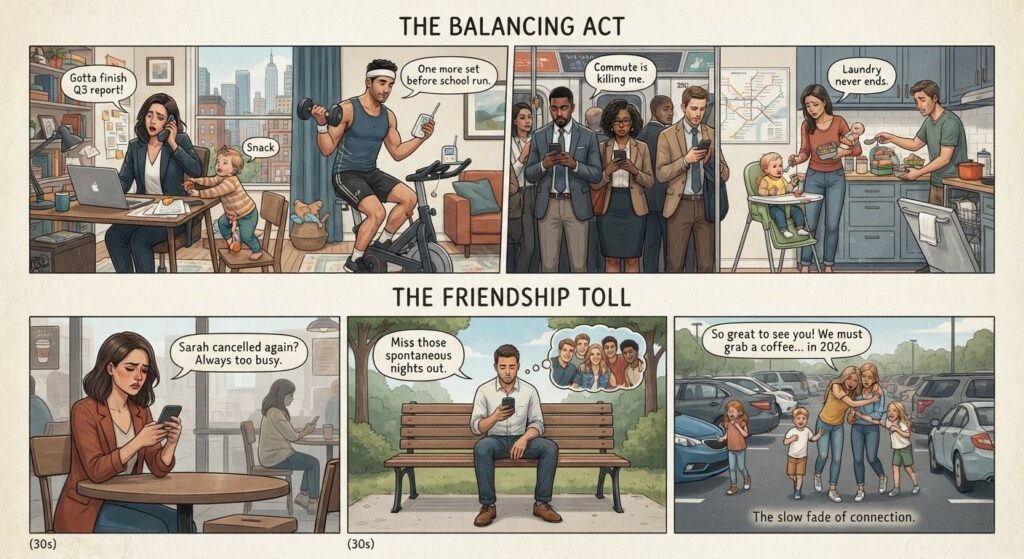
Friendship Is Worth the Effort
Adult friendship may feel difficult not because people have become less caring, but because life has simply become more complicated.
Meaningful connections rarely happen by accident anymore. They grow through consistency, honesty, and shared experience over time. They ask a little more of us now than they used to, a text sent first, a plan actually followed through, a willingness to stay in touch even when it would be easier not to.
But that effort is rarely wasted. Somewhere out there is someone who is also tired of surface level conversations, also craving a friendship that feels real, also wondering if it is too late to build something meaningful. It is not too late. It never really is.
The people you are looking for may be looking for the exact same thing. Sometimes all it takes is one person willing to make the first move, one message sent, one invitation extended, one small act of courage that turns a stranger or an acquaintance into someone who truly matters.
So if a name has crossed your mind while reading this, that might be your sign to reach out. You may just be exactly what someone else needed too.

Frequently Asked Questions
Why is it so hard to make friends as an adult?
Adult life removes the built in structure that childhood and school once provided. Without repeated, low effort interactions with the same people, friendships need deliberate effort to form and grow.
What are the signs of healthy adult friendships?
Honest communication, support that flows both ways, comfort with long gaps between contact, and feeling like yourself around the other person are strong signs of a healthy friendship.
Can adult loneliness really affect physical health?
Yes. Research links chronic loneliness to higher stress levels, weaker immune response, and increased risk of conditions like heart disease, alongside its impact on mental health.

Where is the best place to start making friends as an adult?
Recurring settings work best. Fitness classes, volunteer groups, book clubs, professional networks, or hobby based communities all create the repeated contact that friendship needs to develop.
How long does it usually take to build a close adult friendship?
Studies on adult friendship formation suggest it can take anywhere from 50 to over 200 hours of shared time before a connection becomes a genuinely close friendship, depending on the depth of interaction.
Is it normal to lose friends as you get older?
Yes. Changing priorities, locations, and life stages naturally shift friendships. Losing touch with someone does not always mean the friendship failed, it often just means life took different paths.
Also Read: Why Students Feel Lost in Their 20s (And No One Talks About It)

