


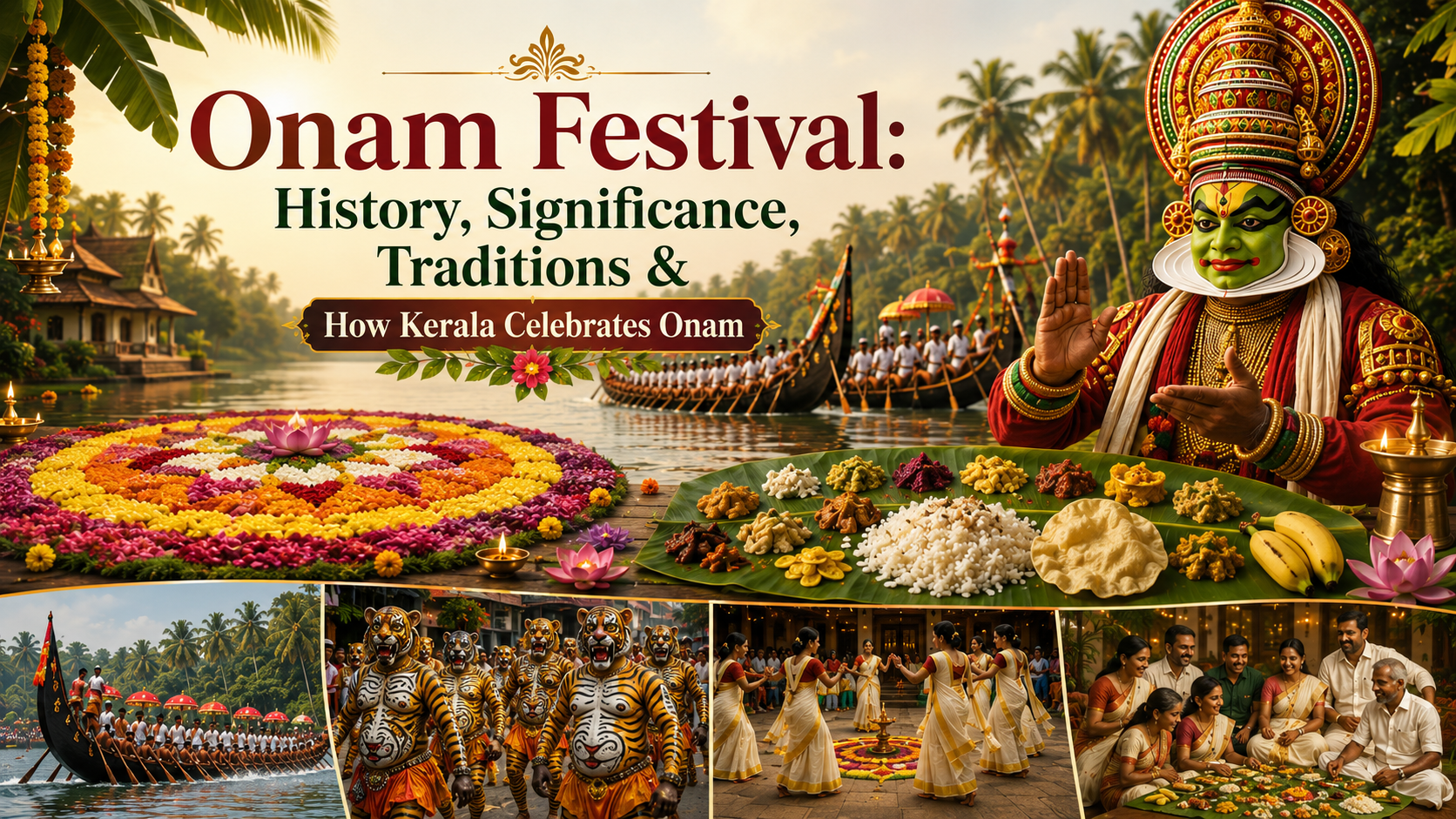
There are festivals that arrive on a particular date, and then there are festivals that create an entire season of memories. Onam is one of them. Celebrated primarily in Kerala during the Malayalam month of Chingam, Onam brings together stories of a legendary king, colourful Pookalam designs, traditional music and dance, boat races, new clothes, family gatherings and the much-loved Onam Sadya.
At the heart of the Onam festival is the story of King Mahabali, whose annual return is remembered with warmth and celebration. Onam is also closely connected with Kerala’s agricultural traditions, marking a season associated with harvest, prosperity and abundance. Kerala Tourism describes it as both a celebration of Mahabali and an agricultural festival representing joy and prosperity.
In 2026, Thiruvonam falls on 26 August, marking the most important day of the 10-day Onam celebration.
But what makes Onam so significant? What is the story behind Mahabali? Why do people make Pookalam? And what makes an Onam Sadya such an important part of the celebration?
Here’s everything you need to know about the Onam festival, its history, significance, traditions and celebrations in Kerala.
Table of Contents
What Is Onam?
Onam is Kerala’s major harvest and cultural festival, celebrated over a period of 10 days beginning with Atham and culminating in Thiruvonam. The festival falls during Chingam, the first month of the Malayalam calendar, which generally corresponds to August–September.
The festival is traditionally associated with the annual return of King Mahabali, a legendary ruler remembered for his generosity and for the prosperous period associated with his reign. According to the popular legend, Mahabali was granted permission to return and visit his people once every year. Onam celebrates this homecoming.
At the same time, Onam has a strong agricultural connection. The arrival of Chingam follows the difficult monsoon month of Karkidakam and traditionally represents a period of hope and prosperity for farming communities.
This combination of mythology, harvest traditions, food and community celebrations gives Onam a cultural identity that extends far beyond a single religious ritual.
Why Is Onam Celebrated?
The central question behind the Onam festival is closely connected with the story of King Mahabali.
Mahabali is remembered in Kerala’s popular tradition as a powerful and generous ruler whose kingdom was associated with prosperity and equality. The legend says that during his reign, his people lived happily and there was little distinction between the wealthy and the poor.
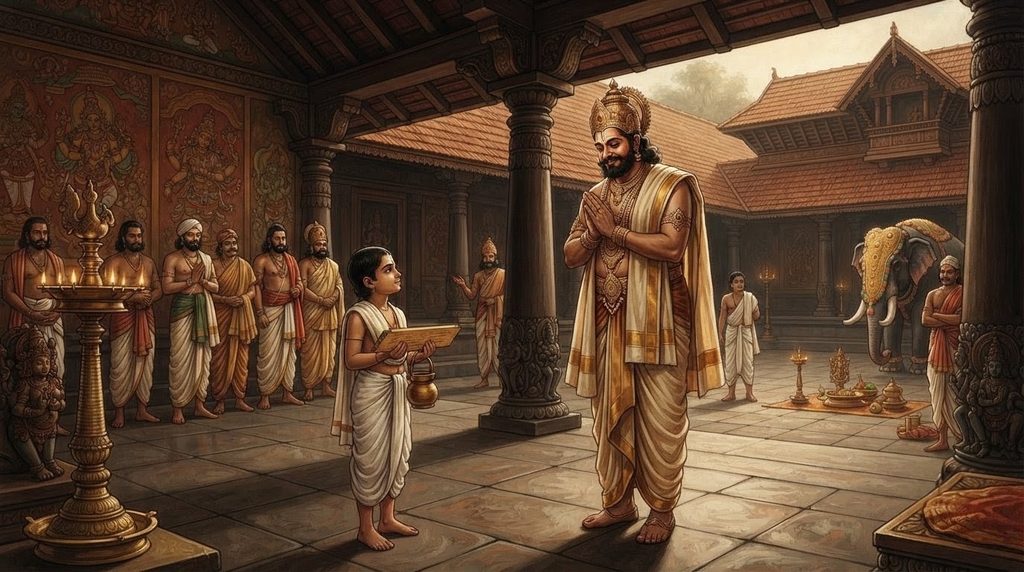
His growing influence eventually concerned the gods. Lord Vishnu appeared in the form of Vamana, a dwarf Brahmin, and approached Mahabali seeking three paces of land.
Mahabali agreed.
Vamana then grew into a gigantic form. With his first two steps, he covered the earth and the heavens. When there was nowhere left for the third step, Mahabali offered his own head.
The story concludes with Mahabali being sent to the netherworld, but because of his devotion and the affection of his people, he was granted permission to return once a year.
That annual homecoming is traditionally associated with Onam.
The legend is therefore central to understanding why Onam is celebrated. Every year, homes are prepared, floral decorations are created and families come together to welcome the memory of their beloved king.
The Story of King Mahabali & Onam
The story of Mahabali gives Onam much of its emotional character.
Rather than remembering a king simply as a figure from the past, the festival treats his return as a joyful occasion. The preparations associated with Onam create the feeling that an honoured guest is coming home.
This is one reason why the festival is so strongly associated with cleanliness, decoration, new clothes, flowers, food and family gatherings.
Kerala Tourism describes Onam as a celebration of the myth of Mahabali, who is believed to visit his former subjects during this season.
The Mahabali story also explains why ideas such as prosperity, generosity, equality and community are often associated with Onam.
Over time, the story has become part of Kerala’s cultural memory and is celebrated by Malayalis across communities. Kerala Tourism notes that Thiruvonam is celebrated irrespective of caste and religion.
When Is Onam Celebrated?
Onam follows the Malayalam calendar and is observed during the month of Chingam.
The celebration begins with Atham and culminates in Thiruvonam, the most important day of the festival.
When is Onam 2026?
In 2026, Thiruvonam falls on Wednesday, 26 August. The 10-day celebrations began with Atham on 16 August and culminate with Thiruvonam on 26 August.
While Thiruvonam is the central day, the festive atmosphere develops throughout the preceding days. Pookalam designs grow larger, homes become busier, families prepare for the feast and cultural events take place across Kerala.
What Are the 10 Days of Onam?
The 10 days of Onam begin with Atham and end with Thiruvonam.
The traditional sequence is:
- Atham
- Chithira
- Chothi
- Vishakam
- Anizham
- Thriketta
- Moolam
- Pooradam
- Uthradam
- Thiruvonam
Each day contributes to the growing festive atmosphere.
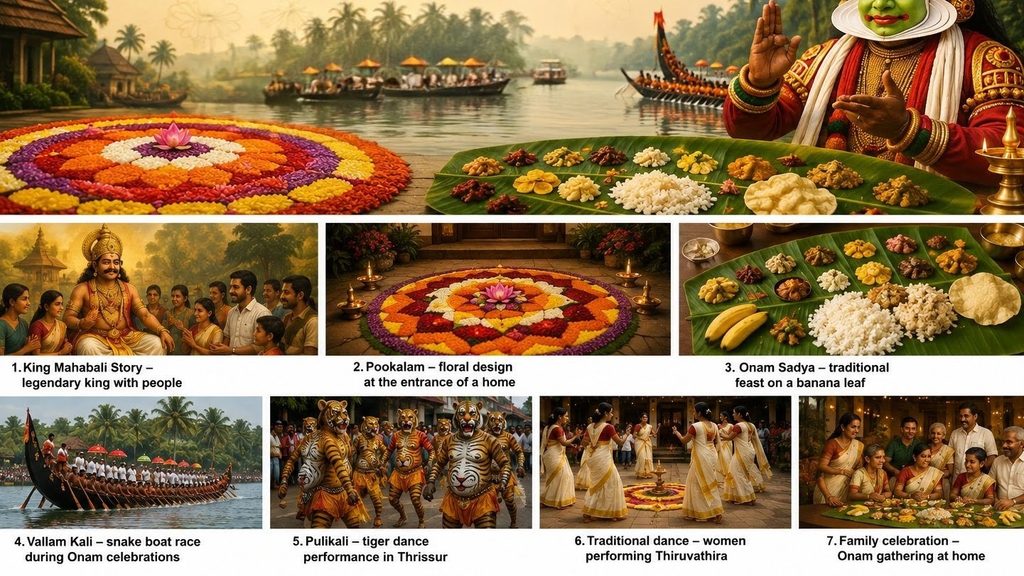
One of the most recognisable traditions is the gradual development of the Pookalam, the floral design made in front of homes. The design becomes increasingly elaborate as the days progress, with the largest Pookalam traditionally associated with Uthradam.
Thiruvonam is the culmination of the celebration, bringing together the most important family, food and cultural traditions of the festival.
Also Read: Beautiful places to visit in South India
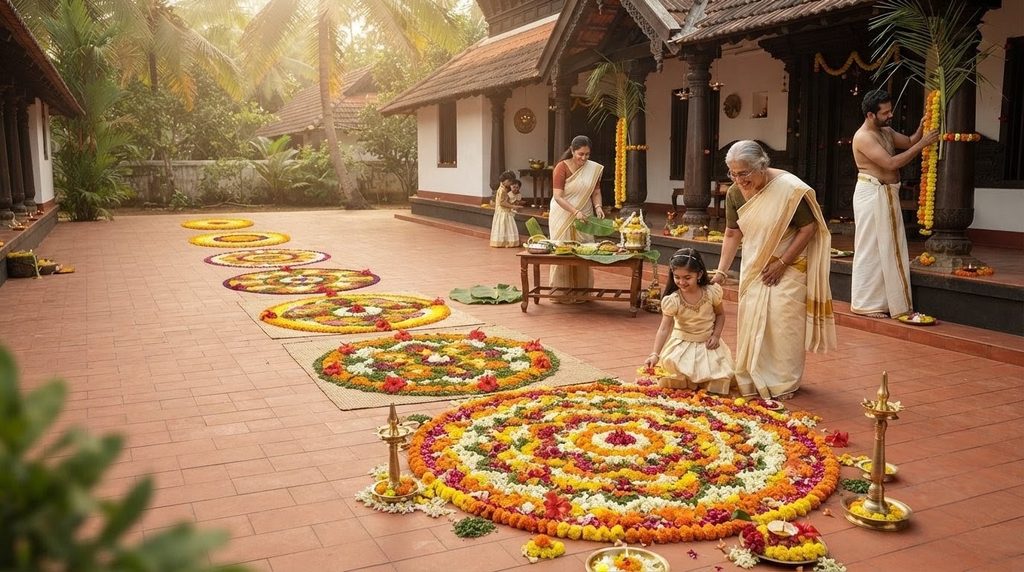
Pookalam: The Floral Art of Onam
Walk through Kerala during Onam and one of the first things you are likely to notice is a burst of colour at the entrance of homes.
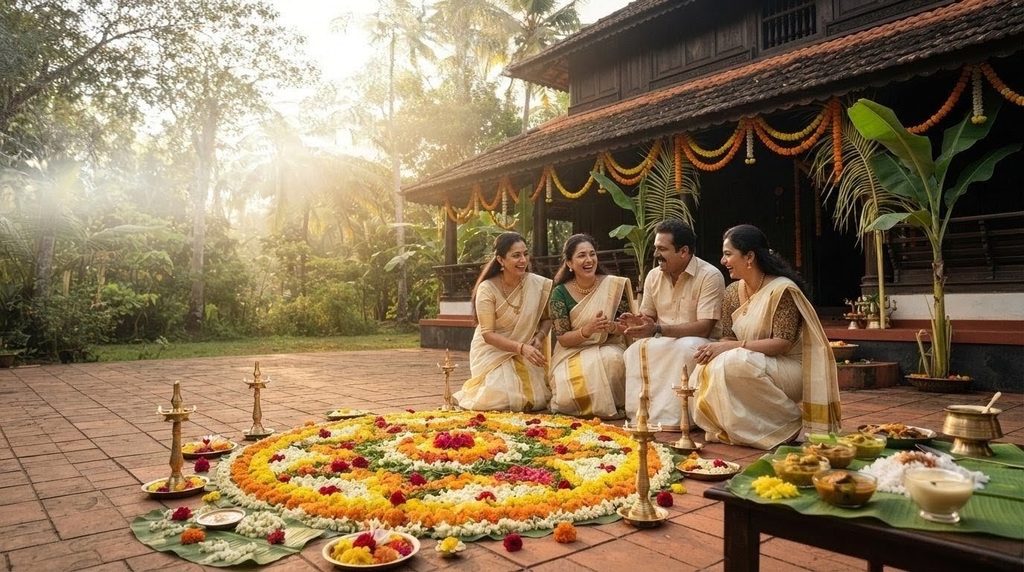
This is Pookalam, a traditional floral arrangement created using fresh flowers.
The word combines poo, meaning flower, and kalam, referring to a design or arrangement. Pookalam is much more than a decorative element. It forms an important part of the visual identity of the Onam celebration.
Families traditionally create Pookalam designs throughout the 10-day festival, adding new layers and patterns as Onam approaches.
The entrance of the home becomes a space for creativity, colour and anticipation. Children and adults often participate together, making the tradition an experience shared across generations.
At Thrikkakara, one of the important centres associated with Onam traditions, Pookalam is prepared throughout the 10-day celebrations.
For many families, the process of gathering flowers and designing the Pookalam is as meaningful as the finished artwork.
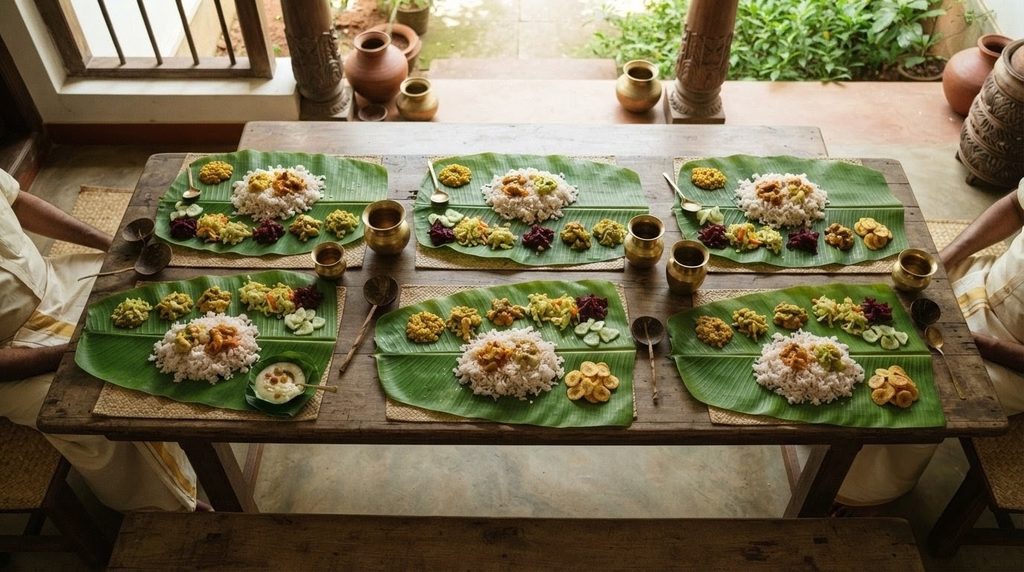
Onam Sadya: The Feast at the Heart of the Festival
If Pookalam gives Onam its colour, Onam Sadya gives it one of its most memorable flavours.
Sadya is the traditional vegetarian feast associated with Onam. It is generally served on a banana leaf and brings together a wide variety of preparations.
Depending on the household and region, an Onam Sadya may include rice, parippu, sambar, avial, olan, thoran, pickles, banana chips, sharkara varatti, pachadi, payasam and several other dishes.
The variety is part of the experience.
The meal is traditionally enjoyed as a communal occasion, with family and guests sitting together and sharing the same feast. Recent 2026 coverage of Onam Sadya continues to highlight the importance of the order of serving and the traditional banana-leaf presentation.
Sadya also reflects the abundance associated with the festival. Different tastes and textures come together on one leaf, turning a meal into an expression of Kerala’s culinary heritage.
And there is a deeper idea behind the feast: Onam brings people together around the same table.
How Is Onam Celebrated in Kerala?
The Onam festival in Kerala combines household traditions with large public celebrations.
Homes are cleaned and decorated. People wear new clothes, prepare traditional food and create Pookalam. Families gather together, while communities organise cultural programmes, games, performances and public events.
Some of the best-known traditions include:
Vallam Kali
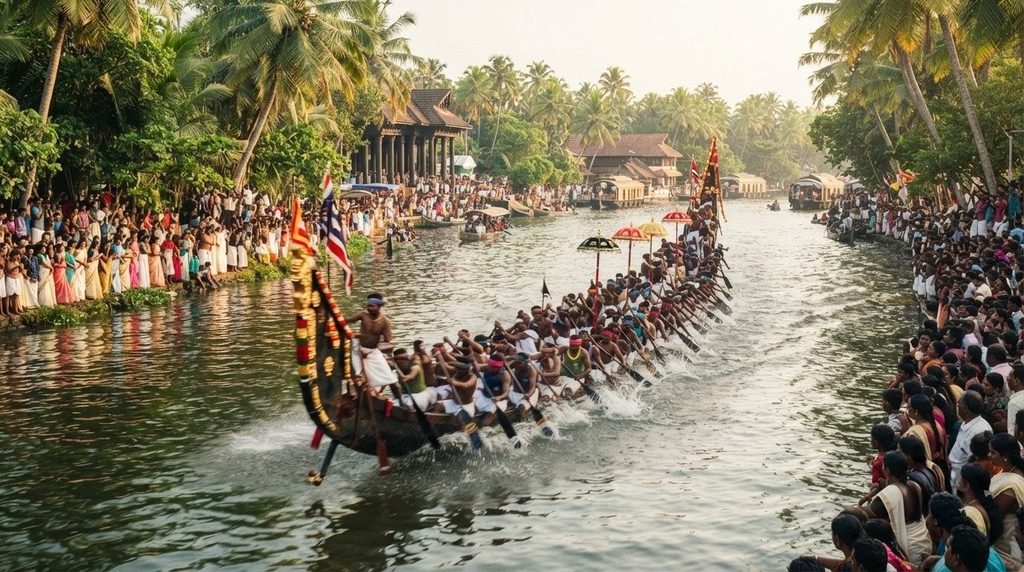
Vallam Kali, or traditional snake boat racing, is one of the most spectacular events associated with the Onam season.
Long, narrow boats move across Kerala’s waterways in coordinated races, with teams rowing together to the rhythm of songs and drums.
The races capture the collective spirit of the festival: dozens of people have to work in complete coordination for the boat to move forward.
Kerala Tourism identifies Vallam Kali as one of the defining attractions of the Onam season.
Pulikali
Pulikali, literally associated with the image of tigers, is a colourful folk performance particularly associated with Thrissur.
Performers paint their bodies and dress as tigers and hunters before taking part in lively public processions.
The tradition adds a playful and theatrical element to Onam celebrations.
In 2026, Kerala Tourism’s festival calendar lists the Pulikali event at Swaraj Round in Thrissur for 29 August.
Traditional Dance & Music
Onam celebrations also feature traditional performances, songs and community gatherings.
Forms of dance and cultural performance associated with Kerala’s heritage become especially visible during the festival season, giving Onam a strong connection with the state’s performing arts.
New Clothes
Wearing new clothes is another familiar part of Onam.
Families traditionally purchase new clothes for the festival, adding another layer of renewal to the celebration. For many people, putting on new clothes on Thiruvonam morning is connected with childhood memories, family rituals and the excitement of the festive day.
What Is the Significance of Onam?
The significance of Onam goes beyond the story of one king.
At its heart, the festival brings together several ideas:
- Prosperity: Onam is closely connected with harvest and abundance.
- Community: Families, friends and neighbours come together during the celebration.
- Generosity: The story of Mahabali keeps the idea of a generous ruler alive in cultural memory.
- Gratitude: The harvest connection creates a natural association with appreciation for the land and its produce.
- Cultural identity: Food, clothing, flowers, music, dance and traditional games help preserve Kerala’s cultural heritage.
This is also why Onam has travelled far beyond Kerala. Malayali communities around the world continue to organise celebrations, prepare Sadya and recreate Pookalam even when they are far from home. Recent reporting on the 2026 festival has highlighted how diaspora communities adapt these traditions while maintaining their cultural connection with Kerala.
Onam Beyond Kerala
Today, Onam is celebrated by Malayalis across India and around the world.
The festival may look different in different places. A family living outside Kerala may create a smaller Pookalam. A community organisation may organise a shared Sadya. Cultural associations may arrange performances or celebrations for people who cannot travel home.
The details can change, but the central feeling remains familiar: coming together, remembering home and celebrating abundance.
This adaptability has helped Onam remain relevant across generations.
For someone who grew up in Kerala, it can mean childhood memories of flowers, Sadya and family gatherings. For someone living away from home, it can become a way of reconnecting with their culture. And for someone discovering the festival for the first time, it offers a glimpse into Kerala’s rich traditions.
Why Onam Still Matters Today
Festivals survive when their traditions continue to mean something to the people celebrating them.Onam has managed to do that by combining heritage with everyday experiences.
A Pookalam turns flowers into art. A Sadya turns food into a shared experience. A boat race turns teamwork into spectacle. A story about a legendary king becomes a reminder of generosity and community.
Even as celebrations evolve, these ideas remain relevant.
That may be the reason Onam continues to feel both traditional and contemporary. The decorations can change, celebrations can move online and communities can adapt their rituals to new places, but the basic idea of coming together to celebrate prosperity and belonging remains.
Also Read: Communication Skills in 2026: Why They Matter & How to Improve Them

