

Communication skills have become one of the most important skills to develop in 2026. Whether you are a student, working professional, entrepreneur, freelancer, job seeker, or business owner, the way you communicate can directly influence your opportunities, relationships, career growth, and professional reputation.
The workplace has changed significantly in recent years. People now communicate through emails, instant messaging, video meetings, social media, presentations, collaborative platforms, and AI-powered tools. This means communication is no longer limited to speaking confidently in a face-to-face conversation.
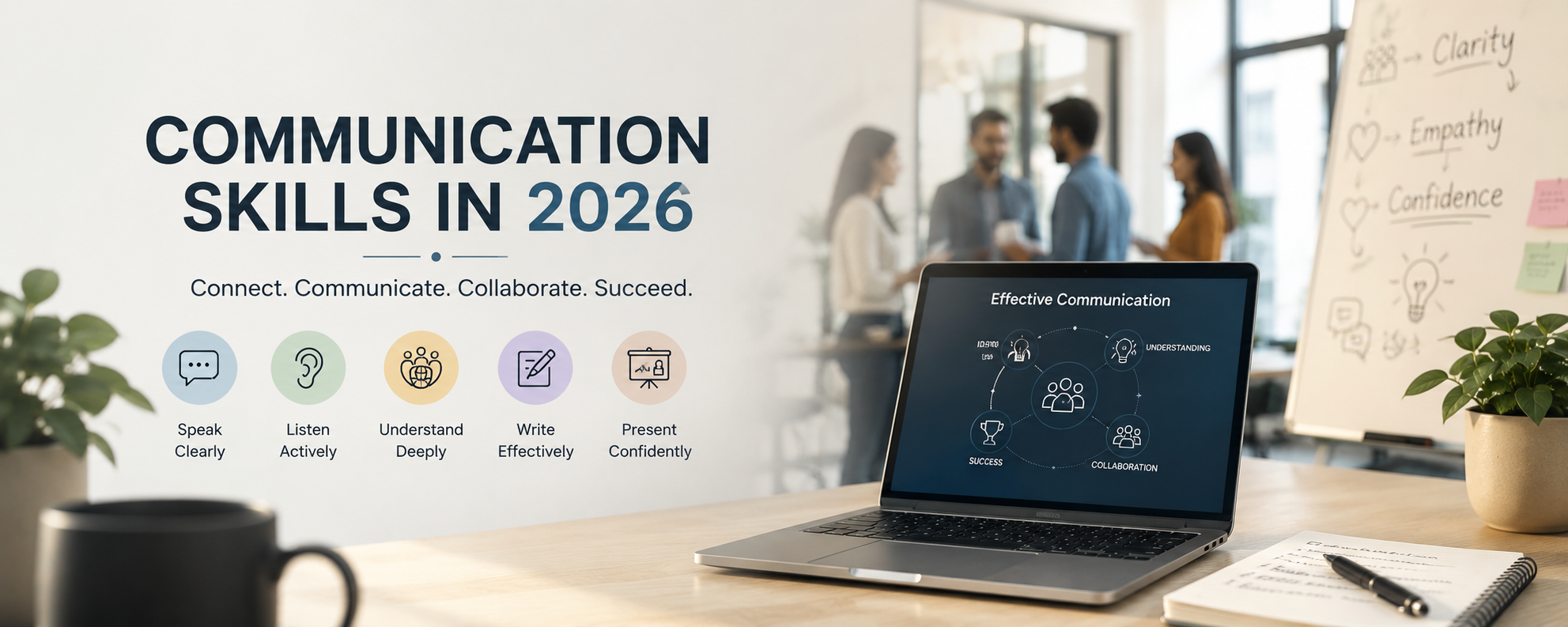
In 2026, effective communication means being able to express your thoughts clearly, understand other people, adapt your message to different situations, listen actively, communicate online professionally, and use technology without losing the human element.
The good news is that communication skills can be learned and improved with consistent practice.
What Are Communication Skills?
Communication skills are the abilities that help a person share information, ideas, opinions, emotions, and instructions clearly and effectively.
Communication happens in several forms. You may communicate by speaking during a meeting, writing an email, presenting an idea, sending a message, creating content, or even using facial expressions and body language.
Good communication is more than simply choosing the right words. It involves understanding your audience, knowing what you want to say, choosing the right medium, listening to others, and making sure your message is understood.
In simple terms, effective communication happens when your intended message reaches the other person with minimum confusion or misunderstanding.
Why Are Communication Skills Important in 2026?
The importance of communication skills has increased because modern professional and personal interactions are becoming more digital, global, and fast-paced.
Communication Skills Improve Career Opportunities
Employers increasingly look for people who can communicate their ideas effectively. A candidate may have excellent technical knowledge, but communicating that knowledge clearly is equally important.
During an interview, communication skills influence how you answer questions, explain your experience, discuss your achievements, and interact with the interviewer.
Once you get the job, communication continues to influence your professional growth. Employees need to communicate with managers, colleagues, clients, customers, vendors, and other stakeholders.
People who can explain complex ideas in a simple manner often find it easier to collaborate and take on leadership responsibilities.

Communication Helps You Work Better With Others
Most modern workplaces involve teamwork. Employees from different departments, cities, cultures, and professional backgrounds often work together on the same project.
Clear communication helps everyone understand their responsibilities, deadlines, expectations, and priorities.
When communication is poor, even a talented team can experience unnecessary delays, confusion, duplicated work, and conflicts.
Communication Builds Professional Confidence
Confidence and communication are closely connected.
When you know how to structure your thoughts and express them clearly, you are more likely to participate in conversations, ask questions, share ideas, and speak during meetings.
Communication practice can therefore help people become more comfortable in professional situations.
Communication Strengthens Personal Relationships
Communication skills are useful outside the workplace as well.
Being able to express your feelings, listen carefully, clarify misunderstandings, and communicate respectfully can improve relationships with friends, family members, classmates, and colleagues.
Good communication creates space for honest conversations while reducing unnecessary assumptions.

Also read: 4 Skills You Can’t Ignore in Today’s Job Industry
Types of Communication Skills
Communication is not a single skill. It includes several abilities that work together.
Verbal Communication
Verbal communication refers to communication through spoken words.
This includes conversations, interviews, meetings, presentations, phone calls, speeches, discussions, and public speaking.
Effective verbal communication requires clarity, appropriate vocabulary, tone, pace, and confidence.
Speaking quickly does not necessarily mean communicating effectively. In many situations, slowing down and explaining your point clearly can make your message much more powerful.
Written Communication
Written communication has become even more important with the rise of remote and hybrid work.
Emails, reports, proposals, social media posts, instant messages, presentations, resumes, and professional documents all require strong writing skills.
Good written communication should be clear, concise, structured, and appropriate for the reader.
For example, the language you use in a formal business email will be different from the language you use when messaging a close colleague.
Non-Verbal Communication
Communication does not depend entirely on words.
Facial expressions, gestures, posture, eye contact, voice modulation, and body language can influence how a message is perceived.
For example, maintaining appropriate eye contact during a conversation can communicate attention and confidence, while constantly looking at your phone may suggest disinterest.
Understanding non-verbal communication can help you become more aware of how your behaviour affects conversations.
Listening Skills
Listening is one of the most overlooked communication skills.
Many people listen while simultaneously preparing their response. Active listening requires paying attention to what the other person is actually saying.
This means avoiding unnecessary interruptions, asking relevant questions, acknowledging the speaker’s point, and responding thoughtfully.
Good listeners often become better communicators because they understand the context before responding.
Visual Communication
Visual communication has become increasingly important in 2026.
Presentations, infographics, charts, videos, social media graphics, dashboards, and other visual formats help people understand information quickly.
A good communicator should know when words are enough and when a visual explanation would be more effective.
Communication Skills You Need in 2026
The communication landscape is changing, and some skills have become particularly valuable.
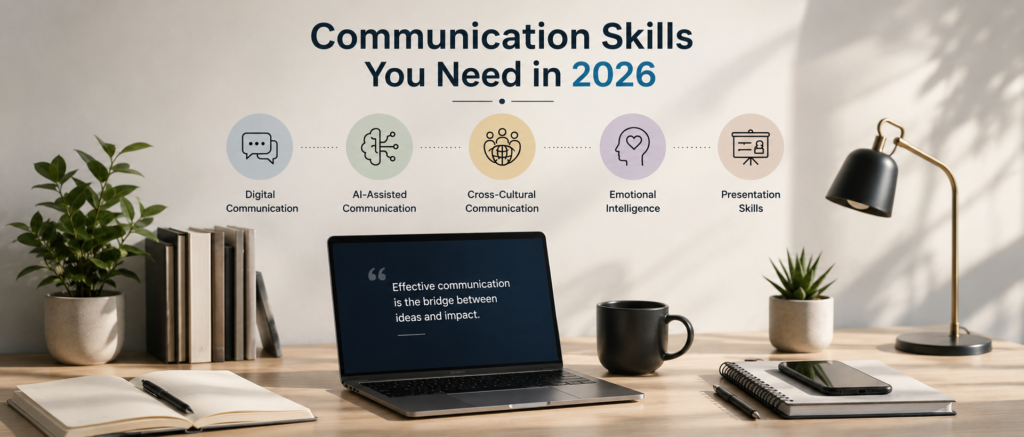
Digital Communication
A significant amount of professional communication now happens through digital platforms.
People communicate through email, workplace messaging applications, video calls, project management tools, and social media.
Digital communication requires understanding the expectations of each platform.
A short message may be appropriate for an instant messaging platform, while a formal proposal may require a structured document.
Knowing how to adjust your communication style depending on the platform is an important professional skill.
AI-Assisted Communication
Artificial intelligence has become part of everyday professional communication in 2026.
AI tools can help with brainstorming, editing, summarising information, improving clarity, and organising ideas.
However, effective communication still requires human judgment.
Simply copying AI-generated text can make communication feel generic or disconnected from the person writing it. Professionals need to review, personalise, fact-check, and adapt AI-assisted content before using it.
The ability to work with AI while maintaining your own voice is becoming an important communication skill.
Cross-Cultural Communication
Modern workplaces often bring people from different cultures, languages, and backgrounds together.
Cross-cultural communication involves understanding that people may have different communication styles, expectations, expressions, and approaches to professional relationships.
Being respectful, asking questions instead of making assumptions, and adapting your communication style can help create better professional relationships.
Emotional Intelligence
Emotional intelligence plays an important role in effective communication.
It involves recognising your own emotions, understanding how others may feel, managing your reactions, and responding appropriately.
For example, during a disagreement, an emotionally intelligent communicator focuses on solving the issue rather than reacting impulsively.
This becomes especially valuable when handling feedback, workplace conflicts, negotiations, and difficult conversations.
Presentation Skills
Being able to present an idea clearly is valuable in almost every professional environment.
Presentation skills involve structuring information, speaking confidently, using visuals effectively, maintaining audience attention, and answering questions.
You do not need to become a professional public speaker to improve your presentation skills. Even small opportunities to present ideas can help you become more comfortable.
Common Communication Problems
Understanding common communication mistakes can help you identify areas for improvement.
Lack of Clarity
One of the biggest communication problems is failing to communicate the main point clearly.
Long explanations, unnecessary jargon, and unclear instructions can make even a simple message difficult to understand.
A useful approach is to ask yourself: What exactly do I want the other person to understand or do?
Once your objective is clear, structure your communication around it.
Poor Listening
Interrupting people, checking your phone during conversations, or immediately shifting the discussion back to yourself can make communication less effective.
Active listening requires attention and patience.
Overuse of Jargon
Professional terminology can be useful when communicating with people who understand it. However, excessive jargon can make your message inaccessible.
If your audience does not understand a term, explaining the idea in simple language can make your communication much stronger.
Communicating Without Considering the Audience
The same message may need to be communicated differently to different people.
For example, a technical explanation for a specialist may be very different from an explanation for a customer.
Before communicating, consider who your audience is, what they already know, and what they need from the conversation.
Poor Digital Etiquette
Digital communication has its own etiquette.
Sending unclear messages, writing unnecessarily long texts, using an inappropriate tone, responding without reading the complete message, or expecting immediate replies can create misunderstandings.
Professional digital communication should respect the other person’s time and context.
How to Improve Communication Skills in 2026
Improving communication does not require a complete personality change. Small, consistent practices can create significant improvement.
Practise Speaking Every Day
Regular speaking practice can improve clarity and confidence.
You can explain an idea aloud, record yourself speaking for a few minutes, participate in discussions, or practise answering common interview questions.
Recording yourself can be particularly useful because it allows you to notice repetitive words, unclear sentences, speaking speed, and pauses.
Read More
Reading exposes you to different writing styles, vocabulary, sentence structures, and ideas.
Read articles, books, essays, interviews, industry publications, and opinion pieces that interest you.
The goal is not to memorise complicated words. Instead, pay attention to how strong writers explain ideas.
Write Regularly
Writing regularly can improve your ability to organise thoughts.
You can maintain a journal, write LinkedIn posts, create short articles, draft professional emails, or summarise what you have learned.
Try to communicate one idea clearly before adding another. This simple practice can make your writing more structured.
Become a Better Listener
During your next conversation, consciously focus on listening instead of preparing your response.
Ask follow-up questions when something is unclear.
You can also repeat or summarise an important point to confirm that you understood it correctly.
For example, you might say, “So, if I understand correctly, you want the campaign ready by Friday.”
This simple habit can prevent misunderstandings.
Learn to Structure Your Thoughts
A useful communication structure is:
What is the situation?
What is the main point?
Why does it matter?
What should happen next?
This structure can be useful for meetings, emails, presentations, proposals, and everyday professional conversations.
Ask for Feedback
Sometimes other people notice communication habits that we cannot see ourselves.
Ask a trusted colleague, mentor, teacher, or friend for specific feedback.
Instead of asking, “Am I a good communicator?”, ask questions such as:
“Was my explanation clear?”
“Did I speak too quickly?”
“Was my presentation easy to follow?”
“Could I have explained that more simply?”
Specific feedback is easier to act on.
Practise Public Speaking
Public speaking can initially feel uncomfortable, but practice makes it easier.
Start with small situations. Speak during team meetings, participate in discussions, present a short topic to friends, or record short videos.
With regular practice, speaking in front of others becomes less intimidating.
Improve Your Digital Communication
Review the messages and emails you send.
Ask yourself whether the recipient can immediately understand the purpose of the message.
For professional emails, use clear subject lines and organised paragraphs. For workplace messages, get to the point while maintaining an appropriate tone.
Good digital communication saves time for everyone involved.
Communication Skills for Students
Communication skills can give students an advantage long before they enter the workplace.
Students need communication skills for presentations, group projects, interviews, internships, networking, academic discussions, and job applications.
Students can begin developing these skills by participating in debates, joining clubs, presenting projects, writing regularly, and practising interviews.
Building these skills early can make the transition from education to professional life easier.
Communication Skills for Working Professionals
Professionals need communication skills at every stage of their careers.
An entry-level employee may need to communicate with a manager and team members. A mid-level professional may need to manage clients and projects. A senior professional may need to communicate strategy, lead teams, negotiate, and make presentations.
As responsibilities increase, communication often becomes more important because the impact of unclear communication also increases.
Professionals should therefore treat communication as a skill that continues to develop throughout their careers.

Communication Skills and Leadership
Strong leadership depends heavily on effective communication.
A leader needs to communicate expectations, explain decisions, give feedback, handle disagreements, motivate team members, and communicate a clear vision.
Leadership communication also involves knowing when to speak and when to listen.
A leader who communicates clearly can help a team understand not just what needs to be done, but why it matters.
The Future of Communication Skills
Technology will continue to change how people communicate.
AI, automation, virtual collaboration, video content, voice interfaces, and new digital platforms will influence professional communication. However, fundamental human skills will continue to matter.
People will still need to listen, understand context, build trust, resolve disagreements, explain ideas, show empathy, and make decisions.
This is why communication skills should not be viewed as a temporary workplace trend. They are transferable skills that can remain valuable even as technology changes.
How Communication Skills Can Help Your Career in 2026
Communication skills can support almost every stage of professional development.
They can help you perform better in interviews, build professional networks, collaborate with teams, handle clients, present ideas, negotiate responsibilities, receive feedback, and take leadership opportunities.
For freelancers and entrepreneurs, communication can also influence how effectively they pitch services, interact with customers, build partnerships, and represent their brand.
For content creators and digital professionals, communication is central to creating content that people can understand and connect with.
In many careers, technical skills may help you get started, while communication skills can help you explain your value and grow further.
Also read: Improve your English writing skills – Analyze your mistakes with ease

