



When someone who drinks heavily suddenly cuts back or stops, their body does not just calm down. It reacts, sometimes violently. This reaction is called alcohol withdrawal syndrome, and it can range from a rough few days of shaking and nausea to a medical emergency that puts a person’s life at risk.
Alcohol withdrawal happens because the brain adapts to constant alcohol exposure over time. It quietly rebalances its own chemistry to function despite the depressant effect of alcohol. When the alcohol disappears, that rebalancing act is exposed, and the nervous system swings the other way, becoming overactive instead of suppressed.
This is why early treatment matters so much. Left unmanaged, alcohol withdrawal is one of the few withdrawal syndromes that can actually kill a person. Managed properly, most people recover fully. According to the World Health Organization’s 2024 Global Status Report on Alcohol and Health, an estimated 400 million people worldwide were living with alcohol use disorders, with 209 million meeting criteria for alcohol dependence specifically. A large share of that group will experience some degree of withdrawal if they try to quit or cut down without medical support.
Table of Contents

Alcohol Withdrawal Syndrome at a Glance
- When it starts – symptoms typically begin 6 to 24 hours after the last drink.
- What it looks like – anxiety, tremor, sweating, nausea, and a racing heart are the early signs.
- How dangerous it can get – seizures and delirium tremens are the most severe complications, and delirium tremens can be fatal without treatment.
- What helps – medical supervision, benzodiazepines, and vitamin support dramatically improve outcomes.
- The golden rule – nobody with a history of heavy, prolonged drinking should attempt to quit cold turkey without talking to a doctor first.
- The scale of the issue – the WHO estimated in 2024 that 209 million people worldwide live with alcohol dependence, a population where withdrawal is a real and recurring risk.
What Is Alcohol Withdrawal Syndrome?
Alcohol withdrawal syndrome is the cluster of physical and psychological symptoms that shows up when a person who drinks heavily reduces or stops their alcohol intake. It is not a sign of weak willpower. It is a predictable, physiological response rooted in how alcohol changes brain chemistry over time, particularly a calming brain chemical system called GABA.
With regular heavy drinking, GABA receptors in the brain become less responsive, as if the brain turns down its own volume to compensate for alcohol’s sedating effect. Once the alcohol is removed, that volume stays turned down for a while, leaving the nervous system unusually excitable. That excitability is what drives most withdrawal symptoms.
Doctors have recognized this pattern for a very long time. Descriptions resembling alcohol withdrawal date back to Hippocrates around 400 BC, though it was not considered a widespread public health issue until the 1700s, as alcohol consumption patterns shifted across societies.
Causes
Alcohol withdrawal is caused by the sudden absence of a substance the brain has come to depend on to maintain its chemical balance. The nervous system essentially overcorrects, and that overcorrection produces the symptoms people experience.
A few things influence how this plays out for any individual.
How much and how long someone has been drinking – heavier, longer-term drinking generally produces more intense withdrawal.
Whether they have gone through withdrawal before – prior withdrawal episodes tend to make later ones worse, a pattern researchers call kindling.
Overall health – liver function, nutrition, and other medical conditions can shape how withdrawal unfolds.
Risk Factors
Not everyone who drinks develops alcohol withdrawal syndrome. It shows up specifically in people who have built physical dependence. Common risk factors include the following.
- Long-term heavy alcohol use – years of consistent heavy drinking is the biggest driver.
- Daily or near-daily drinking – regular, frequent use builds tolerance and dependence faster than occasional heavy drinking.
- A history of previous withdrawal episodes – each prior withdrawal can make the next one more severe, due to the kindling effect described above.
- A history of withdrawal seizures – people who have had seizures during past withdrawals face a higher risk of having them again.
- Liver disease – impaired liver function changes how the body processes both alcohol and the medications used to treat withdrawal.
- Older age – older adults tend to have more medically complicated withdrawal courses.
- Poor nutrition – heavy drinkers are often deficient in key vitamins, which raises the risk of certain withdrawal complications.

Symptoms
Alcohol withdrawal symptoms mainly affect the central nervous system, and they exist on a spectrum. Mild cases might involve nothing more than insomnia and jitteriness. Severe cases can include seizures and dangerous confusion.
To be classified as alcohol withdrawal syndrome, a person generally needs to show at least two of the following after cutting back on drinking.
- Physical symptoms – hand tremor, nausea or vomiting, sweating, and a fast heart rate.
- Sleep and mood symptoms – insomnia, anxiety, and restlessness or agitation.
- Perceptual symptoms – transient hallucinations, which can be visual, auditory, or tactile.
- Neurological symptoms – seizures and signs of autonomic instability, such as unstable blood pressure or body temperature.
Doctors sometimes group these into recognizable patterns. Alcoholic hallucinosis involves hallucinations while a person otherwise remains alert and oriented. Withdrawal seizures occur within the first two days after the last drink. Delirium tremens is the most serious pattern, combining confusion, tremor, heavy sweating, and hallucinations that feel completely real to the person experiencing them.
Stages and Timeline of Withdrawal
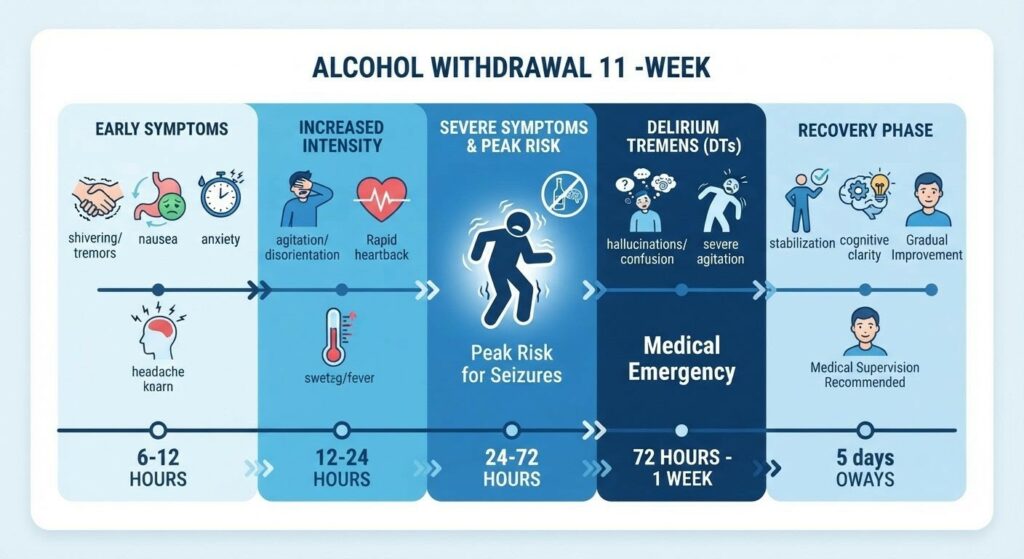
People searching for information on alcohol withdrawal often want a straightforward answer to one question. How long does this actually last? The honest answer is that it depends on the person, but there is a fairly consistent general pattern.
6 to 12 hours after the last drink – shaking, headache, sweating, anxiety, and nausea typically begin.
12 to 24 hours – symptoms can intensify. Some people develop hallucinations while still remaining aware that what they are seeing is not real.
12 to 48 hours – this is the highest-risk window for withdrawal seizures, which occur in roughly 3 to 5 percent of cases.
48 to 72 hours – most people start improving around this point, but this is also when delirium tremens, if it occurs, tends to peak.
3 to 7 days – acute symptoms generally resolve within about a week for most people.
Weeks to months later – a subset of people experience what is known as protracted withdrawal or post-acute withdrawal syndrome, with lingering issues like insomnia, low mood, and cravings. Some of these effects have been reported to last a year or more.
Complications
Untreated or poorly managed alcohol withdrawal carries real risks beyond just discomfort.
Dehydration and electrolyte imbalance – vomiting and sweating can quickly deplete fluids and key minerals.
Seizures – generalized seizures can occur, particularly in the first two days.
Delirium tremens – this is the most severe complication, involving profound confusion, hallucinations, and autonomic instability, and it can be fatal without treatment.
Heart rhythm disturbances – changes in heart electrical activity have been observed during early withdrawal.
Brain injury from repeated withdrawal – going through withdrawal multiple times, especially without treatment, has been linked to lasting cognitive effects, including problems with memory and impulse control.
Death – among people who develop severe withdrawal symptoms, a meaningful percentage die without appropriate treatment, which is why medical support is not optional in serious cases.
Diagnosis
Doctors typically use a structured scoring tool called the Clinical Institute Withdrawal Assessment for Alcohol, often shortened to CIWA-Ar, to measure how severe a person’s withdrawal is and how much medication they need. This tool has been streamlined over the years while keeping its reliability, which matters given how quickly withdrawal can escalate.
When a person’s drinking history is unclear, blood tests looking at markers like carbohydrate-deficient transferrin or gamma-glutamyl transferase can help confirm heavy alcohol use.

Treatment
The good news is that alcohol withdrawal syndrome is highly treatable when caught early. Treatment intensity depends on symptom severity. People with mild symptoms may be managed at home with daily check-ins from a healthcare provider, while those with more severe symptoms usually need inpatient care.
Benzodiazepines
These are the primary medications used to control withdrawal symptoms and prevent seizures. Longer-acting options like diazepam and chlordiazepoxide are common choices, while shorter-acting options like lorazepam may be preferred for people with liver problems. Dosing is often adjusted based on ongoing symptom scores rather than a fixed schedule.
Vitamins
Heavy drinkers are frequently low in thiamine and folic acid, and replacing these is critical to prevent a serious complication called Wernicke syndrome. This is often done intravenously before any carbohydrates are given, since carbohydrates can trigger Wernicke syndrome in a thiamine-deficient person.
Anticonvulsants
Medications like gabapentin or carbamazepine sometimes support treatment of mild to moderate withdrawal, though they are not considered reliable enough to use alone for severe cases.
Other supportive medications
Clonidine may help with certain symptoms alongside benzodiazepines, and beta blockers are sometimes used for elevated blood pressure. Antipsychotics are occasionally added for agitation, though they need to be used cautiously since some can lower the seizure threshold.
Also Read: Vitamin Deficiency Symptoms: Why Vitamin B12, Vitamin D, and Iron Deficiencies Are Rising

Recovery
Recovering from the acute phase of alcohol withdrawal usually takes about a week, but full recovery is broader than that. Ongoing recovery from alcohol use disorder itself involves addressing the underlying dependence, not just the withdrawal symptoms.
Medications like naltrexone, acamprosate, and disulfiram are used after withdrawal has passed to help reduce the chance of returning to drinking. These work differently from withdrawal medications. They target long-term relapse prevention rather than acute symptom control.
Protracted symptoms like insomnia and low mood can persist well beyond the first week. Treating these matters too, since unmanaged insomnia in particular has been associated with a higher chance of relapse.

Prevention
The most reliable way to prevent severe alcohol withdrawal is medically supervised detox, especially for anyone with a history of heavy, prolonged drinking. Trying to quit suddenly and alone, particularly after years of daily drinking, carries real risk.
Medically supervised detox
Gradual tapering or medication-assisted withdrawal under a doctor’s care is the safest route for anyone with significant dependence.
Avoiding sudden cessation
People with heavy drinking histories should not simply stop overnight without medical guidance.
Rehabilitation programs
Structured programs address both the physical and behavioral sides of alcohol use disorder.
Counseling
Therapy helps address the reasons behind drinking patterns, not just the physical dependence.
Family and social support
A strong support system during and after withdrawal has a meaningful effect on long-term outcomes.

When to Seek Emergency Medical Care
Some symptoms during alcohol withdrawal are not something to wait out at home. Seek emergency care immediately if any of the following occur.
- Seizures – any seizure during withdrawal needs urgent medical attention.
- Hallucinations or severe confusion – these can signal progression toward delirium tremens.
- High fever – this can indicate a dangerous level of autonomic instability.
- Chest pain or irregular heartbeat – withdrawal can affect heart rhythm, and chest symptoms should never be ignored.
- Difficulty breathing – this requires immediate emergency evaluation.
- Loss of consciousness – this is always a medical emergency, regardless of the cause.
Alcohol withdrawal syndrome is uncomfortable at best and life-threatening at worst, but it is also highly treatable. Early medical support, proper monitoring, and the right combination of medications turn a genuinely dangerous process into a manageable one for most people. Nobody needs to go through severe withdrawal alone, and nobody with a heavy drinking history should try to.
Long-term recovery from alcohol use disorder is realistic with the right support in place, whether that means a structured rehabilitation program, ongoing counseling, or simply a strong network of people checking in along the way.
This article is intended for educational purposes only and should not replace professional medical advice. Anyone experiencing symptoms of alcohol withdrawal, or supporting someone who is, should seek guidance from a qualified healthcare provider. If symptoms are severe, treat it as a medical emergency.

Frequently Asked Questions
Can alcohol withdrawal be fatal?
Yes. Severe cases, particularly those involving delirium tremens, can be fatal without treatment. Prompt medical care significantly lowers that risk.
How long does alcohol withdrawal last?
Acute symptoms usually resolve within about a week, though some people experience lingering effects like insomnia or low mood for months afterward.
What is delirium tremens?
It is the most severe form of alcohol withdrawal, marked by intense confusion, tremor, hallucinations that feel real, and unstable vital signs. It typically peaks between 48 and 72 hours after the last drink.
Can alcohol withdrawal happen after binge drinking?
It is more strongly associated with sustained heavy drinking, but repeated binge drinking cycles can also sensitize the nervous system over time through the kindling effect, making withdrawal more likely with each cycle.
Can alcohol withdrawal be treated at home?
Mild cases sometimes can, with regular monitoring from a healthcare provider. Anyone with a history of severe withdrawal, seizures, or heavy long-term drinking should be evaluated in person rather than managing symptoms alone.
Which vitamins are important during alcohol withdrawal?
Thiamine and folic acid are the most critical, since deficiencies in these can lead to a serious neurological complication called Wernicke syndrome.
Is alcohol withdrawal an emergency?
It can become one quickly. Anyone showing signs of seizures, hallucinations, severe confusion, or high fever needs emergency medical attention right away.
Also Read: Eating Disorder: Types, Symptoms, Medical Complications and Their Consequences

