


A brand campaign strategy is the plan behind a marketing campaign designed to strengthen how people understand, remember or feel about a brand. It answers a deceptively simple question: What do we want people to think, feel or do because of this campaign?
The answer then influences everything else — from the campaign idea and messaging to the platforms you use and the metrics you track. A good strategy connects the dots between business objectives and audience needs.
It isn’t simply a content calendar. It is the thinking that comes before the content.
Brand Campaign vs. Product Campaign
A product campaign usually focuses on a particular product, service, feature or offer. Its job may be to generate sales, leads or sign-ups.
A brand campaign operates at a broader level. It might introduce a new brand identity, change perceptions, build awareness, establish credibility or create an emotional connection.
Of course, the two can overlap. A memorable product campaign can strengthen the brand, while a strong brand campaign can eventually influence sales. The difference is primarily in the strategic job the campaign is expected to perform.
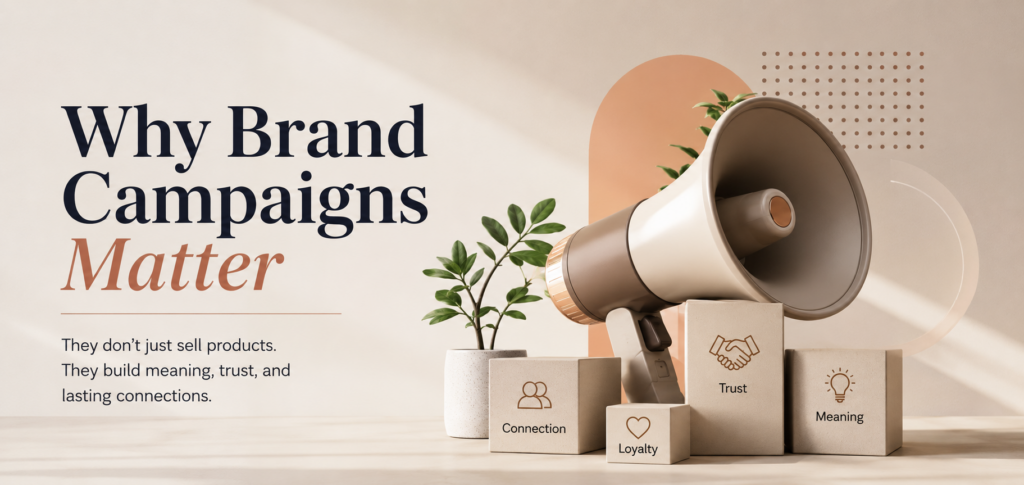
Why Brand Campaigns Matter
People rarely make decisions based on information alone. They remember stories, associations, experiences & feelings.
That is why two businesses selling similar things can be perceived completely differently. One becomes familiar. The other becomes forgettable.
A thoughtful brand campaign helps build mental availability — making your brand easier to recall when a relevant need arises. Over time, repeated associations can become one of your most valuable marketing assets.
Start With a Clear Campaign Objective
Before asking, “What should we post?” ask, “What are we trying to change?”
This is where many campaigns go off track. Teams often try to increase awareness, generate sales, gain followers, improve engagement & launch a product simultaneously.
The result? A campaign trying to do everything often communicates nothing clearly.
Start with one primary objective.
Awareness, Consideration & Loyalty Goals
Your objective could sit at different stages of the customer journey.
An awareness campaign might introduce your brand to a new audience. A consideration campaign could explain why your solution is worth considering. A loyalty campaign might deepen the relationship with existing customers.
Each requires different messaging & creative treatment.
For example, a new brand may need to answer, “Who are you?” A mature brand may instead need to answer, “Why should I continue choosing you?”
Choose One Primary Goal
Write your objective in one sentence.
Instead of saying, “We want more awareness & engagement & sales,” make it measurable: “Increase qualified brand awareness among urban professionals aged 25–40 over the next three months.”
You can track secondary outcomes, but one primary goal should guide decision-making.
If an idea doesn’t help that goal, question whether it belongs in the campaign.
Know Exactly Who You Are Talking To
“Everyone” is not a target audience.
If your campaign speaks to everyone, it often sounds like it was written for nobody.
Audience research should help you understand not only who your customers are but what matters to them.
What problem are they trying to solve? What frustrates them? What influences their decisions? What language do they naturally use? What would make them stop scrolling?
These questions can completely change the way you build a campaign.
Build an Audience Profile
Start with useful basics such as age, location, occupation, income range, interests and purchasing behaviour.
Then add context.
Imagine the person’s day. What are they doing before they encounter your brand? What competing choices are already on their mind? Where do they discover products or ideas?
A realistic audience profile gives your creative team something tangible to work with.
Instead of simply saying “women aged 25–35,” you might describe a working professional who values convenience, follows lifestyle creators, researches products online and prefers brands that feel authentic.
That is much easier to communicate with.
Go Beyond Demographics
Demographics tell you who someone is. Psychographics can tell you why they behave the way they do.
Someone might be a 30-year-old professional living in a large city. That’s useful, but incomplete.
Perhaps they value convenience, dislike complicated processes & want brands that feel transparent.
That insight can shape your campaign much more powerfully than age alone.
The best brand campaigns don’t just target a demographic. They speak to a mindset.
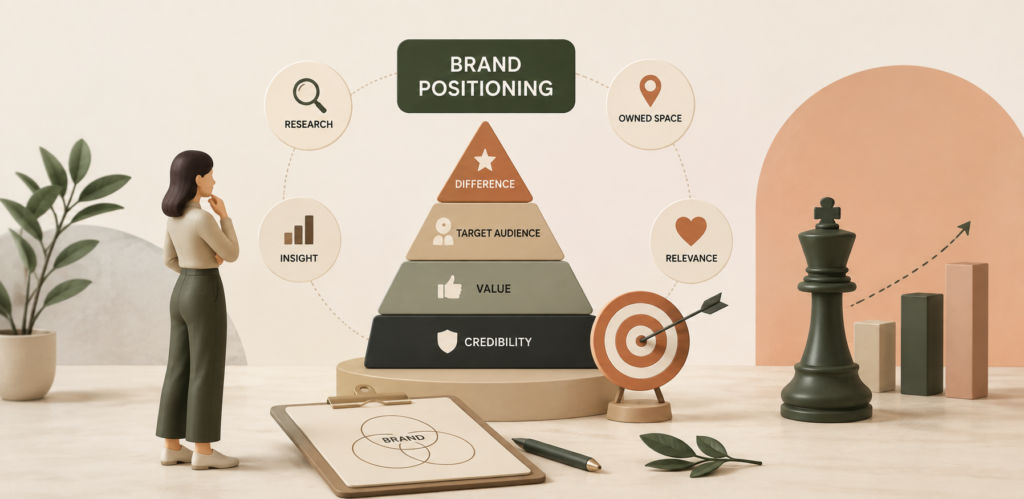
Define Your Brand Position
Before creating the campaign, clarify what you want your brand to stand for.
Your positioning is essentially the space you want to occupy in the customer’s mind.
What makes you different? Who are you for? What do you promise? Why should people believe you?
If your campaign doesn’t reinforce your positioning, it may create attention without building brand equity.
Also Read: Why Brand Storytelling Matters More Than Traditional Marketing in 2026
Identify Your Core Brand Promise
Your brand promise should communicate the value people can consistently expect from you.
It doesn’t need to sound poetic. In fact, simple is often stronger.
A useful formula is:
For [audience], we provide [value] by [distinctive reason to believe].
This gives your campaign a strategic foundation.
Every major creative decision should feel connected to that promise.
Make Your Promise Specific
“We deliver quality” isn’t a strong differentiator because almost every brand can say it.
Specificity creates meaning.
Instead of promising an abstract benefit, explain the distinctive experience, outcome or value you provide.
Ask yourself:
Could a competitor copy this sentence tomorrow?
If the answer is yes, keep working.
Your brand should have a reason to exist beyond simply selling something that another company also sells.
Find the Campaign’s Big Idea
Now comes the fun part: the campaign idea.
But don’t start with a slogan.
Start with an insight.
A strong campaign idea sits at the intersection of what your brand wants to communicate and what your audience genuinely cares about.
It should be simple enough to understand quickly but flexible enough to live across multiple formats.
A memorable campaign idea can appear in a reel, billboard, email, website banner or event and still feel like part of the same story.
Turn a Business Goal Into a Human Insight
Suppose a travel brand wants to increase domestic travel bookings.
“Book more trips” is a business objective, not a campaign idea.
A human insight might be that people often spend years planning international holidays while overlooking remarkable places much closer to home.
That tension could become the foundation for a campaign about rediscovering your own country.
The business goal remains underneath it, but the communication becomes human.
That’s the difference between an advertisement that says something and a campaign that makes people feel something.
Build a Messaging Framework
Once you have the big idea, decide what the campaign needs to say.
Don’t throw ten unrelated messages at your audience.
Create a hierarchy.
Start with one central message, then build supporting messages underneath it.
This makes your campaign feel like one conversation rather than a collection of disconnected advertisements.
The Core Message
The core message is the one thing you want people to remember.
If someone sees your campaign once and forgets everything except one thought, what should that thought be?
Write it down.
Keep it short.
Then test every piece of campaign content against it.
If a post, video or advertisement communicates something completely different, you may have a consistency problem.
Supporting Messages
Supporting messages provide reasons to believe the central claim.
They could include product benefits, customer stories, founder stories, proof points, demonstrations or cultural context.
Think of your core message as the spine of the campaign.
Supporting messages are the muscles around it. They add substance without changing the fundamental idea.
Choose the Right Channels
Not every campaign needs to be everywhere.
Your channel strategy should follow your audience & your objective.
If your audience spends significant time on Instagram, visual storytelling may be important. If you’re targeting decision-makers, LinkedIn could play a stronger role.
Search may matter when people already have intent. Email can be valuable for audiences you already own.
The question isn’t, “Which platform is popular?”
It’s:
“Where can this audience meaningfully encounter this message?”
Paid, Owned & Earned Media
Think across three broad categories.
Owned media includes your website, email list and social profiles.
Paid media includes advertising and sponsored placements.
Earned media includes press coverage, organic mentions, shares, reviews and word of mouth.
Strong campaigns often combine them.
Paid media can create initial reach, owned channels can deepen the story & earned attention can add credibility.
You don’t necessarily need a huge channel mix. You need the right combination.
Create Content That Carries the Idea
Your campaign idea now needs a creative system.
Decide how the concept will translate into video, static posts, articles, landing pages, advertisements, emails or offline experiences.
Don’t simply resize one piece of content for every platform.
Preserve the campaign’s central idea while adapting the execution to the behaviour of each channel.
A six-second video and a long-form article can tell the same story in very different ways.
The format changes. The strategic idea doesn’t.
Keep Creative Consistent
Consistency doesn’t mean making every asset identical.
It means making the campaign recognisable.
Your visual language, tone, recurring phrases, storytelling style and central idea should work together.
Someone should be able to encounter your campaign without seeing the logo and still have a reasonable chance of recognising the brand.
That’s a powerful test.
If every campaign asset looks like it came from a different company, you’re creating content — not building a brand.
Set a Realistic Campaign Budget
Strategy also means deciding where your money should go.
Divide your budget according to the campaign’s priorities rather than automatically spending the largest amount on media.
You may need resources for creative production, research, influencers, advertising, landing pages, events, software or testing.
Leave room for optimisation too.
A campaign that spends every rupee before launch has no flexibility when something unexpectedly works.
Your budget should give you enough room to test, learn & scale the elements that show promise.
Build a Campaign Timeline
A campaign needs rhythm.
Break the campaign into phases such as preparation, launch, amplification, optimisation and wrap-up.
During preparation, finalise the audience, messaging, creative assets and tracking.
At launch, focus on reach and early signals.
During amplification, put more weight behind promising content or channels.
Later, analyse performance and document what you learned.
A timeline prevents the common mistake of treating launch day as the entire campaign.
Remember, a campaign is not just a moment. It is a sequence.
Measure What Actually Matters
Measurement should be connected directly to your objective.
If you’re building awareness, impressions alone may not tell the whole story.
Look at reach, video completion, branded search behaviour, direct traffic, recall or changes in brand perception where appropriate.
If you’re driving action, consider conversion rate, qualified leads, customer acquisition cost or revenue.
Vanity metrics can look impressive while telling you very little about business impact.
A post receiving 100,000 views sounds exciting. But what did those views actually accomplish?
That’s the question your measurement framework needs to answer.
Brand Metrics
Brand metrics help you understand whether people’s relationship with your brand is changing.
Depending on your campaign, you might track awareness, recall, consideration, sentiment, share of voice or branded search interest.
These measurements are especially important because brand effects may not appear immediately in sales data.
A person may see your campaign today and purchase from you three months later.
Brand building often works quietly before it becomes visible in revenue.
Performance Metrics
Performance metrics show what people do.
These can include clicks, leads, purchases, sign-ups, landing-page conversions and return on advertising spend.
The important point is not to collect every metric available.
Choose a small group that directly answers whether the campaign is doing its job.
The right metrics are the ones that help you make better decisions.

Test, Learn & Optimise
Your first version doesn’t have to be perfect.
In fact, expecting perfection before launch can slow a campaign down unnecessarily.
Test different creative hooks, headlines, formats, audiences or calls to action where appropriate.
Then look for patterns.
What gets attention? What creates meaningful action? What produces cheap clicks but poor-quality traffic?
Good optimisation is less about chasing random spikes and more about learning why something worked.
For example, if one campaign video performs significantly better than others, don’t simply celebrate the result.
Ask why.
Was the opening stronger? Was the message clearer? Did the audience relate to the story? Was the format better suited to the platform?
The answer can improve the rest of the campaign.
Common Brand Campaign Mistakes to Avoid
Several mistakes appear again & again.
The first is starting with content instead of strategy.
The second is trying to communicate too many messages.
The third is copying competitors instead of developing a distinct position.
Another is choosing channels because they are fashionable rather than useful.
And perhaps the biggest mistake is stopping measurement at likes and impressions.
Vanity metrics can create the illusion of success.
A campaign might generate thousands of likes while failing to improve awareness, consideration or sales.
Another common problem is inconsistency.
If your campaign says one thing on Instagram, another thing on your website and something completely different in advertising, people may struggle to understand what your brand actually represents.
Clarity wins.
A Practical Brand Campaign Strategy Checklist
Before launching, ask yourself:
- Is the business objective clear?
- Is the audience specific?
- Do we understand the audience’s motivations?
- Is the brand position defined?
- Is there one strong campaign idea?
- Is the core message memorable?
- Are supporting messages consistent?
- Are channels selected based on audience behaviour?
- Is the creative adaptable across formats?
- Is the budget realistic?
- Is the timeline clear?
- Are tracking systems ready?
- Have we defined success before launch?
- Do we have a plan for testing and optimisation?
If you can answer these questions confidently, you’re not simply creating marketing content.
You’re building a campaign with a strategic backbone.
Conclusion
A brand campaign that works isn’t necessarily the loudest, biggest or most expensive one.
It is the one where every important decision points in the same direction.
The objective informs the audience. The audience informs the insight. The insight shapes the idea. The idea guides the message. The message determines the creative. The channels deliver it to the right people. Measurement tells you whether it worked.
That’s the chain.
Break one link and the campaign can wobble. Strengthen them together and your marketing starts behaving like a system rather than a collection of posts.
Ultimately, great brand campaigns aren’t built by asking, “What should we post today?”
They’re built by asking, “What do we want people to remember about us — and how can we make that memory matter?”
Also Read: Performance Marketing for Beginners: The Complete Guide to Driving Measurable Business Growth

