


There is an ongoing conflict in West Asia that is likely to hurt economies even after it ends. India will not be an exception. Let that sink in. The world’s fastest-growing large economy could still do better than many others. However, your money is at odds with any semblance of stability. The purchasing managers’ index (PMI) data shows that India has experienced expansionary activity every month. Yet the labour market in India has softened, with unemployment rising, according to the Reserve Bank of India’s latest monetary policy report. That is likely to hurt the income side of your household balance sheet if you are the one looking for a new job or expanding your work profile to boost your income.
Rising Inflation Is Making Everyday Life More Expensive
On the other side, inflation is likely to rise. Energy price spikes driven by the war in West Asia pose risks to the domestic inflation outlook going forward. That means that while income uncertainty rises, your consumption is likely to become more expensive. Rising fuel costs do not just affect what you pay at the petrol pump. They also increase transportation and logistics costs across industries, making food, medicines, clothing, and other daily essentials more expensive. Even businesses are forced to pass on higher operating costs to consumers, putting additional pressure on household budgets.
Consumer Confidence Is Weakening
That is also reflected in the latest forward-looking consumer survey published by the RBI and in the monetary policy literature. Consumer confidence for the current period deteriorated, and for the year ahead, though optimistic, also declined from the previous round of a similar survey. The RBI survey also shows that household perceptions of employment have worsened for now and for the year ahead. It is a strange situation in which we hear stories of faster economic growth but poor job prospects. For many households, this uncertainty often leads to postponing major financial decisions such as buying a home, purchasing a vehicle, or investing in higher education. Families naturally become more cautious when they are unsure about future income.
India’s Structural Economic Challenges
India’s structural economic bottlenecks – primarily a persistent jobs crisis and a lack of manufacturing depth are directly impacting personal financial stability, leading to lower savings and a growing reliance on debt. García Herrero and R. Sengupta argue in their paper titled ‘Tackling India’s Jobs Plight: Underutilised Levers and Lessons from China’ that at the heart of India’s economic challenge is a structural paradox: high GDP growth is failing to generate sufficient quality employment.
Manufacturing and Employment Gap
A primary reason for that is a low-par expansion in the manufacturing sector. About 42% of India’s workforce is still employed in low-productivity agriculture, which contributes barely 15-16% to the gross domestic product. Despite that, the rural story is not such a problem for India. RBI’s report observes a strong growth in rural consumption. What remains challenging is the ability of the economy to move workers into sectors that offer better productivity, higher wages, and long-term career growth. Without stronger manufacturing and labour-intensive industries, creating employment opportunities for millions entering the workforce every year becomes increasingly difficult.
Also Read: Financial Resilience Must Include India’s Credit-Invisible Workforce
The Employability Crisis Among Young Indians
The problem is more pronounced among the educated class, where unemployment among the 15-24 age group is as high as 45%, according to the European think tank.
Even for those who find work, the ‘quality’ of jobs is a major concern. The economy has leapfrogged from agriculture directly into high-skill services like IT and finance, which employ relatively few people and offer limited opportunities for the broader population. A large section of the workforce continues to rely on contractual jobs, freelance work, or gig-based employment. While these opportunities provide flexibility, they often come without social security benefits, paid leave, or long-term financial stability, making future planning far more uncertain.
How Macro Problems Hit Your Wallet
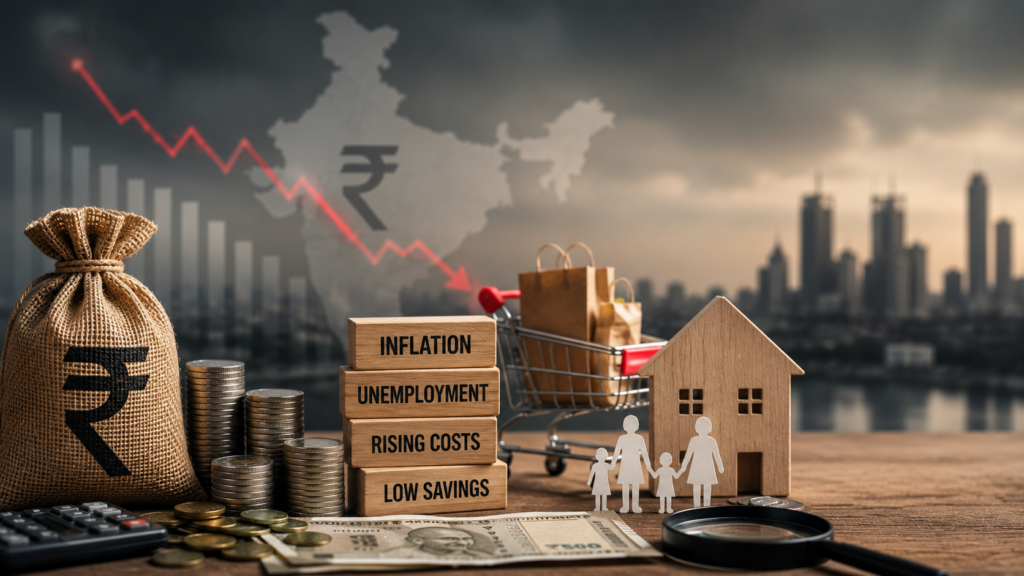
This “jobless growth” isn’t just a government statistic. It translates directly into personal money problems in several ways.
1. Falling Savings
Firstly, it erodes your savings. That is reflected in the drop in the net financial savings rate to 5% of GDP in 2026, from over 7% in 2021. You end up dipping into your retirement savings to maintain your current lifestyle. In many households, emergency funds that were meant for unexpected medical expenses or future goals are increasingly being used to manage rising monthly costs. This reduces financial resilience and leaves families more vulnerable to future economic shocks.

2. Growing Debt Burden
Secondly, it creates a debt trap. As savings decline, you tend to borrow more money for your consumption. The share of retail credit in total bank credit rose to 33% in 2023-24 from 19% in 2010-11. While credit card loans remained stable in the year to January 2026, borrowing against gold more than doubled as gold prices continued to rise. That indicates an effort to mobilize money to meet higher monthly or other household expenses. While borrowing can temporarily ease financial pressure, it also increases the burden of future repayments. Higher interest obligations reduce disposable income, making it even harder for households to save or invest.

3. Fewer Quality Job Opportunities
The third way you are affected is through a decline in employment opportunities. The European think tank’s working paper notes that only about 42.6% of Indian graduates are considered employable, and just 8.3% secure jobs that match their qualifications. This forces many into the informal sector or gig economy, where they lack pensions, health insurance, and stable wages. Over time, this mismatch between education and employment can discourage skill development and reduce productivity across the economy. For young professionals, delayed career growth also affects their ability to build wealth through investments, home ownership, and retirement planning.
Conclusion
Ultimately, the country’s macroeconomic challenges are not distant policy concerns. They influence everyday financial decisions, from how much you spend at the grocery store to how confidently you plan your future. Understanding these links can help households make more informed financial decisions during uncertain economic times.

