


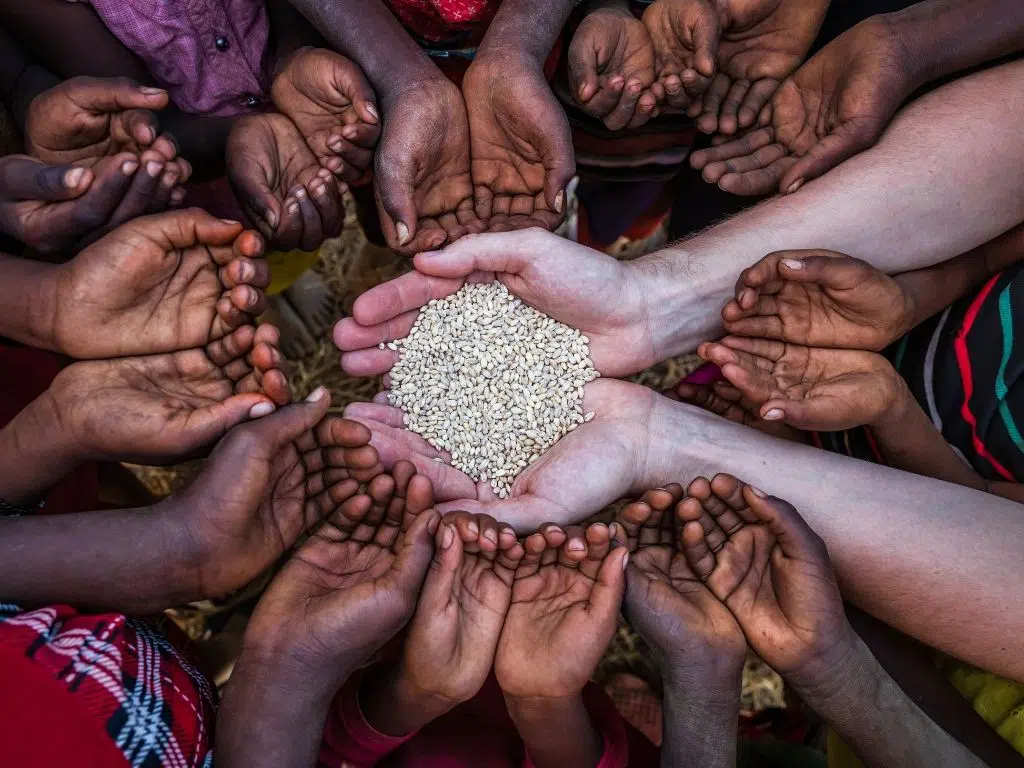
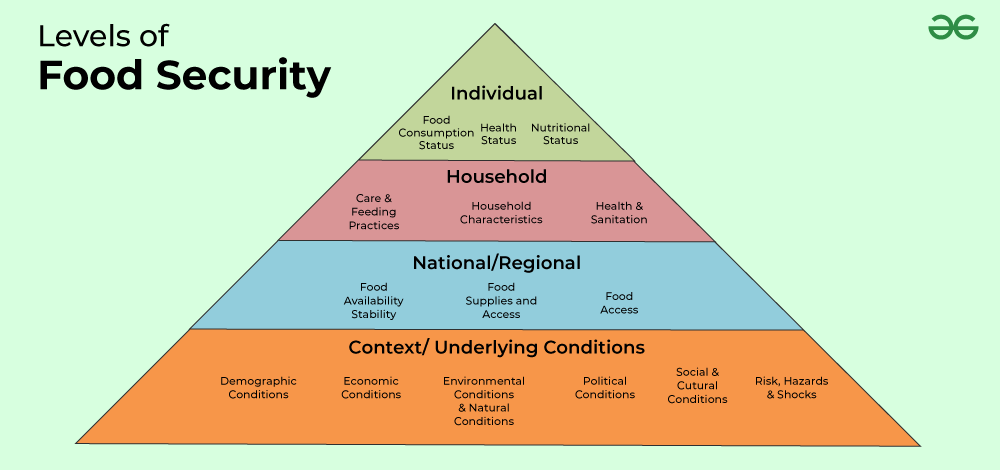
Food security is defined as a situation that exists when all people, at all times, have physical, social, and profitable access to sufficient, safe, and nutritive food that meets their salutary conditions and food preferences for an active and healthy life. Four confines of food security have been linked in line with different situations. 1) Vacuity d National. 2) Vacuity d Household. 3) operation d Individual. 4) Stability – may be considered a time dimension that affects all the situations.
All four of these confines must be complete for full food security. More recent developments emphasize the significance of sustainability, which may be considered as the long- term time( fifth) dimension of food security. Food security is considered a causal, linked pathway from product to consumption, through distribution to processing, recognized in several disciplines, rather than as four “ pillars ”.
Food and food insecurity are dynamic, reciprocal, and time-dependent and the attendant status depends on the commerce between the stresses of food insecurity and the managing strategies to deal with them. Universal pointers for measuring food are challenging. Different pointers may be applied to different situations of food .
Measuring food security at the ménage position involves five orders of pointers salutary diversity and food frequency, spending on food, consumption conduct, empirical pointers, and tone-assessment measures. Food security, nutrition, and sustainability are increasingly mooted in the same terrain.
The integration of food security as an unambiguous part of the sustainability program would go a long way toward such a thing. The final common pathway of all these sweats is towards sustainable food security and nutrition for our earth. description of Food is a flexible generality as reflected by the multitudinous attempts to define it in disquisition and policy operation.
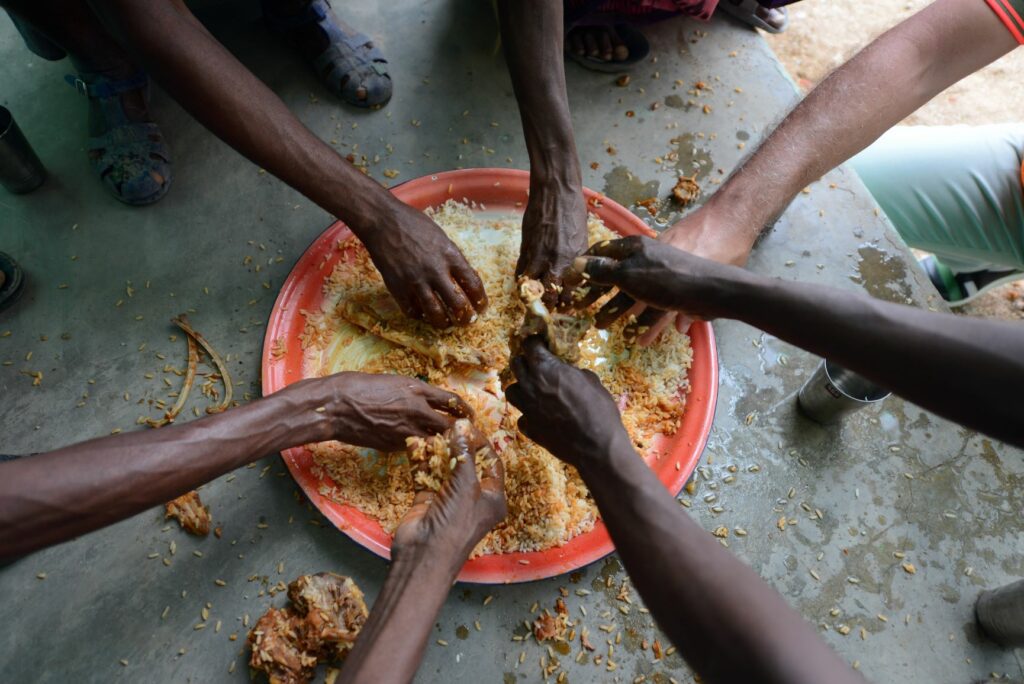
The generality of food security began some 50 times ago at a time of global food heads in the early 1970s. Indeed two decades ago, there were about 200 delineations for food security in published notations( Maxwell and Smith, 1992), showing the contextual dependent features of the description. The current considerably accepted description of food security came from the Food and Agriculture Organization’s ( FAO) periodic report on food security “ The State of Food Insecurity in the World 2001 ” Food security( is) a situation that exists when all people, at all times, have physical, social and profitable access to sufficient, safe and nutritive food that meets their salutary conditions and food preferences for an active and healthy life( FAO, 2002).
The last revision to this description happened at the 2009 World Summit on Food safety which added a fourth dimension – stability – as the short-term time indicator of the capability of food systems to repel shocks, whether natural or man-made ( FAO, 2009).
Confines of Food Security Four confines of food security have been linked according to the description( FAO, 2008). 1) Vacuity of food produced locally and imported from abroad. 2) Vacuity. The food can reach the consumer( transportation structure) and the ultimate has enough capital for purchase. To analogous physical and profitable vacuity is added socio-cultural access to ensure that the food is culturally respectable and that social protection nets live to help the less fortunate. 3) operation.
The existent must be suitable to eat respectable amounts both in volume and quality to live a healthy and full life to realize his or her eventuality. Food and water must be safe and clean, and thus respectable water and sanitation are also involved in this position.
A person must also be physically healthy to be suitable to condensation and use the food consumed. The fourth sphere of Stability deals with the capability of the nation/ community/( ménage) person to repel shocks to the food chain system whether caused by natural disasters( climate, earthquakes) or those that are man-made ( wars, profitable heads). Thus, it may be seen that food security exists in several situations. Vacuity- national; Vacuity – Household; operation – Individual; Stability – may be considered as a time dimension that affects all the situations. All four of these confines must be complete for full food.
Still, not all the rudiments in food security are of equal significance as inferred by the pillar analogy. Their weightings are terrain and country-specific ( Berry et al., 2015). For illustration, in multitudinous developing countries, vacuity depends on the transport structure which may limit the physical access to food; while in developed countries, profitable access is the main barricade for food security.
A script after a natural disaster, e.g., an earthquake, the vacuity, vacuity, operation, and stability are all major problems. In these different surroundings, the weights of the four confines should surely not be equal. rather than pillars, a better analogy using a pathway to describe the relations among the four confines of food security.
This analog was used by The State of Food Insecurity in the World 2013( FAO, WFP, and IFAD, 2013), to show the links from food product( vacuity) to ménage( vacuity) to existent( operation). Reducing these amounts is a major challenge for securing world food vacuity in the future. From a systemic view, obesity may also be considered a type of food waste. Linking Food Security to Sustainability The notion of Sustainable diets links sustainability with food security to ensure holistic sustainable food systems, as can be seen from their separate delineations.
Sustainable diets are defined as bones that “ are protective and regardful of biodiversity and ecosystems, culturally respectable, accessible, economically fair and affordable; nutritionally respectable, safe and healthy; while optimizing natural and mortal resources ” ” while “ a sustainable food system “ is a food system that ensures Food Security and Nutrition( FSN) for all in such a way that the profitable, social and environmental bases to induce FSN for future generations aren’t compromised ”( HLPE, 2014, 2017).
The content is taken up at some length in the composition on generalities of Food Sustainability.
It has been internationally agreed that climate change is a trouble to the sustainability of food security. still, the conditioning involved in food systems accounts for some 20 – 30 of all mortal-associated hothouse gas( GHG) emigrations, and, similarly, contributes to climate change( Garnett et al., 2016a). There might be a trade-off relationship between dwindling mortal associated GHG and guaranteeing food security under the current prevailing food system.
Thus, a methodical and intertwined approach is demanded, to meet the short- and long-term conditions of FSN, meanwhile, to mollify the negative environmental impact due to GHG from the conditioning involved in the food system itself. Though what sustainable food systems look like is still unclear, our understanding is constantly evolving( Garnett et al., 2016b).
Description of Food Insecurity Food Insecurity( FINS), on the other hand, will do when there are problems at any one position in the food product-consumption pathway. The upstream dimension/ position of FINS largely affects those downstream.
The description of FINS is “ whenever the vacuity of nutritionally acceptable and safe foods, or the capability to acquire respectable foods in socially respectable ways, is limited or uncertain ”( Expert Panel, 1990).
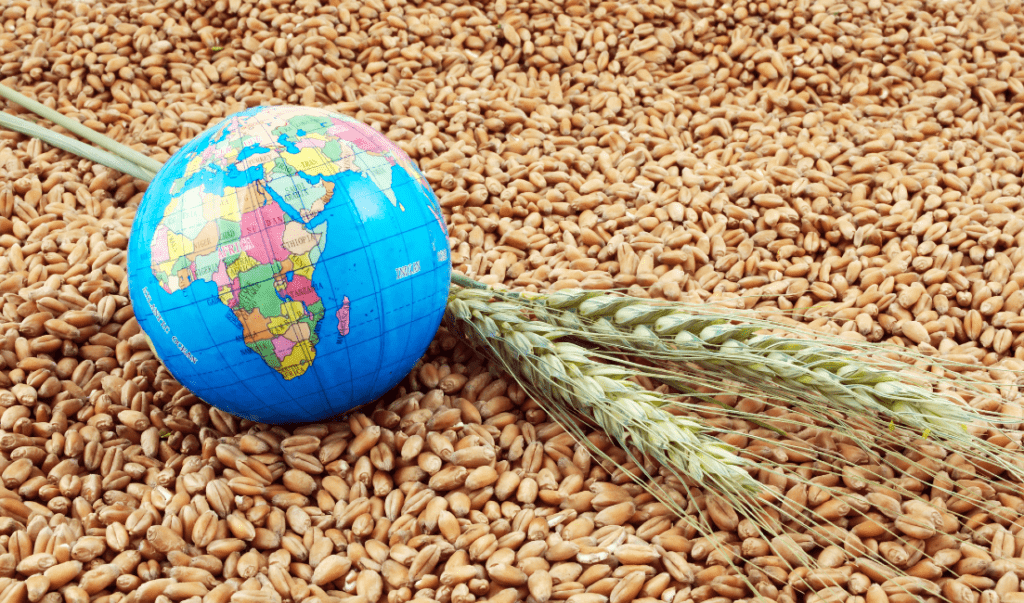
Food instability, as virtually measured in the United States, is endured when there’s( 1) query about unborn food vacuity and access,( 2) insufficiency in the quantum and kind of food needed for a healthy life, or( 3) the need to use socially inferior ways to acquire food( National Research Council, 2006). piecemeal from the most common constraint and lack of profitable coffers, food instability can also be endured when food is available and accessible but can not be employed because of physical or other constraints, such as limited physical functioning of the senior or impaired( National Research Council, 2006).
Still, with the emphasis on health equity, focus should be given to the people under the most underprivileged conditions. They’re under colorful natural and man-made stresses similar to cataracts, famines, conflicts, and wars. They also have a critical demand for better managing strategies for food instability. Paradoxically, the groups of subjects most food insecure, such as settlers, displaced persons, and homeless, aren’t generally included in checks on food security, which accordingly underrate the problem.
Connections between Food Security and Food Insecurity
Food security and food instability are dynamic, complementary, and time-dependent and the attendant status depends on the commerce between the stresses of food instability and the managing strategies to deal with them. The stresses of food instability may occur at any point along the food security pathway – Vacuity, Availability, Application, and Stability.
The inspired managing responses may take place in the public, ménage, or individual situations. The two processes are interrelated linearly with re-iterative feedback circles similar in that stress leads to managing responses that may or may not be acceptable, thereby taking variations in the managing strategies until food security is recaptured( Peng and Berry, 2018, handwriting under modification).
dimension of Food Security Universal pointers for measuring food security are grueling.
They need to be extensively accepted as correct and nicely objective and to be homogeneous across time and space. Different pointers may be applied to different situations of food security. pointers for Global Food Security Suitable pointers for global food security must be dependable, unremarkable and available for the maturity of countries of the world. There is, still, no accepted agreement as to what are the optimal bones for food security( Berry et al., 2015).
The State of Food Insecurity in the World 2013 The Multiple confines of Food security. Salutary Diversity and Food Frequency – This order of pointers generally captures the number of different kinds of foods or food groups that people consume, and the frequency of consuming them. The result is a score, showing the diversity of diets.
The Food Consumption Score( FCS) and the Household Dietary Diversity Score( HDDS) – These are two common pointers measuring salutary diversity( Maxwell et al., 2013; FANTA, 2006; FAO, 2010). Spending on Food People who spend a lesser proportion of expenditure on food, have been considered less secure in ménage food security( Maxwell et al., 2013; Smith et al., 2006).
Consumption Actions – This order of pointers measures actions related to food consumption, therefore landing food security laterally. The most extensively known index in this order is the managing Strategies Index( CSI), with a docked interpretation of “ reduced CSI ”( rCSI)( Maxwell and Caldwell, 2008).
Another well know index is the Household Hunger Scale, applied in more severe actions( Maxwell et al., 2013). Experiential pointers Household Food Insecurity Access Scale( HFIAS) and a culturally- steady subset of HFIAS did Household Hunger Score( HHS) are landing ménage actions signifying inadequate quality and volume. Some transnational associations, including USAID and FAO, have espoused and promoted the HFIAS and HHS( Maxwell et al., 2013). Lately, the Voices of Hunger or Food Insecurity Experience Scale( FIES) has been used in worldwide checks( FAO, 2018).
Tone- assessment Measurement – Introduced in recent times, and used by Gallup Bean ( Headey, 2011), these measures are largely private in nature and may be too easy to manipulate in check. It’s extensively accepted that all these pointers represent some aspects of the multidimensional nature of food security. still, no single index captures the complete picture of ménage security. In addition to grading the pointers, Maxwell also compared these measures and specified the confines denoted by each index( Maxwell et al., 2013).
Monitoring of Food Security( 1990 – 2015) The 1996 World Food Summit assigned FAO the responsibility for covering progress towards the ideal of the Plan of Action reducing by half the number of estimated undernourished people by the time 2015. From the data released by the FAO, the overall frequency of undernourishment has been dwindling from 14.8 in 2000 to 10.7 in 2015( FAO, 2016), showing the overall enhancement in global food security.
Still, in 2016, the number of chronically undernourished people in the world is estimated to have increased to 815 million, over from lower than 800 million in 2015( FAO, IFAD, UNICEF, WFP, and WHO, 2017). This recent increase is a signal of a reversal of trends. The food instability has worsened particularly in corridors of Sub-Saharan Africa, South-Eastern Asia, and Western Asia, and these downfalls have been observed especially in conflicts and conflict combined with famines or cataracts. Climate change may also be intertwined. The limitation of the current parameter for covering food security – frequency of undernourishment – is that it reflects only one of the triadic- burden of malnutrition, videlicet undernourishment, micronutrient insufficiency, and over-nutrition.
To demonstrate and compare the overall nutritive status of the global, indigenous, and public situations, the Global Nutritional Index( GNI) has been developed( Rosenbloom et al., 2008) and streamlined( Peng and Berry, 2018). The overall trends of the GNI from 1990 to 2015 showed a drop in nutrition and increased over-nutrition, which has become a major cause of malnutrition worldwide( Peng and Berry, 2018). This trend poses new challenges to achieving overall food security and nutrition.
A sustainable food system( HLPE, 2017) may be the frame to give a possible result. Food security, nutrition, and sustainability are decreasingly bandied in the same environment. The integration of food security as an unequivocal part of the sustainability docket would go a long way toward such a thing. The final common pathway of all these sweats is towards sustainable food security and nutrition for our earth.
Major Conditioning include
• Strengthening safety nets to ensure that vulnerable families have access to food and water – and plutocrats in their pockets to make vital purchases.
• Delivering expedited exigency support by fast- shadowing backing through being systems to respond to extremity situations.
• Engaging with development mates to address food security challenges. Instruments include rapid-fire diagnostics and data-grounded monitoring instruments and hookups similar to the shortage Action Medium and the Agriculture Observatory.
• Promoting husbandry systems that use climate-smart ways, and produce a further different blend of foods, to ameliorate food systems’ adaptability, increase ranch inflows, and enable lesser vacuity and affordability of nutrient-thick foods.
• Improving force chains to reduce post-harvest food losses, ameliorate hygiene in food major distribution channels, and better link product and consumption centers.
• Applying an integrated “ One Health ” approach to managing pitfalls associated with beast, mortal, and environmental health.
• Supporting investments in exploration and development that enable adding the micronutrient content of foods and raw accouterments.
• championing for policy and nonsupervisory reforms to ameliorate the effectiveness and integration of domestic food requests and reduce walls to food trade.
• Working with the private sector, government, scientists, and others to strengthen capacities to assess and manage food safety pitfalls in low and middle- income countries.
Also Read – Demystifying Anaemia

