


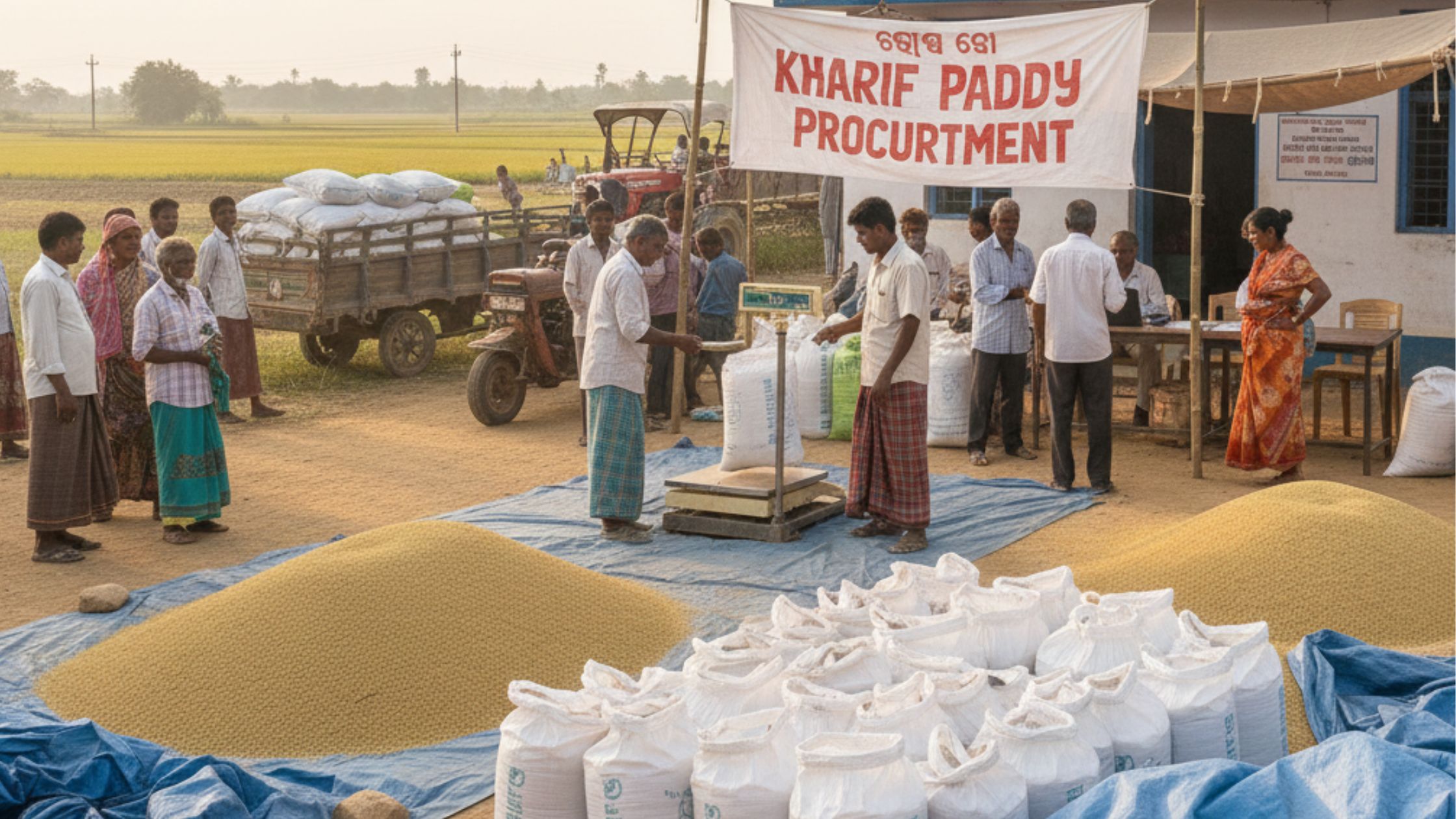
Minimum Support Price (MSP) has long been a support mechanism for the farming community, shaping farm incomes, cropping decisions, and rural credit cycles. For decades, MSP has functioned not just as a price guarantee, but as a signal of state support—especially in districts where paddy is the primary livelihood and market alternatives are weak. MSP procurement often determines whether farmers can repay loans, manage household expenses, or invest in the next cropping season.
Against this backdrop, Odisha’s recent revision of the MSP for paddy to ₹3,100 per quintal, an increase of ₹800, has generated strong expectations across farming communities. In paddy-growing regions, the announcement is widely seen as a promise of better income security, fairer compensation, and protection from distress sales. Yet for many cultivators, particularly smallholders and tenants, the experience of MSP has always depended less on the announced price and more on access to procurement itself, who gets included, when procurement happens, and how smoothly payments are made.
A farmer from western Odisha says, “The price sounds good on paper, but what matters is whether my grain actually gets bought at that rate.”
MSP Procurement and the Exclusion Debate
MSP is only one element of a much larger procurement architecture. In Odisha, sharecroppers and tenant farmers, who constitute an estimated 25–40 percent of paddy cultivators in coastal and western districts remain largely outside MSP procurement because eligibility continues to be linked to land ownership records or PACS-issued tokens (Government of Odisha, 2022; NITI Aayog, 2016). While policy guidelines have, in principle, allowed for the registration of sharecroppers, there is no concrete data on their actual inclusion in procurement operations. Field interactions across districts such as Rayagada, Cuttack, and Keonjhar suggest persistent reluctance on both sides: landowners fear loss of control over land records, while tenant farmers worry about future access to leased land. As a result, informal cultivation arrangements remain invisible to the procurement system, limiting the reach of MSP despite higher announced prices.
Women cultivators, despite increasing land titles under joint patta initiatives, often face difficulties in registration and documentation, limiting their independent access to procurement centres (Agarwal, 2018). Migrant households, where cultivation is managed by women or elderly family members during peak procurement periods, frequently miss procurement windows due to rigid timelines and digital registration requirements (Rao et al., 2021). As a result, a substantial share of paddy continues to be sold below MSP to local traders and mill agents, turning the announced price into a notional benchmark rather than a realised income support for many small and marginal farmers.
The Procurement Framework: How the System Operates
Paddy procurement in Odisha is conducted through Primary Agricultural Cooperative Societies (PACS) and Large Area Multi-Purpose Societies (LAMPS), with procurement volumes linked to land records, farmer registration, and seasonal tokens. Payments are routed through Direct Benefit Transfer (DBT) to registered bank accounts, and rice millers play a key role in lifting, processing, and storing procured paddy. 2023 reports show that Odisha had approximately 2,495 PACS and 215 LAMPS covering its 6,794 gram panchayats supporting agricultural credit, procurement, and other rural services. (Indian Cooperative News, 2025).
Structural Gaps in MSP Access
Exclusion of Tenant and Sharecropping Farmers
In several districts, tenant and sharecropping cultivators are unable to register for MSP procurement and are compelled to sell paddy through intermediaries, often below the declared price. Consequently, the gains from higher MSP accrue largely to landowners, while those who actually cultivate the land remain outside the formal procurement system.
Dependence on Rice Millers
Rice millers continue to exert significant influence over procurement timelines and volumes. Milling capacity, drying facilities, and lifting schedules determine how quickly paddy moves out of mandis. Delays in lifting lead to congestion, repeated farmer visits, and in some cases distress sales. For small and marginal farmers, delayed procurement can mean higher storage losses and increased dependence on local traders.
DBT: Transparency with Transactional Challenges
Direct Benefit Transfer has strengthened accountability, but operational challenges persist. Bank account mismatches, Aadhaar authentication issues, and delayed verification can result in payment lags. While such delays are administrative rather than systemic failures, they erode trust—particularly when farmers expect immediate payment at higher MSP rates.
Exclusion of Tenant and Sharecropping Farmers
A persistent limitation of Odisha’s paddy procurement system is its dependence on land ownership records, which structurally excludes tenant and sharecropping farmers. In several western and coastal districts, such as Bargarh, Nuapada, Kalahandi, and Kendrapara, cultivation through informal tenancy and sharecropping arrangements is widespread. Estimates suggest that 25–35 per cent of cultivators in these regions do not possess formal land titles, despite being the primary producers (Government of Odisha, 2022). Since MSP procurement requires registration through PACS and digital tokens, these cultivators remain ineligible to sell directly at the Mandis. These operational realities become especially critical when MSP is increased, as higher prices raise expectations without necessarily expanding system capacity.
As one paddy cultivator from Keonjhar district explained during a field consultation, “We grow the crop, but the land record is not in our name. When procurement starts, we have no option but to sell to traders at whatever rate they offer.” Such accounts reflect a broader pattern where tenant farmers and sharecroppers are compelled to rely on intermediaries, often receiving prices below the declared MSP. The revised MSP, therefore, disproportionately benefits landowning households, while the actual cultivators—particularly small tenants, women cultivating family land without titles, and seasonal migrant workers who lease land temporarily—remain outside the formal procurement net.
Also read – Why India’s Organic Farming Push Remains Stuck in Tribal Pockets?
A major limitation of the current MSP procurement framework in Odisha is its reliance on land ownership or formal registration, which systematically excludes many cultivators who do not hold legal title. According to the Agriculture Census 2015–16, there were approximately 5.31 lakh “leased-in” operational holdings in Odisha—far more than what official records reflect due to widespread informal tenancy and sharecropping (Odisha Diary, 2025). Even though the government has attempted procedural fixes (such as allowing sarpanch certification of sharecroppers for paddy procurement), actual inclusion remains low; only about 57,000 sharecroppers have been identified in procurement databases, despite tens of thousands more operating in rental or oral tenancies (Scroll, 2019).
These informal tenants and sharecroppers, often landless or marginal cultivators, therefore struggle to register for MSP procurement and are frequently compelled to sell their produce at prices well below MSP through intermediaries. This dynamic means that higher MSP largely benefits landowning farmers while actual cultivators engaged in informal arrangements continue to be excluded from institutional support.
The Need to Shift from Price to Access
An increase in MSP, by itself, does not guarantee higher realised income for farmers. In Odisha, many cultivators—particularly tenant farmers and smallholders—are unable to sell their entire marketable surplus through the formal procurement system. As a result, a portion of their produce continues to be sold below MSP to traders or millers. For these farmers, MSP functions more as a benchmark price than a reliable income floor. This underscores a core policy limitation: MSP effectiveness depends not only on the announced rate, but on who can access procurement and under what conditions.
Reform must therefore move from a price-centric approach to an access-centric procurement framework. First, formal recognition of cultivators independent of land ownership is critical. Evidence from states such as Andhra Pradesh shows that mechanisms like cultivator cards or locally verified tenancy certificates can improve inclusion without disturbing land rights.
Second, Odisha’s procurement architecture remains heavily dependent on millers for storage, drying, and lifting. Greater public investment in decentralised storage, drying yards, and procurement logistics would reduce bottlenecks during peak harvest periods and improve procurement speed for small farmers.
Finally, administrative reliability matters as much as infrastructure. Streamlining Direct Benefit Transfer (DBT) processes, strengthening grievance redress mechanisms, and ensuring predictable payment timelines can restore farmer confidence in the system. Over the long term, MSP reforms should be integrated with broader income strategies—crop diversification, market access beyond paddy, and soil health interventions—to ensure income security that is resilient rather than subsidy-dependent. Without such structural alignment, MSP revisions risk reinforcing existing inequalities rather than delivering broad-based farmer welfare.
Conclusion
The increase in MSP to ₹3,100 per quintal represents a significant policy signal aimed at supporting farmers. However, its effectiveness ultimately depends on the procurement system’s ability to deliver that price equitably and efficiently. Structural issues, particularly the exclusion of tenant farmers, operational dependence on millers, and administrative frictions continue to shape outcomes more decisively than price revisions alone.
For Odisha’s MSP regime to deliver meaningful impact, reforms must prioritise access, inclusion, and institutional capacity alongside price support. A procurement system grounded in these principles can move to provide real income security for the state’s diverse farming communities.
References
References

Agarwal, B. (2018). Gender equality, food security and the sustainable development goals. Current Opinion in Environmental Sustainability, 34, 26–32. https://doi.org/10.1016/j.cosust.2018.07.002

Government of Odisha. (2022). Odisha State Agriculture Policy: Implementation review. Department of Agriculture & Farmers’ Empowerment.

NITI Aayog. (2016). Report of the Expert Committee and Model Law on Agricultural Land Leasing. Government of India.

Rao, N., Garikipati, S., Singh, C., & Gupta, J. (2021). Gendered vulnerabilities to climate change in agriculture: Insights from Odisha. World Development, 137, 105116. https://doi.org/10.1016/j.worlddev.2020.105116

Government of Odisha. (2022). Status of agricultural tenancy and land access in Odisha. Department of Agriculture & Farmers’ Empowerment.

Government of Odisha. (2025). Preliminary Draft State Cooperative Policy (p. 1). Cooperation Department, Government of Odisha. Retrieved from https://coop.odisha.gov.in/sites/default/files/2025-09/

IndianCooperative.com. (2025). Odisha plans to form 1,300 new PACS & LAMPS [News report]. Retrieved from https://www.indiancooperative.com/co-op-news-snippets/odisha-plans-to-form-1300-new-pacs-lamps/

Scroll Staff. (2019). How do Telangana, Odisha identify the beneficiaries of their income transfer schemes? Retrieved from https://amp.scroll.in/article/917701/

Government of India. (2023). Status paper on paddy procurement and MSP operations. Ministry of Agriculture & Farmers Welfare.

NITI Aayog. (2016). Evaluation of agricultural tenancy and land leasing policies. Government of India.

Reddy, D. N., Mishra, S., & Reddy, A. A. (2018). Land tenancy, leasing and agricultural productivity in India. Indian Journal of Agricultural Economics, 73(3), 327–340.

Reserve Bank of India. (2022). State finances: A study of budgets. RBI.

Government of Odisha. (2022). Paddy procurement operational guidelines. Department of Food Supplies & Consumer Welfare.
Author: Sibabrata Choudhury - A social entrepreneur and public policy professional working at the intersection of rural livelihoods, land rights, and technology-driven development, with experience across agriculture, land reform, climate resilience, and grassroots governance.

